

Chapter 19: Magdalena Beck: Arrival, Christmas 1929
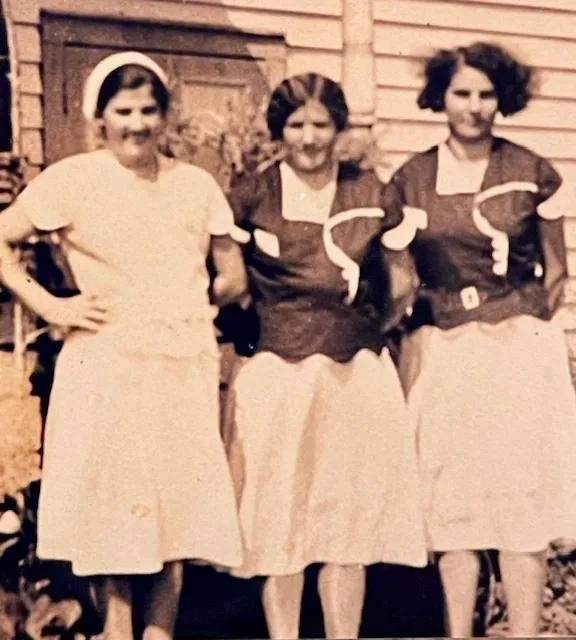
The Beck Sisters — Magdalena Beck, Rosalia Beck (Schmieder), and Theresia Beck (Kautz).
Embarkation at Bremerhaven
Coal smoke from the station engines mingled with the cold brine of the Weser and hung in the morning air. On Saturday, December 14, 1929, the 5’4”, blue-eyed twenty-seven-year-old Magdalena Beck—sister to Rosa, Albert, and Theresia, already settled in Western New York—buttoned her dark wool coat and stepped out of the Columbusbahnhof.
She crossed the Columbuskaje—the great ocean-liner quay in Bremerhaven—toward the waiting SS Columbus. At the gangway, her heart quickened; she tugged her felt cloche low against the wind and climbed the steps. Like the others in third class, she wore a linen-backed identification card pinned to her coat with her name, ship, and manifest line.
Third-Class at Sea
Third class on the SS Columbus was close and straightforward: narrow cabins with stacked bunks and wool blankets; a shared lavatory at the end of the corridor; a bustling third-class dining saloon where enamel pitchers clinked and children wove between benches. The December crossing ran beneath low clouds and a steady Atlantic roll. When the wind eased, passengers stepped onto the open deck, cheeks burning with salt and spray, the engines thrumming a dull, comforting hum.
Rumors of a Shaken World
In the public rooms, German passengers who had lived through postwar hyperinflation whispered about the Wall Street crash two months earlier and what it might mean for jobs, wages, and supporting their families. Each noon, the purser’s wireless bulletin went up on a corkboard—markets “irregular,” factories cutting hours—and near the desk, a slate still read “4.20 RM = $1.”
Men folded copies of the Frankfurter Zeitung and Berliner Tageblatt. Magdalena checked her sponsor letter from her brother-in-law, George Schmieder, and counted out $45 in small bills—what she would show at Ellis Island to prove she would not be a “public charge.”
Night Thoughts of Home
During the night, as the sea rocked the ship, she thought of her father, Jakob—gone nineteen months now, seventy-five at his death on the very day Monika turned sixty-six. Diabetes had worn him down, and what doctors called paralysis agitans—“shaking palsy”—had slowed his gait and set his hands trembling. With tears in her eyes, she pictured her mother’s steady care—the washing, the lifting, the long nights—and felt again her double grief: a husband laid to rest and children crossing the ocean to begin a new life in America.
Landfall: New York Harbor
By the morning of December 23, 1929, tugs guided the large liner to Pier 42, Christopher Street. Gulls circled overhead, mooring lines pulled tight, and horns along the waterfront sounded as Manhattan emerged from the gray dawn; passengers pressed against the rails—some applauding, a few making the sign of the cross.
Ellis Island and Grand Central
First- and second-class passengers were cleared on board; third-class travelers like Magdalena were gathered, counted, and ferried to Ellis Island—paperwork, questions, a doctor’s quick glance—where she set down her letter of support and her $45 in small bills, and the inspector nodded—before the final stamp that would send her toward family and Christmas at the Schmieder farm in Alexander, New York.
After clearing inspection, she made her way to Grand Central and bought a coach ticket west. At Grand Central, the New York Central agent checked her trunk through to Batavia, tying on a stout manila strap tag and handing her the matching claim stub so she could travel with only her carry-on bag.
Westbound to Batavia
Late that evening, she boarded a westbound New York Central coach—the terminal’s starry ceiling fading behind her as steam heat hissed and the windows fogged. The train moved along the Hudson and across the Mohawk; she dozed between jolts and station announcements—Utica, Syracuse, Rochester—hands wrapped around her handbag.
Other travelers’ parcels were stacked in the rack above. At first light on Christmas Eve, with snow swirling across the platforms and coal smoke billowing from the engine, the conductor’s call—“Batavia!”—brought her to her feet and out into the cold Christmas air. Albert tipped his cap, grinning, and strode forward to greet her.
A Christmas to Remember
Albert brought the clattering motorcar up the frozen cinder drive; the tires crunched as he rolled to a stop by the porch. Their farm dog barked; wood smoke curled from the kitchen chimney; the warm, savory smell of Rosa’s cooking drifted out the doorway as the children burst to the door to greet their Aunt Magdalena.
It had been five years since Magdalena had last seen Rosa; time showed in a few fine lines and work-hardened hands, but her sister’s reserved smile was unchanged. The “little ones” she carried in her mind—Hilda, Fred, and Arnold—were no longer toddlers and were sure of themselves, each stepping in for a warm, awkward hug.
And finally, she met the newest Schmieders, whom she had only known from letters: George Jr. with his steady gaze, Paul with his mischievous grin, and baby Herbert, who watched the goings-on with eyes bright with curiosity. For a moment, she relished the reunion she looked so forward to and stood in it—the cold still in her coat, the comfort of the warm kitchen—and felt the years of absence fall away.
After finishing chores and having Christmas Eve supper, George and Albert placed a small Scotch pine in the parlor and secured it in a wooden stand. Under the glow of a single bare bulb, the children draped a string of popcorn around the tree.
Then Albert, disguised as Belsnickel (Pelznickel)—old coat turned inside out, cap pulled low, soot-smudged cheeks, a switch in one hand and a sack over his shoulder—rapped the floorboards and quizzed the children about their behavior: had they minded their lessons, helped with chores, spoken kindly? The obedient received walnuts and small candies from his sack.
Rosa and Magdalena chuckled at their brother’s theatrics and the children’s wide-eyed answers. They traded quiet memories of humble Christmases on the rented farm in Schönberg, and then she surprised the children with small gifts from herself and their grandmother, Monika.
Rosa’s Christmas Dinner Preparations
On Wednesday, Christmas morning, the kitchen was already warm from the wood-fired range. Rosa moved with quiet efficiency, grateful for Magdalena’s hands beside hers. She gave her sister a gentle hug and said, “Frohe Weihnachten, Schwester.” “Frohe Weihnachten,” Magdalena answered as they turned back to their Christmas dinner preparations.
With six children, a husband, her brother, and a hired man to care for—and no telephone, radio, electric stove, washing machine, or indoor plumbing to lighten the load—every minute counted.
At first light, the house came alive. Fred and Arnold brought in armloads of wood from the shed, primed the hand pump with a dipper of hot water from the range’s water reservoir, and filled pails at the well. They emptied the enamel chamber pots in the two-hole privy on the north side of the house and dusted lime over the contents. Hilda helped dress George Jr., Paul, and Herbert, then settled them at the breakfast table.
Christmas Mass at St. Vincent’s
After completing morning chores, George Sr., Hilda, and Fred went to the 9:00 a.m. Christmas Mass at St. Vincent’s. The small-town church was full. Men loosened their topcoats and clicked their fedoras into the pew-back hat clips. Women wore plain wool dresses, low heels, and dark felt cloches—some with net veils—as others tied neat black kerchiefs as head coverings, prayer books in hand.
The Altar and Rosary Society had twined evergreen garlands along the altar rail and around the crèche. At the ring of the sacristy bell, the procession entered—cross-bearer, two acolytes with candles, thurifer, and boat-bearer—and Father Bernard P. Gill followed in white with gold vestments. At the foot of the altar, he blessed the grains of incense in the boat, placed a pinch on the glowing coal, and swung the thurible in three measured arcs—center, right, left. Blue-gray smoke rose like a veil over the altar, sweet with frankincense as the Christmas Day Mass began.
Company from Buffalo
As preparations for the midday Christmas dinner continued, the Kautz family arrived—Theresia, 25, the youngest of the Beck siblings; her husband, August (“Gus”); and their nine-month-old son, Henry. Married in 1928, they were living in a $24-a-month apartment at 43 Urban Street in Buffalo. Gus had hired on as an air-brake man—one of the shop mechanics who kept the streetcars’ compressors, valves, and brake rigging in good order.
They had come out from Buffalo that morning in the cold, a light dusting of snow brushing the road. Frost filmed the windshield; Gus scraped a clear patch with a scraper and cracked the glass a finger’s width to keep it from fogging. They rode under a lap robe, baby Henry tucked between them, taking what little warmth the engine could spare.
Theresia, a skilled baker, arrived with tins and parcels: a sugar-dusted Stollen ring, and tins of German cookies—lebkuchen and pfeffernüsse —spiced with clove and anise. The house buzzed with reunion and celebration—Beck sisters’ voices overlapping in the kitchen; by the woodstove, George, Albert, and Gus (August) poured hard cider into glasses with a quiet “Prosit”; and in the parlor, the children turned the little Christmas tree into a stage for games and laughter.
Paths Unseen: After Christmas 1929
As the Schmieder, Beck, and Kautz families kept a simple German Christmas in 1929—on the edge of a changing world—their lives unfolded in ways none of them could yet see. Theresia and Gus welcomed two more children, Eugene and Patricia. George and Rosa were blessed with two daughters, Erma and Shirley. Albert later married Frances Peuckert and became the father of eleven children.
Magdalena eventually moved to New York City, where she worked as a cook for Schrafft’s—the Boston candy company that operated a chain of restaurants and tea rooms. She married John Alfred Nicholsen, a Danish-born seaman, on July 20, 1942, in Manhattan. According to family memory, the marriage ended soon after—she had married for love, while he had married for citizenship. She carried that hurt quietly for the rest of her life.
Quiet Remnants: Christmas 1929
That winter day faded toward evening: dishes stacked to dry, the small Scotch pine dim in the parlor, children drowsy by the stove. Outside, a light snow softened the fields.
Christmas 1929 left its quiet traces—extended family, sugar-dusted stollen, a wisp of incense, children’s laughter. From such small things, a family kept faith, kinship, and purpose. In the lean years to come—through the Depression—the paths of the Becks, Kautzes, and Schmieders would differ, some bright, some difficult; yet the memory of that Christmas endured.
Note: This account of the Schmieder, Beck, and Kautz families’ lives combines oral history, documented events, and thoughtful interpretation. It reflects both historical facts and family memory while recognizing the limitations of fully capturing lived experiences over time.
Frederick Schmieder