
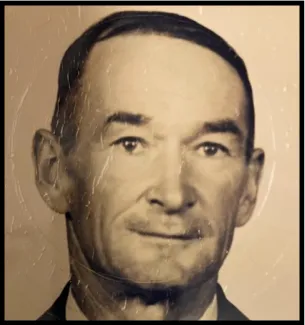
George Schmieder: A Legacy Remembered
George Schmieder (1897–1967)
Immigrant son of Reichenbach, Germany.
Devoted husband, father, and farmer.
His legacy of faith, family, and hard work endures across generations.
A Chilly New Year’s Morning
Before dawn broke on January 1, 1967, George and Rosa Schmieder stirred from their warm bed and began their familiar morning ritual. The crisp winter air crept through the farmhouse, carrying with it the quiet solemnity of a new year. Outside, a heavy overcast sky cast a gray melancholy across the frozen landscape.
George pulled on his well-worn work clothes, barn jacket, and tattered leather boots before stepping into the cold. The barn, weathered yet sturdy, greeted him with the gentle stirring of livestock and the sweet scent of hay. Though the chores were second nature, he felt the weight of age pressing upon him. Since his heart troubles in November, his pace had slowed. Every movement now required more effort—each task a quiet reminder that he would turn seventy in just eighteen days.
When the morning work was finished, he reached for his flannel-lined denim coat hanging from a nail on a wooden post, slipped it on, and switched off the barn lights. As he slid the door open along its squeaky tracks, he paused to gaze at the small metal sign affixed to the siding: George Schmieder and Sons.
It was more than a name—it stood as a quiet monument to a lifetime of labor, sacrifice, and enduring hardship.
A short walk from the old barn, the new dairy barn stood solid in the muted morning light. Inside, George Jr. and the hired hand tended the last of the cows. George paused in reflection. Pride stirred in his chest—not for himself, but for what had been built through years of toil, setbacks, and unwavering perseverance. This farm was more than just fields and structures—it was a living legacy, shaped by his hands and those of his sons.
Inside the house, the aroma of percolating coffee welcomed him home. Rosa moved about the stove with practiced ease, her motions both efficient and comforting. George breathed in the warmth of the kitchen as it chased away the chill from his bones. Wrapping his hands around a steaming cup, he allowed himself a rare moment of quiet contentment before preparing for Sunday Mass.
A Drive Through Memories
Dressed in his topcoat and hat, George said farewell to Rosa and gently eased his dark-colored Buick out of the driveway. Before turning onto Route 98, he passed his son George Jr.’s house across the drive. Once on the main road, he cruised past the homes of his children: Fred’s to the left, Hilda’s to the right, and the old Stroh Farm, now operated by his son Paul. Each landmark stirred memories—stories of hard work, perseverance, and enduring family ties.
As he passed his farmlands, he noticed the glass-paned greenhouse beside one of the fields, its tall red brick chimney rising like a monument to the labor of growing roses. Crossing the steel-framed bridge over Tonawanda Creek, he saw thin layers of ice clinging to the steep banks—a quiet reminder of winter’s grip. After turning right onto Genesee Street, he glanced toward Maplewood Road, where his son Herbie’s farm lay nestled into the rolling landscape.
A New Year’s Day Mass
As he made his way into Attica, George passed the parish school, convent, and rectory of St. Vincent de Paul Catholic Church. After parking, he entered through the west doors, removed his hat, dipped his fingers into the holy water font, and crossed himself before genuflecting toward the altar. Finding his usual pew near the front right side of the church, he knelt and prayed in preparation for New Year’s Mass celebrating the Solemnity of Mary, Mother of God on this first day of the new year.
The familiar rhythm of the liturgy unfolded—scripture readings, quiet prayers, the consecration. Surrounded by the soft light filtering through stained glass, George reflected on the passing year and the blessings still to come.
As the choir’s final hymn echoed through the sanctuary, the priest offered a blessing to the congregation. George exchanged New Year’s wishes with family and friends before heading home, filled with a quiet sense of peace.
A Day of Rest and Football
Rosa greeted him with breakfast, and as they sat at the table, she inquired about any news from the congregation. Later, while she washed the dishes, George settled into his chair with the Courier Express newspaper. The headlines buzzed with excitement—the Buffalo Bills had won the AFL Eastern Division Championship and were set to host the Kansas City Chiefs that afternoon. The winner would advance to the first-ever Super Bowl.
At 1:00 p.m., as thousands across Western New York gathered around their televisions, George poured himself a glass of hard cider from his basement barrel and prepared to watch the game. In Buffalo’s War Memorial Stadium, over 42,000 fans braved the 32-degree cold, rising to their feet as the game kicked off. But enthusiasm soon turned to disappointment. A fumble on the opening kickoff led to an early Kansas City touchdown. Although the Bills managed a 69-yard touchdown pass from Jack Kemp to Albert Dubenion, it was their only score. Kansas City controlled the game, winning 31-7 and securing their place in history.
A Sudden Tragedy
As the game progressed, George suddenly complained of unusual back pain and lightheadedness. He shifted uncomfortably in his chair. Within moments, his body went limp. Rosa’s heart surged with panic as she rushed to his side, pleading for him to speak. His face had gone pale, his breath barely perceptible.
Panicked, she called out to their son, George Jr., who lived just across the driveway. Urgently, she summoned help. The ambulance arrived, sirens piercing the cold afternoon air, but it was too late. George was rushed to Genesee Memorial Hospital in Batavia, where he was pronounced dead. An undetected abdominal aortic aneurysm had ruptured, causing a catastrophic loss of blood pressure.
He was gone.
Outside, the winter sky remained gray, indifferent to the sorrow that had descended upon the Schmieder family.
The News That Shook the Farm
That late afternoon, the news rippled through the family. Jim, Bill, and Freddie Schmieder were outside playing beneath the dull sky when a car pulled into the driveway. Aunt Anita stepped out briskly, her expression strained with urgency, and hurried inside to speak with Fred and Marilyn.
Uncle Herbie remained in the passenger seat, his head bowed in silence. The boys stood frozen, their game forgotten as a heavy silence settled around them. Moments later, the news came—a simple, shattering truth: their Grandpa Schmieder was gone.
A Final Mass at St. Vincent’s
Days later, family and friends gathered at St. Vincent’s Church for his funeral Mass. His usual pew, now occupied by grieving loved ones, bore silent witness to his absence.At the front, Rosa sat near the closed casket, her dark coat contrasting with her faded gray hair. Her hands trembled as she wiped away silent tears, her body heavy with grief.
George’s sons and son-in-law, Carlton Lippold, lifted the casket as the priest intoned the final prayers. Moving solemnly down the aisle, they passed through the vestibule, where Mr. Marley opened the heavy church doors. Outside, the winter wind cut through the mourners’ coats as they followed the hearse in procession through the village.
They passed the Marine Midland Bank, which had financed George’s new dairy barn, then the old shoemaker’s shop and the train depot where he had once shipped hay to Buffalo. Beyond the railroad tracks, the cemetery awaited.
Farewell Beneath the Pines
At St. Vincent’s Cemetery, towering pines stood sentinel over the rows of gravestones, their shadows deepening the solemn atmosphere. In the distance, the formidable walls of Attica Prison cast an imposing presence—a stark reminder of confinement, sharply contrasting with the eternal peace that lay beneath the sacred ground.
The priest’s voice rose above the fridgid wind as he conducted the graveside prayers, his words echoing in the chill. The Schmieder family huddled together, shoulders drawn tight against the cold, grief gripping their throats like a vice.
Rosa, clutching her coat against the bitter wind, stepped forward with hesitant resolve. She placed a trembling hand on the polished casket, her breath rising in shallow gasps. In a soft whisper, she offered her final goodbye, her voice heavy with the weight of a lifetime filled with love, sacrifice, and shared committment.
As the casket began its descent into the earth, Rosa turned away, gently supported by her family. Each step from the graveside felt unsteady—a sorrowful passage from the life she had known to a future she had never imagined.
The end of her forty-six-year marriage to George marked the beginning of a new and unfamiliar chapter, filled with sorrow, silence, and the unspoken ache of letting go.
Closing Reflection
The story of George Schmieder’s final day is more than the closing of a chapter—it is the portrait of a life forged in hardship. He endured the trenches of war, the ache of parental estrangement, the loss of his farm-restaurant in Wagenhausen, Germany, and the long, hope-filled journey of rebuilding in a new land.
From his first steps on American soil in 1923 to his final rest beneath the pines of St. Vincent’s Cemetery in 1967, George’s life stands as a testament to quiet perseverance, enduring faith, and dedication to family.
Though the homestead is no longer in the family, George’s legacy endures—in the house that once echoed with his footsteps, the barns he built, the fields he tended, and the faith that shaped his days. Most enduring of all, it lives on in his descendants, who carry his spirit forward, one generation at a time.
_____
Note: This account of George Schmieder’s final day in 1967 is a tapestry woven from factual events and personal memory. It blends documented moments with individual reflections and interpretations, while acknowledging the limitations of reconstructing family history.
—Frederick Schmieder