
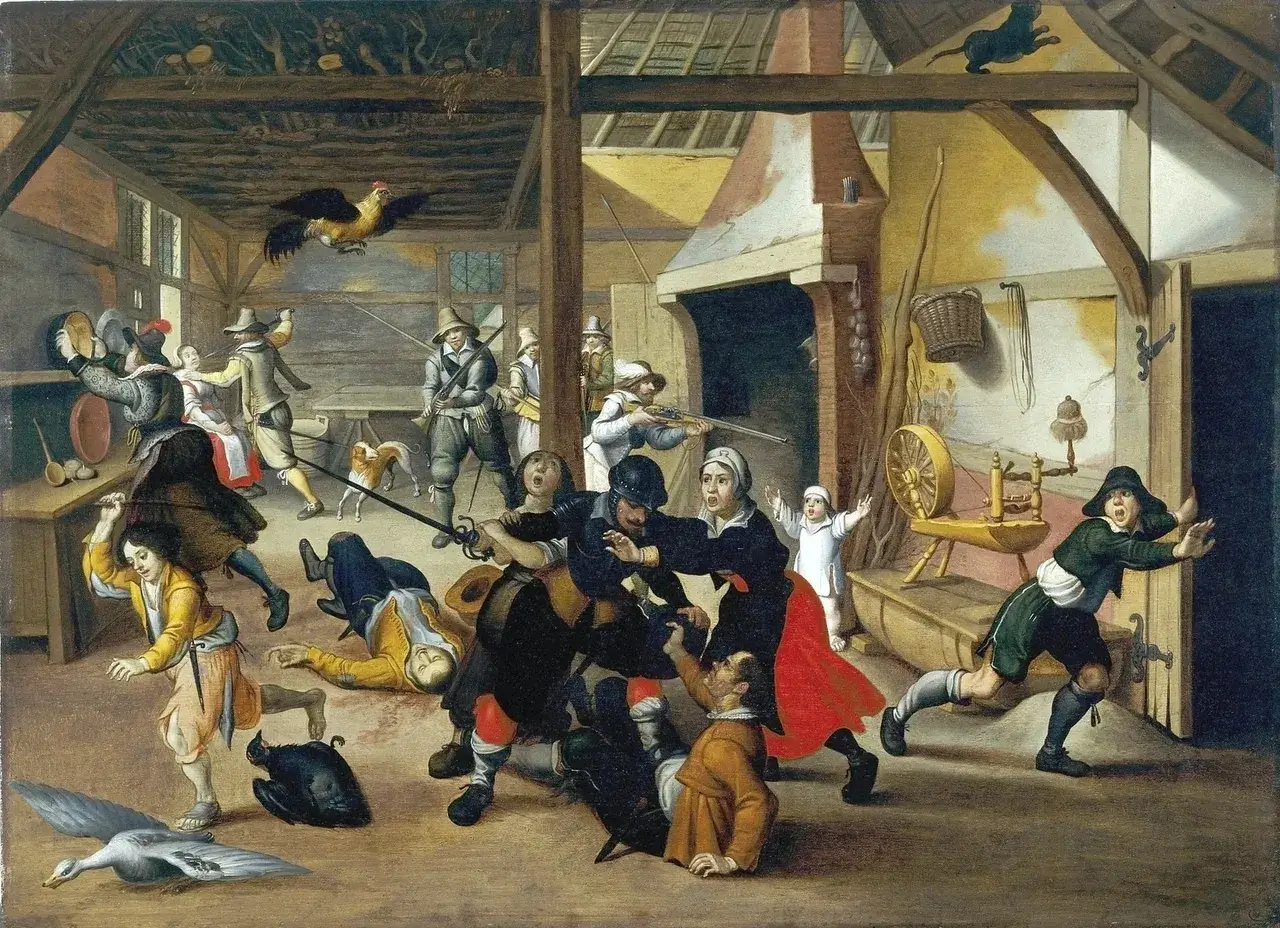
The Thirty Years’ War and the Trials of Our Ancestors (1618-1648)
From the war-torn fields of Lützen to the famine-scarred valleys of the Black Forest, this account traces the devastation of the Thirty Years’ War through the lived experiences of our ancestors. Amidst destruction, plague, and despair, their endurance shaped a legacy of faith, strength, and survival.
Famine, Plague, and Destruction: The Thirty Years’ War Beyond Faith (1618–1648)
The Thirty Years’ War, which began in 1618 as a local religious uprising in the Bohemian states, swiftly escalated into a continent-wide catastrophe that engulfed much of Central Europe. Initially sparked by sectarian tensions between Catholics and Protestants, the conflict soon evolved into a broader struggle for political dominance, drawing in major European powers and reshaping the geopolitical landscape of the era.
A decisive escalation came in 1630 when King Gustavus Adolphus of Sweden—an ardent Protestant and skilled military strategist—invaded the Catholic territories of the Holy Roman Empire. With a modernized army and tactical skill, he secured a series of rapid victories, pushing deep into German Catholic strongholds. The confrontation reached a dramatic climax on November 16, 1632, at the Battle of Lützen—an engagement that would prove fateful for the Swedish king and pivotal for the course of the war.
Lützen: When the Invader Fell
On the blood-soaked fields of Lützen, deep within the Holy Roman Empire, musket fire cracked in relentless volleys as gunpowder smoke thickened the air, turning day to dusk. The stench of sulfur and death filled the lungs of battling soldiers as steel clashed and cannons thundered. Cries of the wounded echoed across the battlefield, where mud ran red with blood and musket balls tore indiscriminately through flesh and bone.
In the heart of this chaos rode King Gustavus Adolphus of Sweden, the feared Protestant invader who had brought devastation to the Catholic lands of the Holy Roman Empire. Determined to press the attack, he pushed too far into the fray and became separated from his guards. A musket ball struck him from behind, unseating him. Staggering and wounded, he was overtaken by Imperial soldiers. A blade pierced his chest, and a final shot ended his life. The northern king, whose campaigns had scorched the countryside and desecrated churches, fell on foreign soil—his blood mingling with the ruin he had wrought.
Although the Swedish army held the field and claimed a costly victory, their leader’s death cast a shadow over the triumph. Nearly 9,000 soldiers perished, and the town of Lützen was left in ruin. For the Catholic townspeople, the true cost of that day was not measured in battlefield strategy, but in lost loved ones, desecrated sanctuaries, and the bitter winter ahead—bereft of warmth, shelter, and peace.
The Swedish Onslaught
Piercing screams shattered the once-serene landscape of Catholic villages east of the Rhine River in the Black Forest. The cries echoed across wooded hills and narrow valleys, spreading panic like wildfire. Parents clutched their children and gathered what few belongings they could carry, fleeing into the dense forest. These peaceful communities, nestled in the rolling countryside for generations, now quaked beneath the shadow of war.
Huddled beneath the towering pines, families held their breath. Every rustling leaf, every muffled sob felt like a betrayal of their hiding place. The tension was suffocating as they listened to the distant thunder of galloping hooves and the brutal clang of metal on metal. The very earth trembled beneath their feet as the Swedish army—relentless in its advance—swept into their homeland.
Then came the horror. Clad in blue and yellow, Swedish soldiers swept through the region like a storm. The Catholic church, the beating heart of village life and faith, crumbled under cannon fire.
Rectories, homes, and farmsteads were set ablaze, the flames consuming generations of labor and memory. Thick black smoke curled skyward, blotting out the sun and choking the air with the stench of ruin. Families wept as their world collapsed around them, clinging to rosaries and whispered prayers—desperate for divine protection as ashes fell like snow.
Devastation in the Black Forest
The region of Ortenau, stretching from the fertile Upper Rhine Plain to the rugged foothills of the Black Forest, became a crucible of suffering during the war. In the summer of 1632, the Imperial Army stationed a garrison in the small city of Lahr to defend the surrounding Catholic villages. But the defense proved short-lived. Later that year, Swedish forces breached the lines, seized control, and unleashed a reign of terror that lasted until 1634.
Neither side spared the local population. Both armies—Imperial and Swedish alike—extracted grain, livestock, and coin with ruthless efficiency. Franz Sebastian Roder von Diersburg (1611–1656), a nobleman tasked with overseeing the lands of Reichenbach, struggled to shield his people.
His stewards and bailiffs were forced to hide tax revenues—barrels of grain, hay stores, and copper coin—in cellars and forest caches to keep them from military hands. But hunger made men merciless.
Soldiers, unpaid and half-starved themselves, turned to pillage. Farmsteads were looted. Animals were driven off or slaughtered. Tools and plows were broken or stolen. Homes were violated. Hope thinned with every passing week.
When the Imperial Army finally expelled the Swedish forces in late 1634, they found little left to reclaim. The villages stood in ruins. Fields lay fallow and overgrown. Barns had collapsed. Smoke-stained hearths remained cold.
The vital seeds needed for spring planting had been eaten or stolen, leaving the people facing another year without harvest. Heavy war taxes returned with the Imperial forces, as did forced requisitions for supplies. The few cattle and oxen that remained were seized. Hunger became a constant companion.
Among the countless souls who suffered were the ancestors of the Schmieder and Beck families—farmers and tradesmen whose lives were upended by fire and famine. Their familiar hills and pastures were now haunted by the sounds of soldiers’ boots and the wails of grieving mothers.
Generations of labor and devotion to the land were wiped away in mere seasons, and the war showed no sign of ending.
Mercenaries Unleashed
As the war dragged on, the people of Reichenbach and its neighboring villages endured not only the marching armies but something more sinister—bands of mercenaries untethered from any code of honor.
These hired soldiers, loyal only to plunder, left a trail of devastation in their wake. Homes were ransacked, livestock stolen, and families shattered. Women were violated, children orphaned, and the elderly left to die.
Fear became a daily companion, and with each new outrage, the bonds of trust and neighborly life unraveled. The very soul of the villages seemed to vanish amid the smoke and screams.
When Hunger Stalked Reichenbach
As famine spread across the war-ravaged land, the people of Reichenbach and its neighboring villages were driven to the edge of survival. Starving families scoured the forests for roots, acorns, and wild berries—anything that might quiet the gnawing in their stomachs. In one final act of desperation, some slaughtered their last remaining animals, sacrificing the future to survive the present. Grim accounts from the time speak of villagers collapsing in the fields, blades of grass still clenched between their teeth. In their hunger, some traded entire plots of land for a single loaf of bread. Emaciated and weakened, their bodies fell prey to disease, and their spirits dimmed under the unrelenting shadow of starvation.
A chronicler of the time wrote:
“People died like flies… and I saw with my own eyes a mother boil the flesh of her dead child, whom she herself had borne into this world, and eat it.”
— Magdeburg Chronicle, 1636
Though the records of our ancestors in the Black Forest may be lost to time, their cries joined a chorus of suffering that echoed across the German lands—where war, famine, and plague devoured the living as surely as any invading army.
The Price of Survival
During the worst months of the famine, Johann, a farmer from the outskirts of Reichenbach, kept his children alive by trading his wife’s wedding ring for a sack of barley.
“The man who took it was no better off than me,” he later recalled. “We both knew it was the only way our children would eat. Neither of us wanted to make that trade. But war does not give men choices.”
The Little Ice Age: When Nature Turned Against Them
The early modern period was marked by climatic instability, and the “Little Ice Age” (1300–1850) only deepened the misery of war. Colder temperatures shortened growing seasons, reduced crop yields, and triggered recurring famines. Harsh winters buried the land beneath snow and ice, while wet, sunless summers made it nearly impossible to harvest what little grain did grow.
While no direct testimony survives from Reichenbach itself, 17th-century southern German chroniclers deplored the climate-induced famines that swept through the region—trials that almost certainly reached deep into the Black Forest. One such account recorded:
“Harsh winters have shattered our hopes: fields lie bare, livestock lie dead, and the very Earth seems unwilling to yield even a single stalk of grain.”
— Southern German chronicle, mid‑17th century
In Reichenbach and the surrounding villages, where the Schmieder and Beck ancestors already bore the burdens of war, the merciless climate offered no relief. The very earth seemed to turn against them, making survival a daily question with no certain answer.
The Black Death Arrives: A Silent Killer Among Us
As if famine and war were not cruel enough, the plague soon followed, striking a population already broken in body and spirit. The dreaded Bubonic Plague—known as the Black Death—silently crept into Reichenbach and surrounding villages, spreading fear like a shadow over every doorstep. Transmitted by fleas carried on rats, the disease thrived in the unsanitary, overcrowded conditions left in war’s wake.
While the more common bubonic form caused fever and swollen, blackened lymph nodes, the pneumonic variant proved even more terrifying. It attacked the lungs directly, spreading through the air. Victims developed high fevers, relentless coughing, and shortness of breath. Many produced blood-tinged sputum as their lungs failed. Death came quickly—and often without warning.
Entire households vanished within days, and the toll was so swift that there were not enough hands left to bury the dead.
They Remembered the Silence
A survivor from a neighboring village later recalled in a rare account:
“The streets were filled with silence, broken only by the cries of the afflicted. We burned lavender and vinegar-soaked rags, hoping in vain to ward off the sickness. My own mother, once strong and full of life, wasted away before my eyes. By week’s end, I was alone.”
Another account, passed down through generations, tells the story of a young girl named Margaretha, who wandered the village in search of food after losing her entire family.
“She knocked on doors, but no one answered. The homes were silent, and the windows were dark. The only sound was the wind blowing through the empty streets.”
When they found her days later, she was curled beneath the village’s linden tree, clutching a wooden rosary. She never spoke again.
The Aftermath: A Haunted Land
Entire families perished, leaving homes abandoned and villages shrouded in eerie silence. Mass graves dotted the landscape, and the stench of death hung thick in the air—a grim reminder of what had passed.
Efforts to contain the disease were rudimentary at best. Physicians, guided more by superstition than science, could do little to halt the contagion.
In desperation, many communities turned to religious processions and fervent prayer, hoping for divine mercy. Others took harsher measures—isolating the sick, sealing homes, and boarding up doors and windows in a desperate attempt to stop the spread.
A Vow of Faith: The Oberammergau Passion Play
The suffering endured in the Black Forest was not unique. In the Bavarian town of Oberammergau—250 miles to the east—the plague struck with equal fury. In their desperation, the survivors gathered and made a solemn vow to God: if He would spare the remaining townspeople, they would perform a Passion Play every ten years in honor of Christ’s suffering.
According to local tradition, from the moment the vow was made, no further lives were lost. In 1634, the villagers staged the first performance as an act of gratitude and devotion—and they have upheld that sacred promise ever since. Nearly four centuries later, the Oberammergau Passion Play continues to stand as a living memorial to faith, resilience, and the enduring hope that can rise even in the darkest of times.
The Endurance of the Greisbaum Lineage
In our Beck lineage, Roman Greisbaum Sr.—our ninth great-grandfather—was born in 1598 in Schweighausen, a small village in the Black Forest. He lived through the bloodshed, famine, and disease of the Thirty Years’ War.
His son, Roman Greisbaum II, our eighth great-grandfather, was born in 1620, just two years after the war began, entering a world already ravaged by violence and despair. Yet despite the devastation surrounding them, he and his future wife—our eighth great-grandmother—endured. In 1645, as the war drew to a close, they married.
Their union, formed in the shadow of war, stands as a testament to the resilience of the human spirit and the quiet strength of those who came before us.
Childhood in the Shadow of War
Anna Maria Strohler, our seventh great-grandmother on the Beck side, was born in 1631, during the Swedish occupation and a time of widespread instability. She was just a child when foreign soldiers thundered through her village—boots pounding against the earth, leaving behind smoldering homes and echoes of grief. She grew up surrounded by whispered prayers and the hushed terror of those who had already lost too much.
Her future husband, Jacob Wangler, our seventh great-grandfather, was born in 1635 in the small village of Dörlinbach in the Schuttertal, during one of the worst famines of the war. He entered the world as mothers wept over empty cradles and fathers bartered their last possessions for a handful of grain.
What horrors did they witness? What loved ones did they lose? Which faces disappeared from the hearth and were never spoken of again? And how—when so many around them succumbed—did they find the strength to endure?
Resilience and Rebuilding
In the face of overwhelming hardship, the people of the Black Forest—including the survivors of Reichenbach—displayed remarkable resilience. They banded together, sharing what little remained and helping one another endure. In Reichenbach, the population had fallen from around four hundred in 1633 to just fourteen by 1647—a nearly complete collapse.
In the years that followed, the once-thriving region became a landscape of silent ruin. Abandoned cottages and overgrown fields dotted the countryside. Wolves roamed where farmers once tilled the soil, and the stillness that hung over the land bore witness to the suffering that had passed. Yet within that silence, the seeds of rebuilding quietly took root.
What Remained After the War
The Thirty Years’ War ultimately claimed over eight million lives, with famine and disease compounding the suffering. In the Black Forest region alone, population loss is estimated to have reached between 50 and 60 percent. Many villages were abandoned entirely as survivors fled or succumbed to starvation and plague.
The war reshaped Europe—collapsing feudal economies, shifting borders, and forever altering the course of nations. In 1648, the Peace of Westphalia finally brought the conflict to an end. Yet for the survivors in Reichenbach and beyond, the scars of war remained. Generations would labor to rebuild their broken communities, carrying forward the strength and fortitude of those who had endured one of the darkest chapters in European history.
As we journey through our Germanic ancestry, we recover not only the names and places of the past, but also the spirit of resilience that sustained our forebears through fire, famine, and fear. Their stories—though faded into the shadows of history—are not forgotten. Their remarkable endurance is a lasting testament to the indomitable human spirit, a legacy that still echoes in us today.
Note: This account of our ancestors during the Thirty Years’ War is a tapestry woven from both historical fact and personal reflection. While rooted in documented events, it also includes interpretive elements and subjective perspectives. Some names and events have been drawn from oral tradition or constructed to reflect common experiences of the time. Given the passage of time and the scarcity of surviving records, this narrative cannot claim to capture every detail with certainty. Yet it strives to honor the hardships, resilience, and enduring spirit of those who came before us.
— Frederick Schmieder