
Echoes of the Great War: The Schmieder Family’s Story
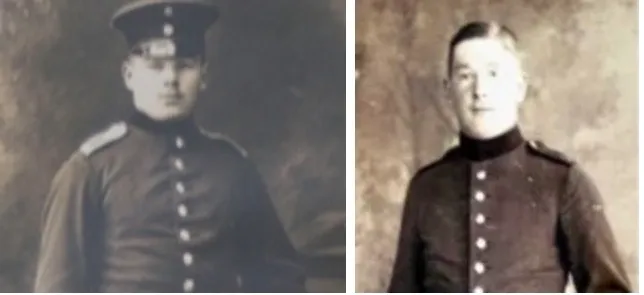
Brothers Xaver and Georg Schmieder, photographed in their Imperial German wartime uniforms—a moment captured before the Great War forever changed their lives.
From Sarajevo to the Zipperhof: How World War I Transformed a Black Forest Family
Sarajevo, 1914: The Bullet That Ignited a World War
Sophie, Duchess of Hohenberg, instinctively turned to her husband, her voice trembling. “For God’s sake! What has happened to you?”
On June 28, 1914, in Sarajevo, an event would change the course of history and the fate of countless families, including ours. At 11:00 a.m., an assassin’s bullet struck Archduke Franz Ferdinand in the neck, severing his jugular vein. Immediately, his pristine military uniform was covered in blood as chaos erupted in the street.
The gunman raised his FN Model 1910 semiautomatic pistol once more. His gaze locked onto Sophie. For a fleeting moment, their eyes met—hers wide with shock, his burning with deadly intent. Then, another sharp crack split the air. The bullet tore into her abdomen.
She swayed, then crumpled into the open-air motorcar, her head coming to rest between her husband’s knees. Thick with desperation, Franz Ferdinand clutched her, pleading, “Sopherl, Sopherl! Don’t die! Stay alive for our children!” But Sophie did not answer. Her body lay limp against him, her warmth already fading.
The March Toward War
Gavrilo Princip, a nineteen-year-old Bosnian Serb nationalist and member of the secret society Black Hand, carried out an act that would spark a global firestorm. His assassination of Archduke Franz Ferdinand and Duchess Sophie sent shockwaves across Europe, setting off a chain reaction that led to World War I.
Princip’s motivations were fueled by a fervent desire to unite South Slavic territories under Serbian rule. Yet his act of defiance would have consequences far beyond his imagining. The Archduke’s three young children—Sophie, Maximilian, and Ernst—were orphaned, and their family was shattered in an instant. The Austro-Hungarian Empire, outraged, demanded retribution.
Within weeks, diplomatic negotiations crumbled. Alliances were activated, and ultimatums were issued. War was no longer a possibility—it was inevitable.
When War Reached Reichenbach
The assassination’s repercussions rippled across Europe, reaching even the quiet town of Reichenbach in Germany’s Black Forest. In this picturesque valley, Georg and Anna Maria Schmieder lived with their five children, their lives shaped by the rhythms of the farm, sawmill operation, and family. But as tensions escalated, an unspoken dread settled over their home, the Zipperhof, darkening their once-peaceful existence.
Their two eldest sons, Xaver (21) and Georg II (17) (our grandfather), stood at a crossroads of youth and duty. In August 1914, Germany declared war on Russia, followed swiftly by declarations against France and Britain. War had arrived like a gathering storm.
At first, cities and towns buzzed with patriotic fervor. Church bells rang, newspapers celebrated honor and heroism, and young men—including Xaver and Georg II—felt the strong call of duty. Yet beneath the cheers and flag-waving, the elder generation exchanged knowing glances. They had seen war before and understood its cost.
As excitement gave way to grim reality, the Schmieder family grappled with the inevitable—war might soon take Xaver and Georg II from them. Like many others, they clung to the fragile hope of a swift victory, but the shadow of uncertainty loomed ever more prominent. Germany’s military leaders quickly mobilized 3.8 million soldiers, drawing their sons closer to the front lines.
A Village Mourns Its First Son
Within three weeks of the war’s onset, the first casualty of a Reichenbach son was announced to the community during Sunday Mass at St. Stephan’s Church. It was Private Ludwig Benz.
On Thursday, August 19, 1914, in the small town of Luneville, France, a young soldier met his tragic fate early in the war. The Battle of Luneville was a skirmish and a fierce clash within the larger Battle of Lorraine. Here, German and French forces fought with an intensity that would leave lasting scars on the land and its people.
Initially, the Germans pushed forward with overwhelming force, but they faced unwavering French resistance that turned the landscape into a brutal and bloody battleground. Amid the loud chaos of artillery and the intense closeness of combat, Ludwig’s life was abruptly ended. His bloodied body remained still, serving as a somber reminder of war’s horrors while the battle continued. Afterwards, he was buried near the very battlefield that claimed his life, forever linked to the tragic history of the Great War.
The news hit hard, echoing deeply in the hearts of those who knew him. He had left with the same hopeful resolve as many others, motivated by ideals of duty and honor. But those noble beliefs were forever shattered amidst the dirt and blood of the battlefield. His parents received only a brief telegram—a cold, emotionless notice of their loss. Their son, once full of life and promise, had been reduced to just a name on a casualty list.
For the people of Reichenbach, Ludwig’s death was more than a statistic—it was a painful wake-up call. The war that began with grand speeches and celebratory parades now revealed its raw brutality: lives lost, families torn apart, and no village truly untouched. As the Schmieder family waited for their call, they understood all too well that Ludwig’s fate could soon be their own.
The death of Ludwig Benz was a poignant reminder of war’s merciless grip. Reverently, his name was whispered during Mass, where candles flickered softly in his honor. In the heart of Reichenbach, a community steeped in faith and resilience, people sought solace in their beliefs. Families huddled together, their voices hushed and sorrowful, as their prayers filled the air. Mothers clutched their rosaries tightly, seeking strength, while fathers exchanged solemn nods, silently acknowledging the profound pain they all shared. That Sunday liturgy transformed into a sacred time of mourning, a hallowed space where the entire community united in grief, fervently praying for their soldiers and earnestly pleading for an end to the war.
The Fragile Faith of Home
Amid the rising tide of war and the fear that gripped her heart, Maria Anna found fragile sanctuary in the quiet rhythm of daily life—kneading bread, whispering prayers, and holding her family together one task at a time.
Each push and fold of her strong hands absorbed her worries, pressing them deep into the soft, yielding surface. As she murmured her daily prayers, the warm scent of flour and yeast mingled with echoes of her sons’ laughter, once vibrant and carefree, now muted by the heavy cloud of war. The weight of what lay ahead bore down on her, yet at this moment, she clung to hope as she prayed for peace.
In the quiet fields and forest, Georg Sr. buried himself in work, his furrowed brow betraying the worry he struggled to contain. The land lay undisturbed with its rolling hills and hushed forests, oblivious to the tempest raging within the world. From a distance, he watched Xaver and Georg II—young yet hardened, their hands calloused from years of toil at his side. An unbearable dread settled over him. The brutal, unyielding specter of war threatened to snatch their light before it had fully shone.
Brothers in the Shadow of Duty
In the stillness of the evening, Xaver and Georg II spoke in hushed tones, their words laden with uncertainty. The unknown drew them closer, yet in the silence between their sentences lingered a quiet struggle: did they possess the courage to be good soldiers? Could they take another life?
Visions of honor and heroism flickered in their minds, shadowed by a deeper, more sinister fear—the brutal and unrelenting truth of war. Would they rise to the occasion, or would the weight of battle crush them before they even had a chance?
As the world spiraled into chaos, the Schmieder family braced themselves for the storm ahead. Their prayers drifted into the night—fragile whispers straining to be heard above the roar of war.
A Mother’s Embrace, a Son’s Departure
The inevitable day came when Xaver, Georg II’s older brother, received a terse and urgent telegram from the German military, ordering him to report to the training facility in Strasbourg. The message carried a stark warning: failure to appear would be deemed desertion—a grave offense in such tumultuous times.
As Xaver prepared to leave, the family was overwhelmed by a swell of emotion and a deep, unspoken fear of what lay ahead. After completing their morning chores on the day of his departure, they gathered around their cherished, albeit worn, wooden table for what felt like a bittersweet breakfast.
The rich aroma of seasoned potatoes and sizzling sausage enveloped the room, providing a fleeting respite from the heaviness that clung to their hearts. They shared warm words and quiet laughter, but the steady tick of the old cuckoo clock reminded them how little time remained.
Maria Anna fought back tears as she gazed at Xaver, her heart swelling with bittersweet memories of that first moment she cradled him—a tiny, vibrant boy—it seemed like just yesterday. Before he departed, the family gathered at the Herrgottswinkel, the Lord’s Corner, adorned with a crucifix and religious symbols, where their collective plea for divine intervention on Xaver’s behalf filled the air.
Gripped by an instinctive yearning to protect him, she embraced him tightly, her silent prayer for his safe return lingering like a fragile whisper. In response, Xaver offered a brave smile, a gentle gesture meant to reassure her—and all those who loved him—that he would surely come home. But as he climbed into his father’s waiting horse-drawn wagon, the weight of their farewell bore down heavily, a poignant reminder of the risks and sacrifices that loomed ominously in the shadows of war.
As the wagon rumbled down the dusty path and faded into the distance, a heavy stillness settled over the farm like a mourning shroud. What words could a father possibly offer his son in a moment like this? Perhaps in the silence of that final ride, Georg Sr. found the strength to speak—his voice calm but strained, weighed with the sorrow he dared not show.
At the Lahr train station, Xaver joined a group of other young men, their families held them close in tight embraces—a poignant acknowledgment of the dangers that lay beyond the safety of home.
Upon arriving in Strasbourg, Xaver and his fellow recruits underwent intense physical examinations and donned their crisp new uniforms. Their uniform pictures were taken to send home to loved ones. They embarked on the rigorous journey of military training. Day after day, they endured grueling marching drills, learned to wield weapons with precision, and immersed themselves in the complexities of battlefield tactics. The days dragged on, heavy with the weight of uncertainty, but letters from home provided fleeting moments of solace—reminders of a world blissfully untouched by the ominous specter of war.
Into the Inferno: Verdun
Then came the orders: Verdun—a name already etched in dread, soon to become the longest and bloodiest battle of the war.
Verdun was 150 miles from Strasbourg, and its rolling hills were soon to be soaked in blood. It would become the most protracted and brutal battle of World War I. As their train arrived at the station, the soldiers disembarked, their breaths shallow with anxiety.
The air crackled with tension. The ground trembled under the weight of distant artillery. Every soldier knew there would be no turning back once they entered the trenches.
Xaver and his unit quickly began unloading crates filled with heavy artillery, ammunition, and supplies. The air was thick with the acrid smell of gunpowder, and the distant roar of cannons constantly reminded him of the battle ahead. When he gazed toward the horizon, he saw trenches carved deep into the earth, barbed wire stretched like a sinister web, and the silhouettes of soldiers preparing for what was to come.
The Battle of Verdun began on February 21, 1916, and lasted ten months. It was not just a battle—it was a test of endurance, a living nightmare. More than 700,000 men lost their lives on the fields and in the trenches of Verdun—a toll that stunned the world.
Xaver served in the artillery unit, a role that demanded precision and composure amid the chaos. He received coordinates from a distant spotter, adjusted his sights, loaded the cannon, and fired. The thunderous blast shook the ground. They repeated the motion repeatedly, the rhythm becoming their only constant. Yet, danger loomed with every breath. Enemy mortars rained unpredictably, their deadly arcs destroying the trenches.
Then, one day, war caught up with him.
A French shell exploded nearby, its force ripping through the air. Xaver was thrown to the ground, his body slamming into the mud. His ears rang, his vision blurred, and pain shot through him like fire.
Dazed, he forced himself to his feet, guided by instinct. Around him, men scrambled to reclaim their positions. Some would never rise again. But there was no time to grieve, no moment to pause. He adjusted his helmet, steadied his hands, and returned to the cannon.
Then—another explosion. Yet this time, it originated from his weapon.
Unbeknownst to him, debris had become lodged in the cannon’s barrel. When he fired, the obstruction caused a catastrophic detonation. The force propelled Xaver thirty feet into the air. The world around him fell silent. His body slammed into the ground. Everything faded to black.
Shattered by Shellfire
When Xaver awoke, he lay in the mud—his body broken, his uniform torn and soaked with blood. Pain pulsed from deep wounds across his face, arms, and chest. Shrapnel had torn through his flesh, leaving scars that would mark him for life.
A medic rushed to his side, bandaging the worst of the bleeding while whispering quiet reassurances. The war thundered around them, but in that moment, the only battle was for Xaver’s life.
He was evacuated from the front and brought to a field hospital, where he drifted in and out of consciousness. His recovery would stretch nearly a year, with pain—both physical and emotional—lingering long after his wounds closed. Back home, the Schmieder family faced a difficult choice: should they tell Maria Anna about her son’s injuries, knowing the news might overwhelm her? In the end, they chose silence.
Xaver refused to give in to despair. Fueled by determination, he battled through pain and injury to reclaim his strength. He yearned for home—the farm, the forest, the life he once knew. And so, he pressed on, clinging to the hope of peace and healing.
A Second Son Called to War
On March 6, 1916, Georg Schmieder II—our grandfather—was called to serve.
The family’s sorrow deepened. Once again, they gathered at the worn wooden table, the weight of another farewell pressing on their hearts. Maria Anna prepared the meal with trembling hands, aware it might be the last she’d share with her son.
As Georg embraced his mother, sisters, and younger brother, Paul, he sensed the finality in their touch—the trembling in his mother’s hands, the tight grip of his younger brother, each one silently saying what words could not.
At the military camp, Georg was assigned to an artillery unit. He trained and was sent to the Eastern Front—likely in Poland or Czechoslovakia. Far from home, he often found his thoughts drifting back to the familiar rhythms of the farm and the comfort of his family gathered around the dining table.
Wounded in Battle
On June 9, 1918, during intense combat as a member of the 8th Battery of the 55th Field Artillery, Georg II was struck by a machine gun bullet that pierced his elbow—missing his head and chest by inches. The impact hurled him to the ground as searing pain shot through his arm. Blood soaked his uniform and pooled in the dirt beneath him.
A medic arrived swiftly, cleaning and dressing the wound. Though in pain, Georg was grateful his injuries weren’t fatal.
On June 25, he was transferred to the reserve military hospital in Lübben, Germany, where he remained under the care of ward physician Dr. Hoffmann. After weeks of recovery, he was discharged on August 16, 1918—just three months before the war’s end.
The War Ends, But the Scars Remain: Aftermath and Echoes
The war that started with the assassination of Archduke Franz Ferdinand and his wife, the Duchess of Hohenberg, by Gavrilo Princip—a nineteen-year-old Bosnian Serb nationalist and member of the secret society Black Hand—finally concluded on November 11, 1918, with the signing of the armistice agreement.
What followed was an astonishing toll: between 15 and 22 million lives lost, another 20 million injured, and a world permanently altered. The war shattered empires, redrew national boundaries, and led to the emergence of new political ideologies. The Austro-Hungarian Empire collapsed, paving the way for newly established nations. At the same time, the Treaty of Versailles imposed harsh reparations on Germany, creating an atmosphere of resentment that would ignite future conflicts.
Though the armistice silenced the guns, the Great War’s echoes endured. For Xaver, Georg II, and so many others, the scars—both seen and unseen—never faded. Their stories still resonate in the soil of the Zipperhof and the hearts of their descendants. We remember them not only for what they endured, but for the future they made possible.
_________________
Note: This account of our Schmieder ancestors during World War I is woven from both historical records and family recollections. While grounded in factual events, it includes personal interpretation and remembered experiences, acknowledging the challenge of fully capturing every detail of lives lived a century ago.
—Frederick Schmieder