
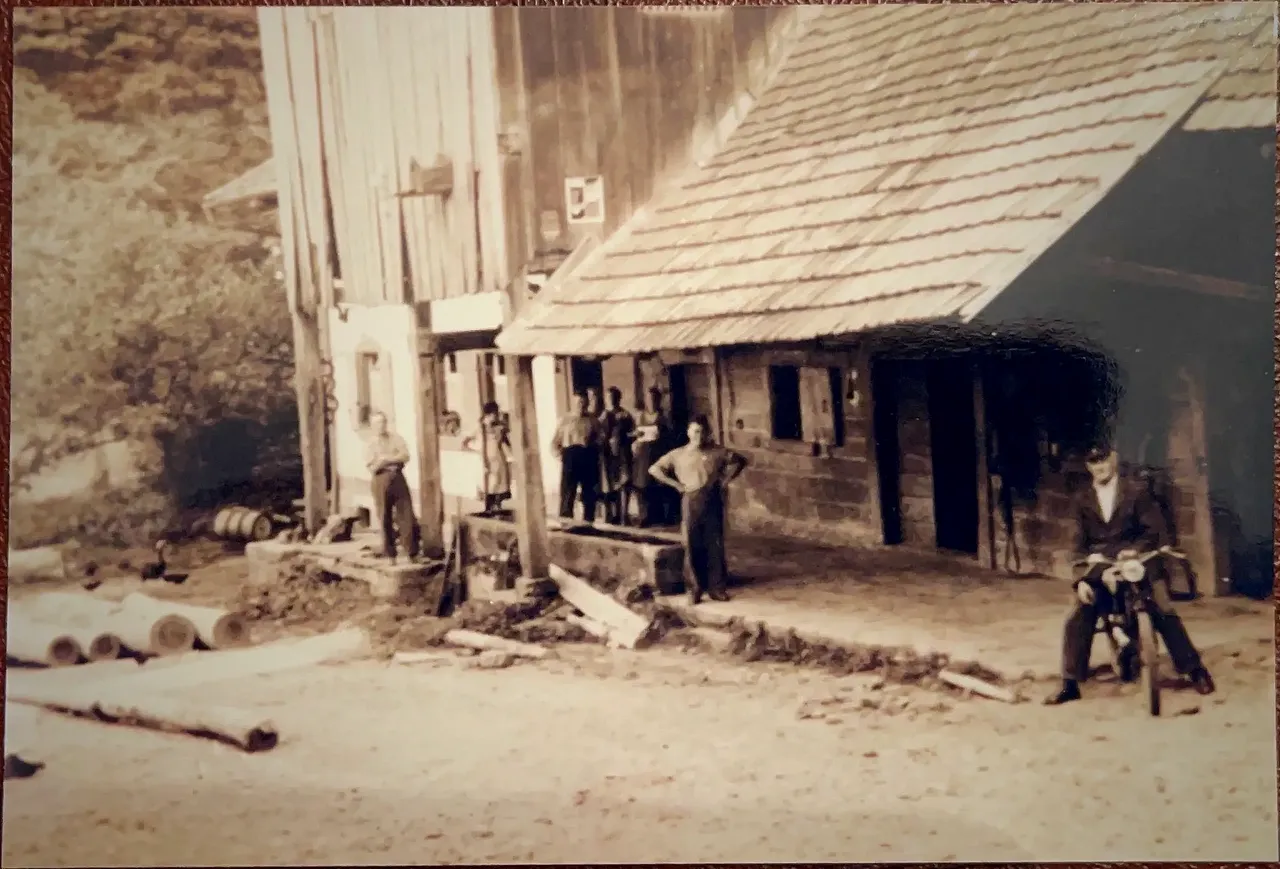
At the Zipperhof: Where the Schmieder Legacy Took Root
he Schmieder family home, fondly known as the Zipperhof, sits nestled in the hills of Reichenbach, Baden, Germany—a place where faith, hard work, and family tradition run deep.
New Life in Spring: Welcoming Xaver Franz
It was the spring of 1894, and the Zipperhof was filled with new life. Fertile fields stretched like a sea of green to the forest’s edge while colorful wildflowers danced in the gentle mountain breeze. The lush forests were alive with birdsong, and the barnyard echoed with the sounds of squealing piglets and a bleating newborn calf. Amidst these sounds, the soft cooing of an infant could be heard.
On a brisk and bright February 15, 1894, the air was filled with excitement as Georg and Maria Anna Schmieder joyfully welcomed their firstborn son, Xaver Franz, into the world. This little boy was named to honor his grandfather, Georg’s father, a man of sixty-eight years whose life exemplified strength and deep love for family. However, the jubilant occasion was tinged with sorrow, for Georg’s mother, Franziska Giessler-Schmieder, had passed away two years earlier, never having the chance to cradle her precious grandson in her arms, leaving a bittersweet echo in the family’s joy.
The family farm, a sacred land that had witnessed generations of toil and triumph, pulsed with new life and energy. The dormant fields were blossoming with fresh growth, symbolizing the promise and hope that the arrival of their son brought to their hearts and home. Each breeze whispered tales of anticipation and their dreams for Xaver’s future as they embraced this new chapter filled with vitality, love, and endless possibilities.
A Legacy Continued: Welcoming Georg II
Nearly three years later, Maria Anna was expecting their second child. On January 19, 1897, labor pains began on a frigid winter day at the Zipperhof. Despite the harsh weather and snow-covered landscape, a skilled midwife attended her while Georg and their son Xaver waited anxiously, praying for the health of both mother and baby. Maria Anna’s labored breathing filled the house until, finally, the cries of a newborn echoed through the walls. The midwife beckoned the family into the room to meet the healthy baby boy they named Georg II. This moment marked a turning point in our family’s history—this child would become our grandfather. He would grow into a man of quiet determination and enduring strength—the steadfast root from which a new generation would flourish in a distant land.
A Nation in Transition: The Shadow of Empire
Georg entered the world during a tumultuous period marked by the reign of Kaiser Wilhelm II (1859–1941), a grand and controversial figure who presided over the German Empire with a mix of ambition and arrogance from 1888 until his dramatic abdication in 1918. As the grandson of Queen Victoria and the son of Crown Prince Frederick of Prussia, Wilhelm’s lineage was steeped in royal tradition, yet his rule saw a nation at the crossroads of progress and peril. Under his leadership, Germany experienced a breathtaking wave of industrialization that transformed its cities and ignited a fervent spirit of nationalism among its people. However, this surge of pride and power also cast a long shadow, as the dark specter of World War I loomed ever closer, threatening to engulf the very empire he sought to elevate. The era was one of stark contrasts, blending hope for a bright future with the haunting strains of an approaching catastrophe.
The Growing Schmieder Family
Over the next six transformative years, Georg and Maria Anna experienced the joy of expanding their family, growing from two to a lively household of five children. Their daughter, Theresia, graced their lives with her arrival in the summer of 1899, bringing laughter that warmed their home. Just a couple of years later, in the chilly depths of winter in 1901, they welcomed their son Paul, a curious and spirited child. The family was finally completed in the late summer of 1903 with the arrival of Mathilde, a sweet soul who brought great joy. The birth of each child was like adding a new patch to a quilt, weaving together joys, pains, hardships, and shared commitments that create the rich tapestry of their history.
The Heartbeat of the Zipperhof Farm
The Zipperhof farm buzzed with vibrant activity, alive with the laughter of children who learned the value of hard work from a tender age. The farmhouse stood as a warm and inviting sanctuary, its walls filled with the comforting aromas of freshly baked bread and hearty home-cooked meals. Despite their relentless labor, the family found joy in life’s simple pleasures: the golden warmth of the sun, the invigorating crispness of the mountain air, and the satisfying view of their well-tended fields, testaments to their collective effort.
Their paternal grandfather, Franz Xaver (our second great-grandfather), was an essential influence during their formative years and was at the center of their family life. A widower, he resided in the adjacent two-story Leibgedinghaus, a dwelling built into the hillside for aging parents. His living quarters occupied the upper level—a serene retreat reached by climbing the sturdy stone stairs carved into the hillside. Below, the lower level served as a wine cellar—a sacred space where wine and schnapps were distilled, continuing a tradition deeply rooted in their culture.
Franz Xaver, an elderly man with a face etched by the passage of time, moved slowly, his gait marked by the weight of his years. His gnarled hands, callused by scythe handles and saws, carried the memory of a lifetime carved in labor.
Yet, despite the toll of those years, he found immense joy in nurturing the bond with his grandchildren, especially with his cherished namesake, Xaver II. The children affectionately referred to him as “Opa.” In his warm embrace, he would recount tales from his youth that bridged generations.
A Final Farewell: Franz Xaver’s Passing
Tragically, Franz Xaver’s life reached its end on a bitterly cold and dreary January day in 1904, at the age of 79. The community mourned, gathering at St. Stephan’s Church in Reichenbach for his funeral Mass, a solemn occasion where friends and family came together to pay their respects. He was laid to rest in the frozen church graveyard, leaving behind a rich legacy that continued to resonate within the Zipperhof, ever woven into its very essence. Though he was gone from this world, his memory lived on, immortalized in the hearts and traditions of his family.
Hard Days and Calloused Hands: Farm Life’s Demands
The joyful laughter of children often struggled to break through the relentless demands of farm life. Each day was filled with a continuous cycle of chores that left them little opportunity for rest or leisure. There were no days off, no vacations—only a steadfast resolve to cultivate a brighter future. Yet, amid this grinding routine, the children’s laughter held a glimmer of hope, a reminder of innocence and dreams that would one day flourish beyond the fields.
Life without modern conveniences presented severe challenges. The family lacked electricity, central heating, indoor plumbing, and telephones—elements we often take for granted. During the frigid winters, they endured biting cold, wrapping themselves in heavy layers of clothing and piling thick blankets on their beds each night to fend off the chill. Laundry was a grueling and time-consuming process, done by hand rather than with machines. The absence of modern medicine cast a shadow over their lives, with diseases constantly threatening their well-being. Yet, despite these hardships, the family drew strength from their faith and perseverance, meeting each day with a spirit of resilience and hope.
Morning Chores and Lantern Light
As dawn approached, the household began to awaken. Georg tended to the wood cookstove, coaxing it to life until it crackled and glowed warmly. Meanwhile, Maria Anna lit the lanterns, filling their home with a soft, golden radiance. Their homestead, constructed in the traditional Einhaus or Quereinhaus style, elegantly merged living space and barn beneath a single roof. A convenient connecting door enabled them to traverse easily between these two essential parts of their lives, even amid the harshest weather conditions.
Every morning as dawn broke, Georg and his young sons stepped into the barn, clutching lanterns that flickered with a warm, inviting light. The soft glow bathed the rugged wooden beams in a golden hue, casting dancing shadows over the quiet stalls where their animals awaited. The gentle rustling and soft bellowing of the creatures awakened in the stillness wrapped around them, creating a comforting symphony that filled their hearts with warmth and purpose.
Georg began his day by climbing a sturdy, wooden ladder, a relic used by generations of Schmieders to access the second-story hay loft beneath the barn’s steep roof. As he entered, he was enveloped by the sweet aroma of cured hay. While he pitched hay down to the cows, horses, oxen, and bull below, the soft thud of his leather-soled shoes against the wooden floorboards resonated in the tranquil morning air. Next to the hay loft, an alcove served as the barn’s entrance, transforming into a bustling hub during the harvest season when grain threshing came to life.
Xaver approached the gentle cow with quiet confidence, softly patting its back to announce his arrival. He carefully placed the milk pail on the ground and set a wooden milking stool beside the cow. As he milked the cow by hand, he savored the peaceful sounds around him—the soft rustle of hay as the cow munched and the occasional swish of her tail. The rhythmic squirt of milk striking the metal pail created a soothing melody that filled the tranquil atmosphere. Yet, amidst this calmness, Xaver’s thoughts wandered elsewhere.
Young Georg began his morning routine by bravely hauling heavy buckets of water from a long, hand-carved stone trough, sheltered by the rustic extension of the barn roof. This trough was not merely a water source; it served as a lifeline for the animals, a place to wash freshly harvested potatoes, and a refreshing haven for weary workers seeking a quick bath after a grueling summer day. Each splash of water invigorated Georg, reminding him of the vitality of the farm and the importance of his labor.
The farm-sourced water came from a pristine mountain stream nearly a thousand feet away. Small-diameter oak, ash, and fir trees were cut into six-foot sections and drilled with a long auger. These sections were then connected end to end and buried in a four-foot trench, creating conduits for the water. This system continuously delivered clear mountain water to the farm and house. A health inspector once noted that the water supply at the Zipperhof was among the best in the region.
Faith at the Hearth of Family Life
As the morning chores were underway, Maria Anna focused on caring for the younger children while preparing breakfast in their modest kitchen, which featured a traditional wood cookstove and a custom-built smokehouse as its focal points. The smokehouse, Rauch Kammer, lined with durable tin, utilized sawdust from their sawmill to impart rich, smoky flavors to the meats. As the fragrant smoke billowed inside, it was channeled through a vent connected to the central chimney, allowing it to escape gracefully above the rooftop and dissipate into the crisp mountain breeze. The meats and sausages were cured in the smokehouse for four to six weeks. Afterward, they were hung in a small, soot-covered room above the kitchen.
As the mouthwatering scent of freshly baked bread, crispy fried potatoes, and juicy, sizzling sausages wafted through the air, the family assembled in the Stube, a traditional living space with plain wood paneling, built-in benches, and handcrafted furniture. Before they indulged in their meal, they bowed their heads in heartfelt prayer, expressing gratitude for their abundant blessings.
The room was filled with the cozy warmth of a wood stove, its crackling flames offering a comforting embrace against the chill outside. Softly illuminating the space, oil lamps cast a gentle glow, enveloping everything in a soothing light. In a revered corner of the Stube known as the Herrgottswinkel—the “Lord’s Corner”—a beautifully crafted crucifix and religious artwork stood as powerful symbols of the deep faith that infused their daily lives. Nearby, the soft, rhythmic chime of a Kuckucksuhr, cuckoo clock, filled the air.
The intricately designed pendulum-driven clock produces the lifelike sound of a cuckoo bird as it strikes each hour, enhancing the ambiance. This ingenious clock dates back to 1738 and was created by Franz Ketterer, a skilled clockmaker from the village of Schonwald in the heart of the Black Forest. It reflects the exquisite craftsmanship that has become a hallmark of this cherished Black Forest tradition.
A Legacy Etched in Soil and Memory
The Zipperhof was not just a farm but a cherished home steeped in family, unwavering faith, and the relentless spirit of hard work. It stood as a sanctuary where knowledge and skill were passed down from generation to generation and the aroma of home-cooked meals wafted through the air. Through every hardship that challenged them and every triumph that uplifted their spirits, the Schmieder family wove a life of faith, commitment, and resilience. Their legacy, built on shared dreams and tireless effort, radiates through the generations as a poignant reminder of the enduring power of family and the deep roots that nourish the soul.
Note: This account of Georg and Maria Anna Schmieder, parents of George Schmieder, is a tapestry woven from factual events and personal recollections. It draws on historical records alongside individual interpretations and reflections, recognizing the inherent challenge of fully capturing every detail of lives lived so long ago.
— Frederick Schmieder