
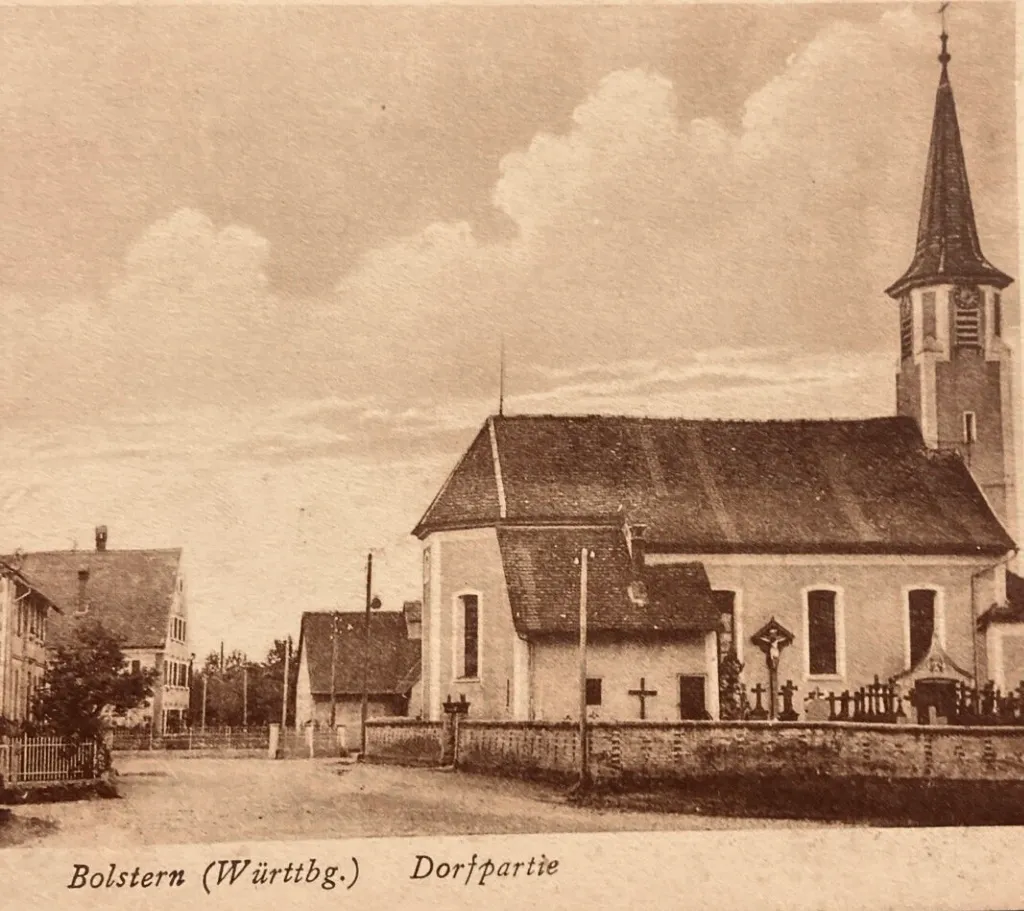
Chapter 1: Hope and Heartache in Wagenhausen-Bolstern
A new Life Begins Wagenhausen-Bolste
In November 1920, following their marriage ceremony at St. Martin’s Church in Freiburg, George and Rosa began planning their relocation to Bolstern. Located about 100 miles east of their neighboring villages, Reichenbach and Schönburg, this quaint agricultural village offered them a promising fresh start. George, longing for independence and a chance to forge his legacy, boldly requested his inheritance early—much like the prodigal son seeking his fortune. Georg and Maria Anna passionately debated the request. His father, though hesitant, ultimately granted this wish, understanding that his son needed the freedom to navigate his own path.
George’s relationship with his mother, Maria Anna, remained characterized by deep resentment that fractured the family. This simmering discontent arose from her disapproval of his choice to marry Rosalia Beck. Despite her humble means, Rosa was described as one of the village’s “nicest” young women, working tirelessly in a cigar factory to support her family. Each time Maria Anna ruminated on George’s defiance, bitterness consumed her. For the last seven years, she carried an unresolved anger that shadowed her every step, a burden she would ultimately take with her to the grave.
A Village Steeped in Faith and History
Nestled in the picturesque, rolling countryside of Baden-Württemberg, Bolstern is a charming agricultural community with a rich history that dates back to medieval times. Once part of the County of Hohenzollern-Sigmaringen, the village has maintained its rural character, influenced by generations of farming traditions. By the early 20th century, Bolstern remained largely untouched by industrialization, flourishing its economy through small-scale farming, dairy production, and local trade.
In this close-knit village, automobiles were rare. Most residents relied on horse-drawn carts or traveled on foot, navigating the well-worn paths that wound through the fields and farmland. The typical home was a half-timbered farmhouse with a thatched or tiled roof, serving as a testament to centuries-old architectural traditions. Electricity and modern plumbing had not yet become widespread, reinforcing a way of life deeply attuned to nature’s rhythms and the enduring bonds of community.
At the heart of the village stood the church of St. Gallus, built in 1817, replacing an older structure that had silently witnessed generations of faith, hardship, and resilience. Its presence anchored the town, offering villagers a spiritual and communal gathering place. Within this tranquil setting, George and Rosa envisioned building a stable and fulfilling life, embracing the simplicity and steadfast traditions of Bolstern.
Kloster Sießen: Bells of Faith Across the Fields
Beyond the village, the melodic chimes of the Kloster Sießen bells drifted through the countryside, their echoes mingling with the rustling fields. Founded in the 13th century, this Franciscan monastery-convent in nearby Bad Saulgau played a significant role in the region’s cultural and spiritual heritage. In later years, it gained renown as the home of Sister Maria Innocent Hummel, whose artistic talents inspired the beloved Hummel figurines cherished worldwide. This rich history, interwoven with the daily lives of Bolstern’s residents, added depth and meaning to their existence, reminding them that even in a small village, history and tradition shaped the present and guided the future.
Prayers in the Fields
Throughout the day, the rhythm of life in the area was beautifully punctuated by the melodic tolling of the bells from the Kloster Sießen bell tower. These bells chimed at six in the morning, at noon, and again at six in the evening, marking not just the passage of time but also calling the faithful to engage in a traditional Catholic prayer known as the Angelus. When the bells resonated across the fields, men, women, and children paused in their daily tasks, bowing their heads in unity as they recited this prayer. This practice highlights their deep connection to faith and community traditions.
The Angelus, a simple yet profound devotion, reflects the essence depicted in Jean-François Millet’s painting, The Angelus. This artwork shows a humble peasant couple taking a moment in a field to pray amid their labor. The image resonates deeply, reminding us that even during challenging times, their faith served as a steadfast anchor, connecting them to generations who found strength in similar rituals of work and devotion. Their practices emphasize the sacredness of faith intertwined with the struggles of everyday life.
Seasons of Labor and Hope
During the vibrant spring and warm summer of 1921, George and Rosa stirred from their slumber long before dawn, their bodies instinctively drawn to the chores awaiting them. With the first light of day breaking, they tended to the livestock. George fed the cattle while Rosa milked the cows and gathered the fresh eggs. The gentle, unyielding rhythm of the seasons sculpted each day on the farm, painting their routine with purpose and predictability.
As the sun rose, casting a warm glow over their modest kitchen, Rosa, now expecting a child, began preparing a simple yet nourishing breakfast. She carefully arranged a spread of crusty bread, freshly laid eggs, rich milk, and creamy butter, each a testament to their hard work and dedication.
As the morning sun began to rise in the sky, George harnessed his oxen and ventured into the fields, his spirit invigorated by the day’s first light. He started by plowing the rich, dark soil, preparing it for the seeds of wheat, oats, sugar beets, and potatoes that he would soon plant. As spring gradually transitioned into the warmth of summer, George continued to toil for long hours under the bright sun. With a sharp scythe in hand, he cut his hay, taking occasional breaks under the shade of his small orchard to quench his thirst and sharpen his scythe, letting the golden rays cure his crop, ensuring it would be ready for gathering and storage. His hands bore the evidence of hard work, calloused and worn, while his neck and arms were tanned a deep bronze from relentless exposure to the summer sun.
Rosa managed the household by preparing for their child’s birth, preserving food for the winter, and cultivating a small vegetable garden that provided fresh produce for family meals. Despite the physical demands of farm life, she and her family experienced a deep sense of satisfaction in their work, knowing that each effort contributed to a brighter future for their growing family. Additionally, she maintained her connection to her Schönberg family by writing letters that shared details about their new life.
War’s Debt Reaches Wagenhausen-Bolstern
Yet, beyond the peaceful confines of Bolstern, the weight of war still lingered. In June 1921, Germany began making its first reparation payments under the Treaty of Versailles, placing a heavy financial strain on the nation. The treaty, signed in 1919, demanded that Germany make massive payments to the Allied powers as compensation for the destruction wrought during World War I. Many economists, including John Maynard Keynes, warned that these reparations were excessively punitive and would cripple Germany’s already fragile economy.
The financial burden quickly took its toll. The Weimar Republic struggled to stabilize its currency, and hyperinflation began to creep in. Rising taxes and inflation made it increasingly difficult to purchase essential supplies, and uncertainty seeped into daily conversations. German citizens, particularly in rural areas like Bolstern, saw their savings dwindle while the cost of goods soared. Political unrest grew, with widespread resentment toward the treaty and its enforcers.
Even from afar, the residents of Bolstern were not shielded from the upheaval engulfing Berlin. Once self-sufficient families now grappled with dwindling resources, tightening their belts in the face of relentless hardship. These struggles intensified the pressure on George and Rosa, testing their resolve to forge a stable home amidst the shadow of uncertainty looming over their nation’s future.
Joyful Arrival of Hilda Maria
Neatly scythed rows of sun-dried hay lay in rectangular fields of their farm. Its sweet scent wafted through the barnyard as George prepared for his morning chores on Sunday, July 31, 1921. He positioned a three-legged wooden stool beside the stanchioned cow, setting a pail beneath her swollen udders.
As the convent bells tolled in the distance, he rested his head against her warm flank and grasped a teat in each of his firm, calloused hands. With practiced rhythm, he pulled and squeezed, the creamy milk streaming against the metal pail in a familiar, steady cadence. This morning, he worked with urgency, finishing quickly before releasing the cows into the summer pasture.
His heart pounded as he returned to the house—not from his labor but from anticipation. Inside, Rosa lay on a straw-filled mattress, her body tense with the pains of childbirth. The midwife knelt beside her, speaking in soothing, measured tones.
“Breathe in slowly, and push hard as you breathe out,” she instructed, her voice firm yet reassuring.
Rosa clenched the mattress, her fingers digging into the coarse fabric as another contraction seized her. The golden light of midday streamed through the window, illuminating the sweat on her furrowed brow. Her sapphire-blue eyes, usually serene, darkened with pain. She gasped between contractions, her neatly pinned hair now damp and disheveled.
“How much longer?” she pleaded, her voice strained.
“Not long now,” the midwife assured her. “Breathe and push.”
With each effort, Rosa felt as though her body would split apart. A final, desperate push—and then, release. A baby’s sharp cry pierced the heavy air. The midwife lifted the newborn, her tiny limbs flailing, her first breaths uncertain.
“She’s here,” the midwife announced, quickly drying the infant. “A strong, healthy girl.”
Relief washed over Rosa as her tensed muscles slackened. Her lips curled into a weak but radiant smile. “Is she all right?” she asked, peering over the blanket draped across her trembling legs.
“She’s perfect,” the midwife assured her, wrapping the infant in warm linens.
Rosa whispered gently, inviting George to hold their daughter. His large, weathered hands, accustomed to the demands of the plow, trembled slightly as he cradled their newborn, Hilda Maria. He looked down at her delicate features, her tiny fingers curled into tight little fists, filled with wonder at the miracle of new life before him.
“She’s beautiful,” he murmured.
The Burden of an Uncertain Future
For a brief period, life fell into a familiar rhythm for the couple as they transitioned into parenthood while diligently managing their farm. However, significant changes were unfolding beyond the tranquility of their quiet village. The once-stable German Mark was experiencing a decline in value, and Germany found itself entangled in the harsh realities of yet another conflict – an economic war.
George watched in dismay as their hard-earned savings began to wither away, swallowed by the relentless hyperinflation plaguing the Weimar Republic. This economic decay forced families like theirs to confront the reality of financial instability, making each day a struggle for survival. Despite the profound turmoil surrounding them, George and Rosa initially met their financial obligations with grim determination, relying heavily on their modest crops and livestock, which had become a lifeline in a world where currency was rapidly losing value. The couple started to feel a deepening anxiety about their future.
Then, one morning, as George entered the barn, he noticed a cow lying motionless in her stall. Her dark muzzle was cold, her breath slow and labored. Thick strings of saliva clung to the coarse hairs around her mouth. He knelt beside her, offering water and grain, but she made no effort to rise.
Concerned, he sought advice from neighboring farmers, but no one had answers. By evening, she was gone.
Within days, more cows fell ill. George tried everything—changing their feed and care—but the sickness spread like a curse. One by one, his herd perished.
As the last cow succumbed, George stood by their empty stalls, his shoulders slumped in defeat.
“How could this happen?” he whispered, his voice hoarse with exhaustion and sorrow.
Rosa, cradling Hilda, had no answers. Instead, she stepped beside him, wrapping her arm around his weary frame. In the silence, their grief mingled, unspoken yet understood. Their dreams, once brimming with promise, now lay in the delicate hands of fate.
A Nation in Crisis, A Family in Fear
By the fall and winter of 1921, the German economy was reeling from the heavy toll of World War I, enduring the effects of staggering reparations as mandated by the Treaty of Versailles. The economy continued to plunge into an abyss of ruin, with hyperinflation setting in at an alarming rate. Prices for goods and services skyrocketed, rendering the German mark nearly worthless, leading to scenes of desperation as citizens hauled wheelbarrows full of cash to purchase necessities. This economic uncertainty permeated daily conversations, where discussions of rising prices and dwindling savings became commonplace, fostering a pervasive anxiety among the populace.
For George and Rosa, these external challenges introduced an additional layer of stress to their already demanding lives, compelling them to reassess their ability to establish stability for their family amidst these unfolding hardships. They were emblematic of the broader struggle of ordinary citizens grappling with the aftermath of a devastating war and a collapsing economy that threatened their very existence. The societal fabric was fraying as families weighed their dwindling resources against the backdrop of a nation in turmoil, highlighting the emotional and psychological toll that such economic despair inflicted on the everyday lives of Germans during this tumultuous period.
The Day That Altered Their Lives
A firm knock at the door echoed through the silence, demanding attention and curiosity. Who could it be?
Rosa rushed to the barn, her voice tight with urgency. “Someone is at the house to speak with you.”
George wiped his hands on his trousers and hurried back with her. The lawyer who had drafted the contract to purchase their farm was seated at their wooden table. The man pulled a stack of papers from his satchel and looked at George gravely.
“Herr Schmieder, I need to discuss our contracted purchase agreement.”
George leaned forward, hands pressed against the table, his heart pounding. The lawyer placed a document before him and read from it, his voice steady yet hesitant. One sentence stood out, repeated with slow, deliberate emphasis.
George frowned. The words were legal jargon, meaningless to him. “What does this mean?” he demanded.
The lawyer hesitated, then exhaled sharply before offering an explanation that struck George like a hammer to the chest. “The contract mandates that the property be returned to the seller, and the purchase funds returned to the buyer in the event of a devaluation of the German mark.”
George shot up from his chair, his pulse roaring in his ears. “You can’t take this property from me!”
The lawyer tapped a manicured finger against the paper, unmoved by George’s outburst. “I am sorry, but this is the agreement you signed. Is this not your signature, Herr Schmieder?”
Rage boiled inside him. His shoulders tensed, and his fists clenched at his sides as he stared into the dark eyes of the man who had come to strip away his home, livelihood, and family’s future. He had a wife, an infant daughter, and another child on the way. The urge to seize him by the collar and rip the contract to shreds surged through him.
A movement from the corner of his eye stopped him. Rosa stood by the cookstove as Hilda napped in the other room, her face pale, her hands clutching her rosary, her modestly swollen belly hidden beneath her apron. She said nothing, but her silence screamed volumes.
George swallowed hard. What was he to do?
The lawyer placed a heavy stack of now-worthless German marks on the table, the crumpled bills seeming to whisper tales of lost value and broken dreams. With an air of solemnity and finality, he set down an eviction notice, the crisp paper a stark reminder of the harsh reality that awaited. Each word printed on the notice felt like a dagger, piercing their hopes in a place they called home. George’s vision blurred with rage. He could only force the man from his home before the last remnants of his composure shattered.
George’s anger transformed into a wave of fear, surging through him like a powerful storm. Rosa held Hilda tightly, her trembling fingers revealing the pallor of her cheeks, which had drained of color. The frantic rhythm of Rosa’s heart made it feel as if her chest could barely contain its beating. She struggled for breath as tears streamed down her face, falling onto their daughter like a torrential rain, as if each drop were a solemn baptism into an unforgiving world filled with pain, suffering, and uncertainty. They stood together, enveloped in despair, hearts heavy with anguish, longing to shield Hilda from the harsh reality that loomed ever nearer.
Note: This account of George and Rosa blends factual events with personal perspectives and interpretations, acknowledging the challenge of fully capturing every detail of past events.
Frederick Schmieder