
Chapter 2: George and Rosa’s Struggle to Survive in Radolfzell
Radolfzell on Lake Constance – A Family’s Struggles and Dreams
Wagenhausen/Bolstern: Where Their World Fell Apart
Amid George and Rosa Schmieder’s deepening despair, life’s unrelenting rhythm continued. Baby Hilda still needed to be fed; the monastery bells rang, and the sun continued to set over Wagenhausen-Bolstern’s rolling fields. Yet beneath the familiar routine, uncertainty gnawed at them. What would they do? Where would they go? The village they had once called home held no future for them now.
At just twenty-five, George found himself homeless and jobless, with his young family’s future hanging by a thread. Rosa, twenty-eight and expecting their second child, felt the suffocating weight of their hardships pressing in from all sides. Each sleepless night was spent wrestling with haunting questions: How had it come to this? What had they done to deserve such a fate? Little did they know that the ripple effects of Gavrilo Princip’s fateful act—the assassination of Archduke Franz Ferdinand and Duchess Sophie—were echoing through history, forever altering the lives of millions, including their own, leaving devastation in its wake.
Their desperation deepened as options dwindled. Returning to their families was impossible. George’s father once possessed comfortable savings, but hyperinflation had turned them to dust. His banker’s failure to convert the money to Swiss marks, as requested, had sealed their fate. Rosa’s family, already struggling, could not take them in.
A New Beginning in Radolfzell
With nowhere else to turn, George, Rosa, and little Hilda left Wagenhausen-Bolstern on August 1, 1922, traveling forty miles southwest to the larger town of Radolfzell. There, at Teggingerstrasse 21, they moved into a modest flat offered by Werner Zaugg, a trusted friend and Hilda’s godfather, who lived just across the way at number 20. Werner, active in real estate and possibly insurance, offered George a chance to work alongside him, a small glimmer of hope amid uncertainty.
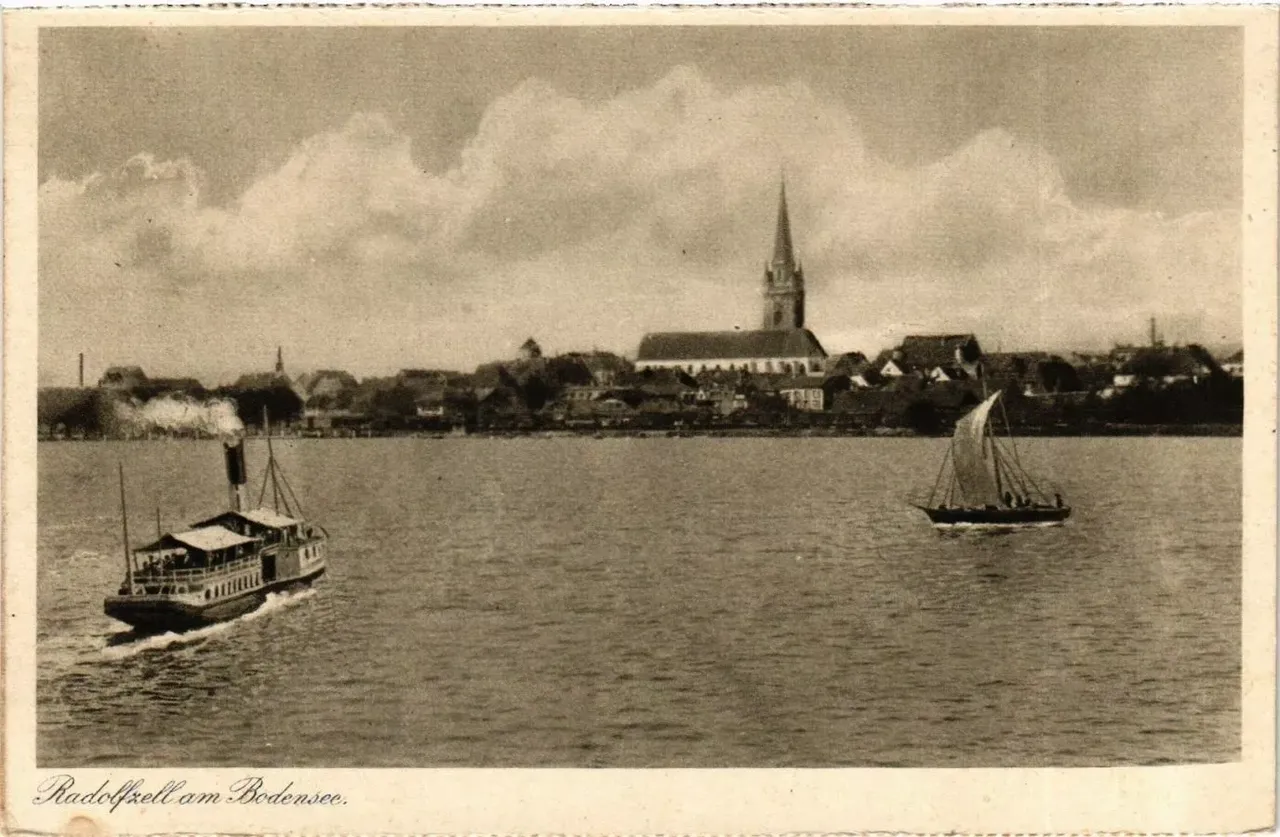
Radolfzell, nestled on the picturesque western shore of Lake Constance, had a rich history dating back to the monastery established in 826. Three early residents—Theopont, Senesius, and Zeno—had been canonized as saints, leaving the town steeped in faith and tradition. Yet for George and Rosa, this historic place was not a sanctuary of peace but a battleground for survival, where every day demanded grit and resilience to forge a new path forward. Their small third-floor apartment offered shelter but little comfort, and despite their determination, economic hardship continued to shadow their every step.
A Son is Born Amid Hardship
Yet, amid the shrouded uncertainty that seemed to envelop their lives, a wave of joy broke through the darkness. On that fateful day of September 5, 1922, Rosa brought forth a precious son, Friedrich (Frederick ), within the modest confines of their small apartment. In the turmoil surrounding them, the couple found comfort in planning his baptism. This ritual, a luminous beacon of hope and love, offered a moment of light in an otherwise shadowy time. George’s sister, Theresia, was graciously invited to be the child’s godmother to strengthen further their bond with the family they had left behind. This small yet significant gesture radiated warmth and connection, a reminder that family ties endure even in the most challenging circumstances.
A Mother’s Unforgiving Heart
However, when the news reached George’s mother, Maria Anna, her reaction was immediate. With icy resolve, she forbade Theresia from accepting the honor bestowed upon her. The arrival of her grandson, a moment that typically brightens hearts, could not penetrate the unyielding walls built from resentment and anger. When George read the telegram, a familiar ache—heavy and sorrowful—settled in his chest like a stone weighing him down, followed by an outpouring of anger that revealed the unforgiveness he, too, held.
He had held onto the hope that Maria’s unforgiveness would soften over time and that the family bonds could mend old wounds. Yet the reality was stark and painful; her anger remained a relentless storm, a tempest that no blessing—no matter how pure or innocent, like the birth of a child—could ever hope to quell. It echoed in his heart, a reminder of the rift that refused to heal, leaving a haunting sense of loss for his newborn son.
However, Mathilde Schmieder, George’s 19-year-old sister, gracefully accepted the honor of being Friedrich’s godmother. Despite the familial rift, Mathilde embraced this role, finding comfort in the bond she could develop with her newborn nephew. Her decision to take on this responsibility showcased her desire to carve her own path. Alongside her, Werner Zaugg served as godfather at Münster Unserer Lieben Frau (Minster of Our Lady), Radolfzell’s principal Catholic church. Initially established in 826 AD by Bishop Radolf of Verona, the church was constructed as a monastic cell and pilgrimage site, housing relics of early Roman martyrs. It was later rebuilt in the 15th century in a grand Gothic style, with its towering steeple becoming a defining feature of the town’s skyline. By 1922, the church had stood for over a millennium as a symbol of faith, tradition, and continuity—an enduring backdrop for the christening of the next Schmieder generation.
Germany in Freefall” or “Hyperinflation’s Grip on Daily Life
Germany found itself engulfed in profound turmoil. Still reeling from the catastrophic effects of World War I, the nation now grappled with an economic disaster of unprecedented magnitude. Hyperinflation had transformed daily life into a relentless battle for survival. Wages evaporated almost as quickly as they were earned, while the prices of essential goods escalated beyond reach, creating a harrowing existence for countless families. A loaf of bread that cost a few marks one morning could soar to hundreds or even thousands by nightfall, plunging the population into constant fear and uncertainty. Families resorted to carting stacks of nearly worthless banknotes in baskets or wheelbarrows to procure necessities, a stark testament to their desperation during this grim chapter in history.
George poured his heart and soul into every job he could find, tirelessly working to support his family. Each day, however, he confronted an insidious, invisible enemy that seemed to grow increasingly vigorous and relentless. The once-thriving farm and beloved home they had cultivated in Bolstern were now distant memories, claimed as casualties of a merciless collapsing economy.
Now, crammed into the suffocating quarters of their third-floor apartment, where the air felt thick with despair, they faced a new, terrifying horror—one that loomed over them like a dark cloud, threatening not only their peace but also the fragile health of their beloved children. It was a burden they could hardly bear, a nightmare that infiltrated their every waking moment, leaving them in a constant state of worry and dread.
Friedrich, just an infant, developed rickets, a disease often intertwined with the shadows of poverty and malnutrition. His fragile, tiny legs began to bow, unable to cope with the harsh realities of their world. Rosa found herself inconsolable, her heart heavy with despair. The ravages of war had already stripped them of their sense of security. Now, as food and milk became increasingly unaffordable, the specter of hunger loomed large, threatening the fragile well-being of her beloved children. The future that once held a glimmer of hope now lay shrouded in darkness, each day an agonizing reminder of their struggles and the relentless tide of despair that enveloped them.
George had survived the brutal trenches of war, yet he found himself grappling with a battle far more insidious. This enemy wore no uniform and wielded no weapons; it was a relentless tide of hyperinflation that was sweeping through Germany, eroding the foundation of countless lives. Prices surged uncontrollably, and everyday essentials became luxuries, obliterating the dreams and hopes of ordinary citizens like George and Rosa.
With every passing day, the currency that once held value transformed into mere scraps of paper, rendering people vulnerable and desperate. George stood firm against this unseen saboteur, refusing to let it dictate his family’s fate. As he watched the life they had built crumble into despair and ashes, a fierce resolve ignited within him. He would not stand idly by as their future was consumed by economic ruin.
Choosing to Leave Everything Behind
It was early spring in 1923 when George and Rosa sat across from each other in the dim light of their apartment. Hilda played quietly, stacking wooden blocks on the worn wooden floor, while Friedrich napped against Rosa’s shoulder. Outside, the last amber light of day cast long shadows over the cobblestone street. A horse-drawn carriage passed below, the rhythmic clatter of hooves momentarily breaking the heavy silence between them.
George exhaled deeply, his gaze fixed on the window. He turned to Rosa, knowing the time had come for the discussion they had avoided for weeks.
Their conversation was not impulsive. It had been born from months of sleepless nights, whispered worries, and unspoken fears. George’s decision was unwavering, but Rosa’s support was vital. He needed her to believe in their escape as much as he did.
She clutched Friedrich tighter, her heart pounding. Her mind screamed no, but reason whispered what choice do we have? Tears welled in her eyes as she met George’s determined gaze. She had spent her entire life in Germany. Leaving would mean saying goodbye to the only world she had ever known—her language, traditions, and family. Yet staying would mean condemning their children to a life of suffering.
A Mother’s Anguish
That night, Rosa lay next to George in a room shrouded in darkness. She pressed her rosary beads between her thumb and forefinger, whispering prayers into the still air. Yet a familiar terror gripped her chest as she sought solace in her devotion.
Her heart pounded violently. A crushing weight pressed down on her ribs, stealing her breath. Panic surged through her veins like ice water. Her hands trembled as she pushed the bedcovers aside and tried to stand. The floor beneath her seemed to sway. Her knees buckled.
She loathed these attacks, these sudden, suffocating waves of dread that left her feeling powerless. The doctor had labeled it a “bad heart” and advised her to avoid stress, as if that were even feasible. George, his brow furrowed with concern, knelt beside Rosa, offering her quiet words of comfort. As her panic began to subside, relief washed over her. With trembling hands, she gripped her rosary tightly, the cool beads grounding her in the moment. Exhausted and vulnerable, Rosa returned to bed, letting the weight of the world drift away as she gradually succumbed to the embrace of sleep.
A Desperate Plea for a New Beginning
In the following days, George and Rosa prepared for a future beyond Germany’s borders. With the weight of uncertainty pressing down on them, they submitted immigration documents for Australia, Argentina, and the United States—each application a fragile hope cast into the unknown. Yet George had an extraordinary longing for America, where his Uncle Anton Schmieder had built a modest life in Attica, New York. Anton had emigrated in 1910, joining another relative, Wilhelm Pfaff. Clinging to this family connection like a lifeline, George wrote a letter.
He poured his heart onto the page, articulating the profound economic struggles that had engulfed Germany in the devastating aftermath of World War I. Inflation had surged uncontrollably, rendering the German mark a mere shadow of its once-strong self. Jobs had become a rarity, wages felt worthless, and hunger loomed as a daily specter in countless households—including his own. Pregnant with their third child, Rosa embodied the fragile hope for a brighter future, yet uncertainty clouded their lives more than ever. As George carefully sealed the envelope, he could only cling to the hope that Anton and Wilhelm might lend a helping hand across the ocean, providing the sponsorship he so desperately sought.
Seeking Solace at the Lake
Spring melted into summer as they waited for a reply, their days punctuated by the mundane and the momentous. On Sundays, they sought solace in the natural beauty of Lake Constance (Bodensee), a shimmering expanse nestled at the edge of the northern Alps. The lake, a vital artery of the Rhine River, had long been a refuge for the people of Radolfzell. Along its banks, fathers and sons cast their fishing lines, young lovers strolled arm in arm, and families like theirs sought a brief reprieve from life’s burdens.
On a warm, sun-drenched afternoon, Rosa and George lingered by the tranquil water’s edge, enveloped in the golden embrace of late summer. With her pregnancy now unmistakable, Rosa moved with a slow, deliberate grace, her hand resting gently on her belly. Beside her, little Hilda, with her bright eyes sparkling with curiosity, watched as George lifted their son, Friedrich, high into the air, enthusiastically pointing toward the distant sails that danced upon the horizon like playful spirits.
The midday sun cast diamonds upon the shimmering lake, creating a moment so beautiful that time paused to take in the scene. The children’s laughter echoed around them, pure and innocent, blissfully unaware of the silent worries in the adults’ hearts. As a gentle breeze carried the scent of wildflowers, Rosa and George exchanged a meaningful glance—filled with deep love, unwavering resilience, unspoken fears, and fragile hopes for the future.
A Letter That Changed Everything
On an early summer morning, the long-awaited letter finally arrived, igniting a wave of anticipation within George. As the postman disappeared down the road, he stood frozen, the envelope trembling in his anxious hands. Rosa, her apron strings twisted nervously between her fingers, held her breath as George carefully unfolded the paper. His heart raced as he stared intently at the handwritten letter, revealing that Wilhelm Pfaff had agreed to sponsor him!
A profound wave of relief surged through George, lifting an immense burden from his weary shoulders. Overcome with a tumult of emotions, he embraced Rosa, illuminating the heart of a man whose fate was finally beginning to crystallize into something tangible.
Driven by a sense of urgency, he quickly submitted the sponsorship documents to the U.S. Embassy in Germany. In August of 1923, the long-awaited approval finally arrived—George was granted a visa to immigrate to the United States. Yet, amid the excitement, a heavy realization settled over them like a dark cloud: the harsh realities of their situation loomed large. The cost of passage across the turbulent Atlantic was steep, and they barely had enough for a single fare. Rosa, heavily pregnant and weary-eyed, could not endure the challenges of such a grueling journey, the thought of which filled her with dread and uncertainty.
Burdened by the gravity of their decision, their hearts ached with the sorrow of parting. After endless conversations filled with uneasy glances and held-back tears, they finally arrived at the heartrending conclusion: George would take the first step into the unknown. With courage kindled by love, he would forge a new life in a distant land, tirelessly seek out work, and, with every ounce of determination, ensure that he would send for Rosa and their beloved children. Despite the looming uncertainty of the road ahead, they clung to faith and hope as their guiding star, their unyielding love illuminating the path through the shadows of separation.
A Farewell They Feared Would Be Forever
As the looming departure date for November drew near, each day they spent together transformed into a treasured memory. They clung tightly to the comforting routines that wove their lives together—the cheerful laughter shared with Hilda and Friedrich, the peaceful serenity of a lakeside stroll, and the warmth of sunlight dancing on the water’s surface. Each moment was imbued with an awareness that everything they cherished would soon be irrevocably altered, wrapping their hearts in a bittersweet blend of joy and sorrow.
Note: This account of George and Rosa Schmieder’s life in Radolfzell, Gertmany during Germany’s 1922–1923 economic crisis draws on both factual events and family recollections. It blends historical research with personal interpretation, recognizing the challenges of fully capturing the details and emotions of the past.
Frederick Schmieder