
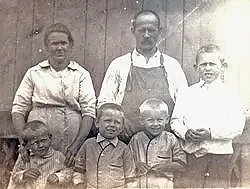
Chapter 4: A Year Apart – George in America, Rosa in Schönberg
Arnold’s Arrival Amidst Separation (Schönberg, Germany – November 1923)
The November wind howled against the weathered facade of Jakob and Monika Beck’s rented three-hundred-year-old home, a steadfast structure that had braved wars, famine, plagues, and the elements since 1605. The thick walls enveloped the comforting warmth radiating from a wood-burning stove, yet the atmosphere inside was charged with an unmistakable sense of anticipation. On this Wednesday evening in November, Rosa Schmieder moved with pained motions, knowing that their third child would soon be born, sadly without her husband George, who had arrived in America less than a week ago. Before he left, they had agreed on names for either a girl or a boy.
The room where the delivery would take place had a sturdy wooden bed and a straw mattress covered with fresh bedding. The cozy space, illuminated by the gentle glow of an oil lamp, was prepared for the birth. If the midwife deemed it beneficial, a birthing stool her mother, Monika, had previously used for her deliveries was nearby. Her sister, Magdalena, busied herself heating water over the wood-fired stove and brewing herbal tea—raspberry leaf—known to help ease contractions, while their sister, Theresia, attended to Hilda and Friedrich. Beside Rosa, Monika murmured words of comfort while gently wiping her brow with a damp cloth.
The midwife, Frau Maria, was a seasoned and resilient woman known for her calm and reassuring voice, and she played a vital role in Schönberg and surrounding villages. With decades of experience, she delivered countless healthy infants, becoming a trusted figure for many families. Despite her dedication and skill, she remains acutely aware of the perilous nature of childbirth, where complications can jeopardize the lives of both mothers and their newborns. This harsh reality touched the life of Rosa’s father, Jakob, who endured the tragic loss of his first wife, Franziska Himmelsbach, on April 22, 1893, at age forty-one. Her death stemmed from complications after childbirth.
With her seasoned insights, Frau Maria reassured Rosa, “You are strong. Let the waves of pain come; your body knows how to respond.”
Rosa gritted her teeth as another contraction seized her. The pain was unrelenting, but she endured it silently, knowing she had experienced this twice before. Frau Maria encouraged her to stand and walk, believing movement would help the baby descend. Theresia and Magdalena supported Rosa’s weight as she swayed through the contractions, her breaths coming in shallow gasps.
Hours drifted by in a haze of pain and resolve. When the moment arrived, Rosa returned to the bed, gripping the wooden frame as she pushed with all her strength. The midwife guided her, her hands firm yet gentle. “Just a little more, Rosa. Your baby is nearly here.”
With one last effort, a piercing cry filled the room. As Frau Maria lifted the newborn into the dim light, relief washed over Rosa. The slick baby squirmed in the midwife’s arms, announcing his arrival with a healthy wail.
“A boy,” Frau Maria declared, her voice filled with warmth and pride. “A strong boy.”
On Thursday, November 15th, 1923, tears filled Rosa’s eyes as she looked over the blankets covering her, gazing at her newborn son and proclaiming his name—“Arnold Joseph Schmieder!”
Frau Maria worked swiftly, cutting the umbilical cord with scissors and tying it off with a clean thread. She gently cleaned Arnold with warm water and wrapped him in soft cloths before placing him against Rosa’s chest. The tiny warmth of his body nestled against her, and Rosa felt a sense of peace for the first time in weeks.
A jubilant mood filled the house as Magdalena and Theresia continued their assistance while Monika brought a steaming cup of broth to Rosa’s lips, urging her to sip. “You need to regain your strength,” she said, smoothing Rosa’s damp hair from her forehead.
Grandpa Jakob gently led Hilda and Friedrich into the warmly lit room, where they were welcomed by the soft coos of their new baby brother, Arnold. Their eyes sparkled with wonder and excitement as they saw him, and their hearts swelled with love and joy for the tiny miracle nestled on their mother’s chest.
For the next few weeks, Rosa adhered to the tradition of the Wochenbett, the lying-in period during which she would rest and recover. Her sisters handled the household chores, giving her time to heal and bond with her newborn.
Though George’s absence weighed heavily on her heart, Rosa found solace in the warmth of her family and the tiny, perfect boy in her arms. In the quiet moments of the night, she whispered her hopes in prayer for the future—that one day, George would hold their son, and their family would be whole again.
A New Life Begins in New York
Meanwhile, George settled across the ocean at the home and farm of Wilhelm Pfaff, his wife Amelia, their children—Joseph, William, George, Carl, Bernard—and George’s Uncle Anton Schmieder on French Road in Bennington, New York.
The home buzzed with activity as George, filled with gratitude, contributed as much as he could on the farm and with the butchering. In the evenings, he would write letters to Rosa at the wooden kitchen table under the soft glow of a kerosene lamp, detailing his travels and progress while anxiously awaiting news from home, which took nearly three weeks to reach him.
Wilhelm Pfaff, a cheesemaker born in 1885, was our second cousin once removed. He emigrated from Reichenbach, Germany, to the United States on April 26, 1910, to start anew while temporarily leaving behind his wife, Amelia Weber, and son, Joseph. In November 1911, he returned to Germany to bring his wife, son, and Uncle Anton Schmieder to the United States, arriving on March 17, 1912.
Wilhelm’s mother, Luise Schmieder, born in 1859, is the daughter of our second great-grandparents, Franz Xaver Schmieder (1825-1904) and Franziska Giessler (1831-1892). This makes her our second great-aunt. Additionally, Luise is Anton Schmieder’s sister.
Anton left Germany to start anew under challenging circumstances. In 1904, his girlfriend, Fraulein Eisenmann, who lived with her family on the rented Weiker Farm near the Schmieder Homestead, became pregnant. Anton’s family opposed their marriage due to concerns about her father’s drinking habits, claiming he wouldn’t amount to anything if he married her. His son, Meinrad Eisenmann, was born on January 20, 1905.
Anton moved to Nordrach, where his sister and her husband were involved in farming and operating a sawmill. While in Nordrach, he met Fraulein Echle, who led to the birth of a set of twins.
Anton arrived in the United States in March 1912. Less than a year later, he returned to Germany, driven by his desire to marry Fraulein Eisenmann and bring her and their son, Meinrad, back to America. Unfortunately, she hesitated to leave her home, fearing the harrowing journey across the ocean. To complicate matters, Anton had conflicts with the German military over his failure to meet conscription requirements, which forced him to make hurried arrangements for his departure from Germany. He returned to New York on April 30, 1913, and never set foot in his homeland again. However, in 1927, his son Meinrad left Germany, settled in Buffalo, New York, and married Bertha Heitz in 1928.
Hard Labor on the Road Crews
Determined to reunite with his family, George worked with a road construction crew in Varysburg. The work was grueling, filled with long, physically demanding days. Each morning, he rose before dawn, his breath visible in the crisp air as he joined his fellow workers. The sound of pickaxes and the roar of heavy machinery formed the soundtrack of his days. Though the hours were long and the labor intense, he toiled under the open sky, clearing rocks, laying roadbeds, and hauling materials alongside other laborers. Yet, despite the exhaustion, he clung to his purpose—every dollar earned brought him closer to bringing Rosa and the children to America.
The loneliness and separation from his family weighed heavily on him, but Rosa’s letters offered comfort. The first letter brought joyful news—the birth of their third child, Arnold, on November 15, 1923, at the Beck farm in Schönberg, Germany. As he shared the good news with Wilhelm, Amelia, and Anton, his heart swelled with joy and gratitude that Rosa and baby Arnold were healthy, yet he felt the persistent ache of their absence.
Throughout the winter and spring, although hampered by the language barrier, George proved his worth as a hard-working construction crew member. However, fate intervened in 1924 when a crane boom struck him while on the job. The impact sent him crashing to the ground, blood spilling from a deep gash on his head. His coworkers rushed to his side, pressing cloths to his wound in an attempt to staunch the bleeding. Dizzy and weak, he was taken to a nearby doctor, who stitched the wound with rough efficiency. Though he healed, a jagged scar remained, a permanent reminder of his struggles and perseverance.
Finding Purpose on the Farm
The nearly catastrophic accident made him realize that roadwork was not his calling. He yearned to return to farming and eventually own his own farm. He soon met Louis Shreder, a 47-year-old of German descent. He was a father of fourteen children and a cattle dealer who owned a dairy farm on Gulf Road in Attica, which would eventually become the Attica Prison Farm.
Shreder offered George a job on the farm and the opportunity to rent the old farmhouse on the property. Although the house was aged and worn, it gave George a deep sense of belonging. He envisioned a fresh start in Attica’s serene hills and fields, bringing him closer to reuniting with his family. On Sunday mornings, after chores, he could walk to Mass at St. Vincent’s Church as he began to acclimate to his new surroundings. On Sunday afternoons, he would visit his Uncle Anton Schmieder, cousin Wilhelm Pfaff, and their family in Bennington, where they would share laughter, conversations, and glasses of cider.
As he lay on his rickety bed each evening after a long workday, he imagined Rosa and the children with him. He pictured Arnold, the son he had yet to meet, learning to walk on American soil, his tiny hands clutching his father’s as they explored the farm together. He envisioned Hilda and Friedrich sitting on his lap while he shared stories, joked, and laughed. The thought sustained him through the most challenging days, driving him forward with unwavering determination. No matter how long it took, he would bring them home.
Everyday Life in Schönberg
Back in Schoenberg, Rosa and the children spent their days immersed in the routines of daily farm life. The family celebrated modest Christmas and Easter traditions. On February 21, 1924, a new cousin was born, Frieda Beck—the daughter of Rosa’s brother, Franz, and his wife, Freida. The children grew accustomed to being with their grandparents, aunts, uncles, and cousins. While some of the siblings initially hesitated about their move due to the economic challenges they faced, they eventually came to enjoy having the children around.
By the summer of 1924, the German economy was starting to stabilize after the severe hyperinflation crisis of 1923, which devastated it and rendered the German Rentenmark virtually worthless. This hyperinflation peaked in November 1923, with prices doubling every few days when George emigrated to America. The stabilization was supported by the introduction of the Reichsmark in November 1923, a new currency designed to restore confidence and value in the economy. Furthermore, implementing the Dawes Plan in April 1924 was vital; it provided a framework for reparations payments and enabled Germany to restructure its debts, securing substantial loans from the United States and foreign investors. This financial support and domestic reforms were ushering in gradual economic recovery.
Friedrich loved to perch on the weathered wooden fence, a perfect vantage point to watch Grandpa Jakob feed the eager pigs. One sunny late afternoon, as he laughed at their antics, he lost his balance and tumbled headfirst into the muck of the pigpen with a startled cry. Jakob rushed to his side, heart racing as he pulled Friedrich out of the muddy chaos. Hearing his distress, Rosa and Grandma Monika rushed to his side to tend to his cut head and soiled clothes while Grandpa received a reprimand.
Hilda and her mischievous Cousin Herbert Beck frequently found joy in their playful antics on the sun-drenched hill behind the house. They would gleefully toss rounded stones down the gentle slope, eager to watch their animated dog leap after them with boundless enthusiasm. However, an errant stone would occasionally thud against the side of the house, causing Grandma Monika to peep through the kitchen window with a mix of exasperation and concern. Her calm voice would ring across the yard, reminding the children they risk breaking a window. Yet, her reprimands always hinted at affection, acknowledging the innocent joy they brought to the summer afternoons.
Friedrich developed a deep affection for his Grandma Monika at nearly two years old. With her gentle smile and kindness, he eagerly followed her around the house, his tiny footsteps echoing with delight. The warm summer days and the scent of sweet, blooming flowers became magical adventures as they spent time together in her large garden. They cherished moments filled with excitement as they spotted bees and bugs, and he learned new words from her as his vocabulary increased.
Hilda turned three years old in the summer of 1924. She cherished the moments when she could delicately hold and open the locket that hung around Rosa’s neck, her fingers tracing the intricate patterns on its surface. With a mix of longing and reverence, she gazed at the military photograph of her father inside, a poignant reminder of his absence.
Arnold’s easygoing disposition brought joy wherever he went. Since he started crawling, he has been the center of attention, with loving eyes constantly watching over him to ensure his safety. His laughter was contagious; several new teeth sparkled into view when he giggled at Hilda and Friedrich’s playful antics. This joyful sight only encouraged Hilda and Friedrich to be even sillier and laugh even harder, filling the room with joy.
Dreams of Reunion
Despite the hardships, George remained determined, but he wondered if he had made the right decision to leave Germany and his family. Each day, he battled the ruminating thoughts, yet he stayed resolute in his plans. He sent financial support to Rosa and continued saving for their journey to America. Every letter he received from Rosa bolstered his resolve. In the quiet moments before sleep, he promised to bring them to a better life in America.
Note: This account of the lives of our grandparents, George and Rosa Schmieder, from 1923 to 1924 contains factual events and personal perspectives. It reflects individual interpretations and subjective insights, recognizing the challenge of accurately capturing every detail of past events.
Frederick Schmieder