

Chapter 10: The Kreutter Farm Years on Hall’s Hill (1926–1928)
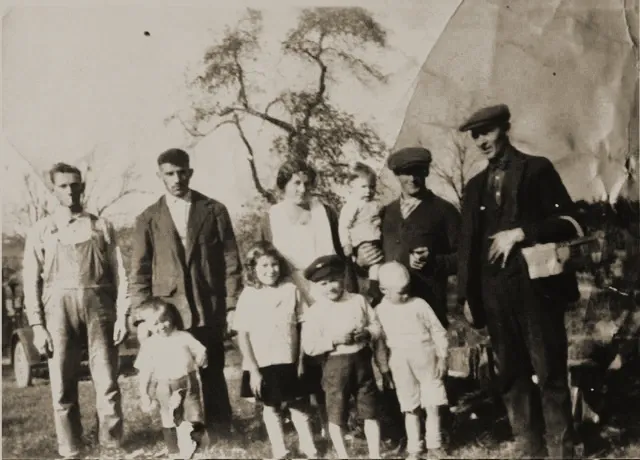
Schmieder Family Photograph — first row (left to right): George Jr., Hilda, Fred, and Arnold; second row (left to right): Benny Feist (hired hand), Albert Beck (Rosa’s brother), Rosa Schmieder, Paul, George Schmieder, and Max Rauscher (friend) – circa 1928
Standing at the Intersection of History and Future
This article is the first in a series exploring the lives of George and Rosa Schmieder during their time on the rented Kreutter Farm (1926–1928). It focuses on their reflections and memories from December 6 and 7, 1928, as they prepared to bid for the neighboring Phelps Farm at the auction. This moment would shape their future and be pivotal in their journey.
Winds of Hall’s Hill: A Legacy of Resilience
The weathered windows of the old farmhouse rattled against the relentless cold of the northwest wind that swept across Hall’s Hill on the night of December 6, 1928—three planting and harvest seasons had passed since George and Rosa Schmieder first rented the Kreutter Farm, located just southeast of the Village of Alexander.
With winter’s approach, they stuffed pages from the Sears and Roebuck catalog into the drafty window frames to keep the frigid air and swirling snow at bay. Yet somehow, the biting cold always found a way inside. The aging house, worn by the elements and creaking in the gusts, had endured storms, harsh winters, and the slow passage of time. It had borne witness to generations of struggle, just as George and Rosa now bore the weight of the challenges that had led them to this new land.
The house and land held memories of those who had lived there before. Jonathan Hall, whose family once tended this land, fought in the War of 1812. He and his descendants worked these fields long before George and Rosa arrived in search of a new home and a legacy that would endure. With each step he took on this land, George felt connected to the past, yet he could not help but wonder: would he also be able to carve out a future if he could purchase the neighboring farm on the south side of Hall’s Hill at auction?
Inside, the house buzzed with the voices of their six children—Hilda, seven; Fred, six; Arnold, five; little George, three; Paul, just one; and the youngest, Herbert, only three months old. The echo of their laughter provided a brief respite from the cold and the uncertainty looming over them. The energy of youth filled every corner of the house, even as the outside world grew colder and darker with each passing day.
Of Children, Land, and Longing
After the children’s laughter faded into the stillness of the night and the house grew quiet, George sat by the warmth of the wood stove, the soft flicker of the fire reflecting off the worn walls as he added more logs. With a glass of dandelion wine in hand, he shared his thoughts, hopes, and dreams for tomorrow’s auction of the Phelps Farm.
The auction offered more than an opportunity to purchase land; it was a pivotal moment for him to ensure a secure future for his family and to establish his own legacy. He didn’t want to squander this chance. With each passing moment, the fear gripping George’s chest intensified. What if he lost in the bidding? Would there be another opportunity to buy a farm, or would he remain a renter?
As the night deepened, George decided to walk to the barn. He took his lantern and checked on the livestock in the night’s solitude. The weight of his thoughts carried him along the familiar path to the barn. The land, shaped by the hands of those before him, seemed to whisper to him in the quiet night. He walked with his lantern, grounding himself in the present while the past lingered in his mind.
Preparing for the Auction — A Fight for the Future
Like the first pioneers who had come before him, carving a life from this unforgiving land, George felt the weight of their toil, exhaustion, sacrifices, and battle against nature and circumstance. He could almost hear their silent prayers, their dreams interwoven with the soil beneath his feet. And though the tools had changed, the fight was the same: to build something lasting, to wrestle a future from the land, and to keep demons of doubt at bay.
The lives and names of the early Alexander settlers have become mere cold letters carved into tombstones, weighed down by the relentless passage of time. Once brimming with hope and dreams, their memories slowly dissolve into the soil, leaving only whispers of what once was. George thought of them, their struggles now buried beneath the earth, and wondered—would his own dreams dissolve into the soil, too? Would the future he hoped to build be lost to time, forgotten as the winds whispered across Hall’s Hill?
The Hall Legacy: War, Loss, and the Land
In 1811, Jonathan Hall Jr. purchased the land that would become his homestead, just thirty-five years after the colonies declared their independence and one year before the War of 1812 with the British. He and his neighboring settlers—the Brainards, Marshes, Hawkins, and deMarys—faced numerous hardships in their daily struggle to carve out a life on the frontier.
Jonathan was not alone in this challenge. He was aided by his father, Dr. Jonathan Hall Sr., a physician and farmer, who had also come to the new town of Alexander and passed away shortly after his arrival in June of 1812.
He served in the Revolutionary War as a private and cornet in Captain John Couch’s company, which was part of Colonel Bradley’s Regiment in General Wadsworth’s Brigade. At the age of eighteen, he began his service on June 30, 1776.
As the war raged on, Jonathan Sr. faced unimaginable hardship. During the surrender of Fort Washington in November 1776, he was captured and imprisoned on one of the notorious British prison ships. Along with 18 other soldiers, Jonathan endured conditions so brutal that only he and one other soldier survived. These ships were overcrowded, filthy, and lacked food and water, with diseases such as smallpox and dysentery rampant among the prisoners. Many died under these horrific conditions.
Jonathan Sr.’s resilience and determination endured the trials despite the immense suffering. After the war, he returned home to become a respected physician, one of the first in his region to introduce smallpox inoculation—a revolutionary medical practice that would save countless lives and establish him as a key figure in his community.
Jonathan Sr.’s legacy lived on not only through his contributions as a physician but also through his children, particularly his son Jonathan Jr. Like his father, Jonathan Jr. took up arms during the War of 1812, serving in Captain Philo Farnham’s New York military unit. He faced his own set of challenges, including the death of his father and his first wife, Alimra, in 1821 at the young age of 21. He would later marry Ann Curtis, and together they had three children: Langford Hall, James C. Hall, and Celestia Hall.
While Jonathan Jr. carried forward the Hall family’s name and traditions, his son James C. Hall would become the most enigmatic figure of the family. James led a life of isolation and mystery that remains largely unexplained. Although he shared his family’s legacy, James’ retreat into solitude starkly contrasted with the resilience and legacy built by his forebears.
Carrying the Weight of the Past
James C. Hall, known locally as the “Alexander Hermit,” reportedly graduated from Harvard College, a distinguished institution of the time. After his father died in 1852, James remained on the family farm, living with his mother and sister. Twenty years later, following his mother’s death, he withdrew from society and chose a solitary existence on the 160-acre farm in Alexander.
James lived in isolation for decades, with the land around him overtaken by weeds and brambles. His house, barns, and sheds gradually deteriorated, abandoned to neglect. Inside the house, amid its unkempt and poor conditions, was a library of over 300 philosophical works, many of considerable value. Yet, despite his profound academic knowledge, James became disconnected from the world—his intellect trapped within the walls of his deteriorating home, his thoughts veiled in mystery.
What prompted James to retreat? Was it a loss too profound to recover from? A broken relationship that never healed? Or perhaps the endless toil of farm life, lived in solitude with no one to share the burden? His reasons for retreating remained locked away, never to be disclosed.
In March of 1903, at the age of 75, a rural mail carrier noticed that James’s house had been eerily quiet for some time. Concerned, the mail carrier entered the property and found James, emaciated and weak, seated in a chair. He had not eaten in days. Despite his protests, the authorities moved James to the Bethany Alms House, where they cared for him. However, James never spoke of the reasons for his self-imposed exile. He passed away several months later, leaving his life—and his choices—a mystery that would never be solved.
To Build What Others Left Behind: George’s Legacy Begins
As George stood in the quiet darkness of the barn, his lantern casting long shadows across the wooden beams, he couldn’t help but think of the men who had worked this land before him—men like Jonathan Hall and his descendants. Their lives, marked by sacrifice, struggle, and resilience, had been deeply imprinted on this soil.
As George faced an uncertain future, he felt their presence as a source of inspiration and a reminder of the weight of the land’s legacy. Through all their trials and triumphs, the early settlers wrestled with the same challenges George faced now: the fight to build a home for their families and to hold onto something tangible in the face of an often unforgiving world.
Jonathan Hall, Sr., fought in the Revolutionary War to secure the future of this country, not just for himself but for those who would follow in his footsteps. His legacy lived on in his son, Jonathan Jr., whose spirit was embedded in every tree, every field, and every rock that composed the land of Hall’s Hill. As George stood there, facing his own battles, he felt that same spirit reminding him of the purpose for which he now fought.
George, who faced the devastation of war and its aftermath as a German soldier in World War I, understood the toll that conflict could take. Tomorrow’s auction would allow him to claim more than just land; it was a chance to secure his freedom and future, something enduring amidst the wreckage of his past.
But the past also holds shadows. James C. Hall’s retreat into isolation, his voluntary disconnection from the world, was not merely a consequence of his struggles—it served as a warning. It’s a reminder that years of hard work without purpose could result in a slow, agonizing descent into despair, where even the land, which should provide sustenance and hope, may turn into a prison.
Perhaps, in some way, this auction represented George’s opportunity to write his own chapter in the ongoing story of Hall’s Hill and the men and women who settled these lands. They fought to build something enduring, more than just the physical land. They sought a future, even if it came at a significant personal cost. For George, purchasing the Phelps Farm, with all its hardships and possibilities, was more than just a plot of land; it was his chance to carry on the legacy of his own and those who came before him with perseverance, hope, and the will to endure.
Note: This family history account of George and Rosa’s years on the rented Kreutter Farm blends oral history, factual events, and personal perspectives. It reflects documented facts and individual interpretations while acknowledging the challenges of fully capturing past experiences.
Frederick Schmieder