
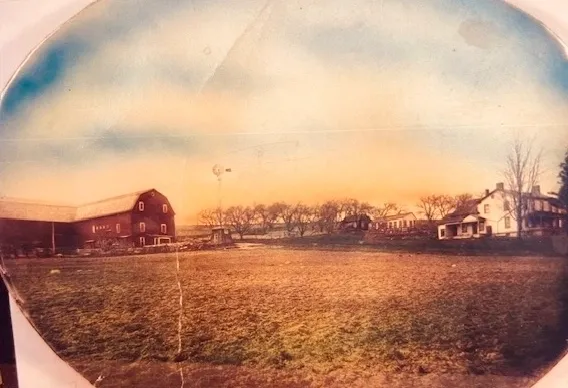
Chapter 14: When the Bidding Stopped — December 7, 1928
By grace and grit, this became more than land — it became the Schmieder Homestead.
This chapter is a continuation of reflections on December 7, 1928, as George and Rosa recount their experiences living on the rented Kreutter Farm, which later became the home of the Kautz Family, situated on Hall’s Hill in Alexander, New York. Through these narratives, we witness the hardships and triumphs they faced, marked by anticipation for the auction of the neighboring Phelps Farm on this pivotal day.
The Breakfast Table: A Morning Ritual
The iron hand pump creaked as cold well water flowed into the metal bucket. Rosa quickly filled the stove’s reservoir and then poured water into the coffee pot. She took a small bag of dry coffee beans from the pantry—purchased from Zwetsch’s General Store in Alexander—and placed a handful into the hopper of the hand-cranked grinder. With a few steady turns of the crank, the beans ground into a coarse powder, releasing their rich, inviting aroma.
The warmth from the stove mingled with the aroma of freshly brewed coffee, enveloping the kitchen in a comforting embrace. After George, Albert, and Benny completed their morning chores, they gathered around the table for breakfast. Hilda and Fred had already gone to school, leaving little Paul to squirm restlessly on George’s lap. His tiny legs kicked with excitement as he reached for bites of food, his innocent energy filling the room with life and joy. The morning bustle was alive with children laughing, clattering dishes, and the hum of family life.
Meanwhile, Albert playfully teased Arnold and George Jr., who were racing around the small kitchen, their laughter contributing to the lively morning. At the same time, baby Herbie had dozed off after his morning feeding.
Louis Shreder Arrives
Just as they were finishing their meal, a familiar figure arrived. Louis Schreder, a local businessman and family friend, sputtered up the driveway. When he stepped inside, his slight limp became noticeable, a reminder of a fall he had taken on Main Street in Attica three years earlier. The accident had fractured his leg, requiring treatment at St. Jerome’s Hospital in Batavia.
Louis held the auction flyer in his hands, the details clearly outlined—household goods and farm equipment would be auctioned first, followed by the sale of the house and farm. His eyes sparkled with anticipation as he shared the details, eager for the day ahead.
Rosa poured Louis a cup of coffee, steam rising as he stirred in milk and sugar. The soft clink of his spoon against the cup caught young Paul’s attention as he reached toward the sound.
For George, the day was a mix of promise and anxiety. He was determined to purchase the Phelps Farm, but a significant obstacle stood in his way—he had no collateral to secure a loan. Without it, his dream of owning the farm felt out of reach. Yet, Louis stepped in, agreeing to partner with George and help finance the purchase. Together, they hoped to secure a place that would provide the Schmieder family with the stability and foundation they had longed for.
Reminder of Hardships
In George’s mind, he envisioned himself, Rosa, and the children in a home of their own—something they hadn’t had since losing their farm-restaurant, known as the Schweizerhof, in Wagenhausen, Germany, during the summer of 1922. More than six long years had passed, each marked by hardship and uncertainty. Would today finally be the day they found a break? The chance to lay down roots and build a future?
However, a quiet fear lingered in George’s mind—the overwhelming burden of responsibility. Even if his bid was successful, could he genuinely make the farm productive? Could he repay Louis? The doubts gnawed at him, but he quickly pushed them away. He understood that failure wasn’t an option. The road ahead would be challenging, requiring all of his strength and effort to transform what seemed impossible into reality.
Walk to the Auction
They gathered their coats and walked across the field to the neighboring Phelps Farm, passing through the remnants of an old orchard. The crisp air carried an unmistakable weight of expectation as they approached the property. A buzz of activity surrounded the homestead, with Model T cars, trucks, horses, and wagons filling the yard. The sounds of excited chatter and the creaking of vehicles echoed across the farm, adding to the sense of anticipation in the morning.
George took a deep drag from his hand-rolled cigarette, the smoke swirling around him as he and Louis registered for the auction. They informed the organizers of their partnership and prepared to bid together. As they walked through the house and barn, their minds raced with possibilities despite the clear signs of deterioration and neglect. The farm’s condition was best summed up by Mr. Waite, a local farmer, who quipped, “If a crow flies over that farm, he’d better pack a lunch.”
George glanced around at the other farmers, their expressions a mix of eagerness and caution, as they wondered who would be bidding against them. The air was thick with nervous tension when the auctioneer’s voice suddenly rang out above the noise, signaling the start of the bidding. The auction began with household items, and within moments, the auctioneer’s cadence quickened as items were sold off one by one.
History of the Property
As George and Louis waited, it was hard to imagine the generations that had lived on this land, a land that had once been a pristine forest, transformed by the efforts of the Marsh family over 115 years ago. Wolcott Marsh first purchased the property in two separate parcels: the first in 1813 for $475.00 and the second in 1814 for $328.84.
Wolcott’s family originated from Connecticut, but he was born in Paris, Herkimer County, New York, in 1788. His name, Wolcott, came from his grandmother, Jerusha Wolcott, who married Samuel Treat. They had a daughter, also named Jerusha, who married Daniel Marsh and named their son Wolcott. Wolcott married Lucy Hart, born in 1790, and they wed in 1811. At that time, they were young newlyweds, establishing a life in the wilderness of Alexander, New York, a place far from the comforts of their previous life.
The Marsh family first transformed this dense wilderness by undertaking the challenging task of clearing the land. They utilized teams of oxen to transport timber to a sawmill along Tonawanda Creek, located near the center of the newly established town of Alexander, New York. This sawmill was constructed by Alexander Rea, a surveyor for the Holland Land Office, who purchased 17½ acres of land in 1802. The town, still in its early stages, was named after him.
The first cabin and outbuildings were likely built near a small stream that flowed south of the property, close to a trail known as the Alleghany. To the south of the Marsh property was Colonel Sebe Brainard, a Revolutionary War veteran who acquired 225 acres on January 16, 1813, for $715. Born in Connecticut on April 14, 1763, Sebe married Anna Pardee in 1786, and they had at least five children: Pardee, Norman, Lucy, Harris, and Anna.
This period was marked by the ongoing War of 1812, with battles occurring on the nearby Lakes Erie and Ontario. A controversy arose when Colonel Sebe Brainard faced accusations of aiding an escaped British prisoner of war named Burchford. On September 15, 1813, he publicly responded to these allegations in The Batavia Republican Advocate, denying any involvement in assisting the prisoner.
Life for Early Pioneers: Trials and Triumphs
Wolcott’s diligent work as a farmer resulted in the success that allowed him to build a new home for his family, likely around the 1830s. The basement, carefully excavated by hand, was constructed from fieldstones gathered directly from the land—stones left behind by glaciers about 20,000 years ago. This two-story Federal-style home was built on a small hill, set back from the road and facing east. It featured two chimneys and five fireplaces—one in the basement, two on the first floor, and two on the second floor—providing warmth and comfort during the harsh winters.
The original kitchen, now the dining room, featured a fireplace for cooking. The fireplace in the basement functioned as a “summer kitchen” during the warmer months. This arrangement enabled Lucy to prepare meals away from the main house’s heat, creating a cooler and more comfortable living space throughout the summer.
The home’s walls were finished with lathe and plaster—a blend of lime, sand, and water, with added horse or cattle hair to reduce cracking. The floors, made from local pine, were cut in widths ranging from 6 to 12 inches, ensuring durability and warmth in the family’s new home.
However, the pioneering life was filled with challenges, and tragedy struck unexpectedly. Wolcott and Lucy faced the heartbreaking loss of their 10-year-old son, Wolcott, on January 10, 1835. Their pain deepened with the passing of their daughter, Elmina, who died at the age of 25 in 1837. These profound losses weighed heavily on the family; yet, in spite of their sorrow, they persevered, fueled by resilience, determination, and an unwavering commitment to their future.
The Marsh family called this place home for many years, yet their lives were marked by hard work and loss. On May 8, 1849, tragedy struck when Wolcott Marsh passed away at the age of 60. His death cast a long shadow over the family, and he was laid to rest at Alexander Cemetery. His passing signaled the start of a new chapter, which ultimately led to the sale of the farm. Shortly after, Lucy was left to navigate life without her husband. She, too, passed away on May 15, 1875, bringing a quiet end to the era of grief that had so deeply affected the family.
As the years passed, the house itself evolved. A front porch was added, creating a welcoming entrance for those who came to the door. At the rear, a large kitchen, pantry, and washroom were built to meet the growing needs of future occupants. A woodshed was constructed next to the washroom, and a porch was added to the south side of the kitchen, providing a place to relax in the warmth of the summer sun.
The house, much like the land, changed with each new family that passed through its doors, a testament to the passage of time and the resilience of those who called it home.
Phelps’ Family Legacy
After Wolcott’s death, the farm was sold to N.B. Smith. However, a pivotal new chapter began around 1870 when Austin Phelps, together with his second wife, Rosina Olney, purchased the property. Austin was a well-respected member of the community, actively involved with both the Free Will Baptist Church in Attica and the Methodist Church in Alexander. His faith served as the cornerstone of his life, evident in his daily actions and the respect he garnered from those around him.
On the evening of Sunday, January 9, 1887, Austin sat before his congregation at the Methodist Church, leading a Bible study. After sharing his testimony, he calmly leaned back to listen to others. Moments later, his head drooped, and he passed away instantly, leaving the congregation in stunned silence. The suddenness of his death sent shockwaves through the community, and once again, the dynamics of the farm would shift.
The 64-year-old Phelps left behind a wife, four sons, and two daughters. His lifeless body was brought back to the family home, where his grieving family prepared his body and laid him out in the parlor for mourners to pay their respects. A black cloth was hung over the front door, signaling the family’s sorrow. He was laid to rest in Alexander Cemetery.
Rosina, his wife, eventually remarried, but her life ended in 1912. Today’s auction is being held for the descendants of Austin and Rosina Phelps, marking the conclusion of their land legacy.
The Auction
As George and Louis stood in the crowd at the auction, the air felt heavy with the weight of history. The farm, weathered by decades of change, had witnessed generations of triumphs, struggles, and losses—from the Marsh family’s early hardships to the more recent sorrows of the Phelps family.
The echoes of those who had worked the land resonated through its weathered walls, serving as a silent reminder of the farm’s long and storied past. Now, it was George’s turn to step into that legacy. He was about to confront the challenge of securing a future for his family—of carving out his place in the land’s history, just as those before him had done.
As the last household goods and farm equipment were sold, George’s heart began to race. The moment of truth was drawing near, and the weight of anticipation pressed down on him. The auctioneer’s voice rose above the low hum of the crowd, detailing the characteristics of the land—the acreage, barns, and house. George felt a surge of excitement mixed with anxiety as he braced himself for the bidding to start.
When the auctioneer paused, George offered a silent prayer, his thoughts momentarily drifting to his family’s journey. He glanced at Louis, his partner in this endeavor, and saw his eyes reflecting the shared weight of their hopes and fears. This was it—the moment that could change everything.
Note: This family history account of George and Rosa’s years on the rented Kreutter Farm weaves together oral history, factual events, and personal perspectives. It presents documented facts and individual interpretations, while acknowledging the challenges in fully capturing past experiences.
Frederick Schmieder