

Chapter 18: From the Schweizerhof to Alexander
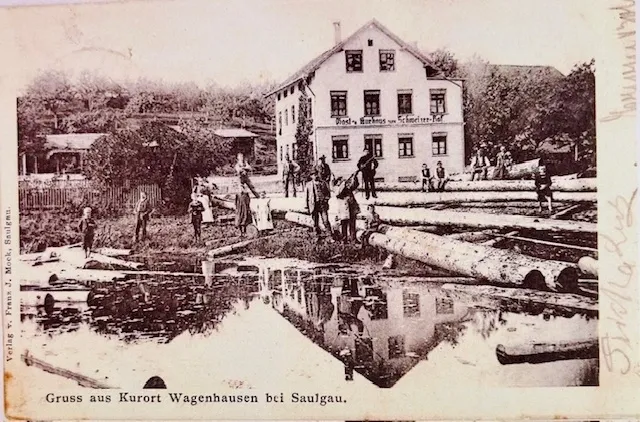
Der Schweizerhof, Wagenhausen, Germany (circa 1905) — The historic farm-inn later owned and operated by George and Rosa Schmieder from 1920 to 1922.
George and Rosa Schmieder purchased the Schweizerhof Guesthouse in late 1920. Nestled beside the Wagenhauser Weiher and under the shadow of historic Kloster Sießen, the Schweizerhof became their first undertaking as newlyweds, a place where they welcomed farmers, travelers, and neighbors. Yet their time there was brief—by the summer of 1922, Germany’s collapsing economy forced them to leave. Although the venture ended in hardship, the memory of the Schweizerhof shaped their resilience and resolve, which they carried forward as they began again on the farm they purchased in Alexander, New York, in 1928.
First Winter on the Schmieder Farm
The winter of 1928–1929 pressed steadily on Alexander, New York. Just before Christmas, on December 21, six inches of snow covered the fields, and bitter northwest winds piled drifts against the kitchen window. Although that season brought less snow than many winters, the cold often cut to the bone.
Inside, George and Rosa worked hard to create a lasting home for their six children on the farm they had recently bought, putting their strength into the stability they hoped to achieve. In the years ahead, two more children—Irma and Shirley—would join the family. But already, the farmhouse resonated with the noise of Hilda, Fred, Arnold, George, Paul, and little Herbert. Their voices, footsteps, and quarrels rose against the winter’s chill, filling the house with warmth and a restless, hopeful energy.
The House That Remembered
The house carried history in its very bones. Weathered by time, a Federal-style home of the 19th century, it still held the imprint of those who had come before—the Marsh and Phelps families, their joys and griefs etched into its grain as though the timber itself remembered. Pine floorboards groaned like voices from the past; window sashes shivered under the wind’s breath; clapboards, worn and scarred, bore the weight of storms. Yet within those rooms, life pressed forward—children’s footsteps chasing across the creaking boards, the soft murmur of bedtime prayers, the clatter of Rosa’s cooking, and the glow of the stove at day’s end.
Rosa met the cold with quiet ingenuity, pressing newspapers into the cracks of window frames and hanging heavy curtains to blunt the drafts. The stove was steadily fed with wood, though warmth often slipped away faster than it could be kept in. Meanwhile, George’s thoughts turned to the barn, where loose boards, sagging shingles, and broken stalls demanded repair before spring planting. The work felt endless, but it was their work—each nail hammered, each chore completed, an act of faith in the future they were building in this new land.
January 14, 1929
On the Monday morning of January 14, 1929—the coldest day of the year—the wind howled across the open fields of the Schmieder farm. The zero-degree air formed a delicate lace of frost on the farmhouse windows, blurring the outside world with frozen patterns.
In the kitchen, the lingering aroma of fried eggs and oatmeal mingled with the crackle of the stove. Rosa drew her children close, the younger ones pressing against her skirts as she helped Hilda and Fred into their winter coats. With steady hands, she fastened each button, pulled wool hats snug over their ears, and slid mittens onto their small fingers, already stiff from the morning chill. As she handed them their lunch pails, a quiet ache stirred within her—she admired their resilience, yet worried about how they would endure the bitter cold on their walk to school.
Rosa scraped frost from the windowpane, her breath fogging up the cold glass. Snowflakes briefly clung to the sill before turning into droplets. Next to her, the younger children pressed close, their small noses and fingertips leaving foggy marks on the glass as they watched Hilda and Fred walk down the icy driveway.
Beyond the kitchen walls, George faced his own battle with the cold. With his brother-in-law, Albert Beck, and the hired hand, Benny Feist, he trudged the frozen path to the barn. Even in such weather, the cows still needed milking, the horses still needed feeding, and the stalls still needed cleaning. Overnight, the troughs had frozen over, cutting off the animals’ water. Albert hammered hard against the ice, each strike splintering the surface, the sound cracking through the frigid air. The cows shifted and bellowed, their warm breath fogging the air, while the horses stamped impatiently, snorts rising in thick clouds.
Then the rhythm of chores began. George forked hay into the mangers, while Benny scraped manure into heaps and spread fresh straw for bedding, the cycle of labor moving with practiced precision. The men set their milking stools beside the cows, drawing comfort from the animals’ warmth as the pulsing streams of milk struck the pails with a steady metallic ring.
The barn echoed with the cadence of chores, the kitchen with Rosa’s steady care—two rhythms woven together, a daily litany that carried their family through the winter’s cold.
A Memory of Another January 14
As Rosa returned to her morning work, her thoughts drifted back to another January 14th. On that Friday in 1921, she and George had stood in the District Council office in Saulgau, receiving the certificate to open the Schweizerhof Gastwirtschaft, granted after an assessment of 160 marks.
It was their first venture, their first hope for a life built together. The winter air bit her cheeks, and snow hushed the fields and the frozen pond as they returned to the stillness of the Schweizerhof. From across the hills, the bells of Kloster Sießen rang the midday Angelus—solemn and unbroken—as if sending a quiet benediction over their fragile beginning.
A Monastery That Endured
The monastery’s presence was always close to life at the Schweizerhof. Founded in the 13th century, Kloster Sießen was home to Augustinian Canonesses Regular—women living under the Rule of St. Augustine—who blended prayer, community, and land stewardship. For centuries, the sisters quietly shaped the region—tending forests and fields, digging ponds like the Wagenhauser Weiher that shimmered just beyond the Schweizerhof, stocking fish for fasting days, and managing the waters of the Wagenhauser Bach.
Their work nourished both body and soul, and their daily prayer provided the region with a steady rhythm of faith. Though wars had ravaged the land and secular decrees had stripped away much of their property, the sisters endured. To anyone living in their shadow—including George and Rosa—the monastery’s resilience stood as a living testament that faith could survive even the harshest storms.
Life at the Schweizerhof
Beside the Wagenhauser Weiher, villagers once came to fish and bathe, and by 1821, the area was already recognized as a retreat near the monastery ponds. In 1842, glazier Gallus Häberle bought a building there from Thomas Störk, using it as both a workshop and an inn. Six years later, in 1848, he demolished the original structure and constructed a larger guesthouse, which he named the Schweizerhof.
When George bought the property, the authorities allowed him to operate four guest rooms, two business rooms, a garden hall, and a nearby garden. For him and Rosa, it was more than just a license—it was their first venture together, a new beginning filled with hope. Farmers with mud on their boots, tired travelers moving between villages, neighbors gathering for feast days, and visitors from the monastery looking for food and rest all passed through its doors. Rosa added warmth to the rooms with fresh bread from the oven, stews simmering on the hearth, and beer from the tap, while George cared for the animals and worked in the fields. Together, they seamlessly blended work and hospitality into their daily lives.
It was here, on July 31, 1921, that their first child, Hilda Marie, was born. Soon after, she was baptized at their local church, St. Gallus, by Fr. Geiger— a moment that connected their fragile beginning to both family and faith. Hilda would be the first of eight children, her birth marking the start of a family story that would extend well beyond the walls of the inn.
Yet even as life blossomed within its rooms, the Schweizerhof’s promise proved short-lived. After only twenty months, George and Rosa were forced to give it up, swept under by Germany’s postwar crisis—hyperinflation, crushing reparations, and the collapse of the economy. The inn passed into other hands and, in time, became the Seestüble, which still welcomes guests by the pond.
But for George and Rosa, the Schweizerhof was never lost. It remained their true beginning—a place blessed by the sound of monastery bells, rooted in a landscape shaped by centuries of prayer, and woven into a story far larger than their own. And soon, that beginning would cross the Atlantic with them, carried like a hidden seed into the soil of a new land.
Those months at the Schweizerhof stayed with Rosa, not as mere dates and places, but as a fragile thread in the fabric of their first venture—the scent of bread, the murmur of guests, the glow of the hearthlight, and the distant echo of the monastery prayer drifting across the fields. Yet woven into that thread was the ache of parting, of a promise too brief. Even years later, on winter mornings in New York, the memory returned with sharp clarity, as if past and present pressed against each other through the glass of a frosted window.
Past and Present Converge
Back then, she had no children to button into coats, only the quiet stirrings of new life inside her. George’s hand was warm in hers, and together they dreamed of rooms filled with patrons, orchards in bloom, and tables spread, of a family not yet seen but deeply longed for.
Now, as she watched Hilda and Fred step into the frigid cold of Western New York on that January morning in 1929, Rosa felt past and present converge. She heard again the monastery’s steady rhythm, remembered the brief promise and loss of the Schweizerhof, and gathered the courage to begin anew in a foreign land. The same truth bound both the monastery and her own life—that roots planted in faith and labor endure, carrying their strength forward to weave a family’s future into the soil of the new Schmieder Farm.
Note: This account of George and Rosa Schmieder’s lives combines oral history, documented events, and thoughtful interpretation. It reflects both historical facts and family memories, while recognizing the challenges of fully capturing lived experiences over time.
Frederick Schmieder