
Chapter 20 – Ordinary Lives, Extraordinary Labor
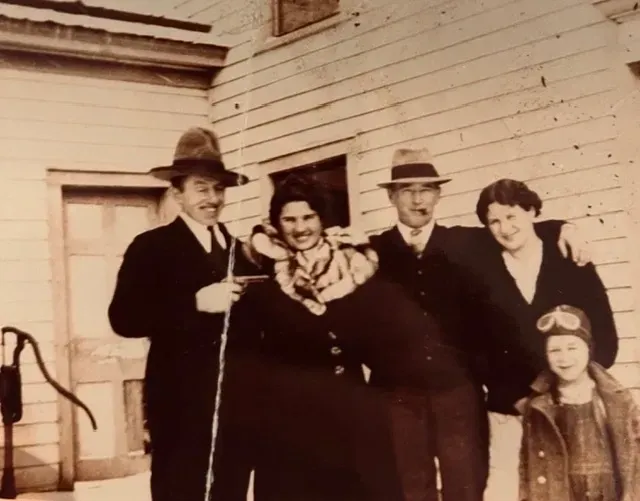
Henry Vollmer (Hired man), Magdalena Beck, George Schmieder, and Rosa Beck-Schmieder. The child in front is George, Jr.
Hope at the Turn of the Year – 1930
George and Rosa stepped into 1930 with family gathered close, the New Year’s table set with hard cider, sauerkraut, pork, and a homemade pretzel—simple comforts carrying a slender thread of hope. Outside, unseasonable warmth rose to fifty-five degrees, meltwater trickling down the sloped driveway. Inside, Rosa moved more slowly; her back ached—her seventh child in nine years growing within her—and yet the work did not let up.
Hilda played with Herbie and Paul while Magdalena tended the simmering pots on the big black cookstove. The smell of fresh bread drifted from the warming oven. Rosa sat briefly at the table to ease her back and peeled potatoes from the bushels stored in the cellar; Fred and Arnold had just carried up a wicker basket full. Beside her, Theresia worked a worn paring knife, potato skins falling in neat curls—scraps for the pigs. Rosa was grateful for her sisters’ steady hands—each small act a quiet mercy.
In the front room, George, Albert, Gus, and the hired men—Benny and DeForest (“Krissy”)—spoke in low tones about the year ahead while the older boys played outside. George leaned forward, the ledger’s sums flickering in his mind. Just a year ago, dairymen across western New York were getting nearly $3 per hundredweight; now each milk check is a little less.
“They say Buffalo’s industry is cutting shifts,” Gus said, lifting his glass of cider. “Men sent home till further notice.”
No one responded. The warmth of the New Year couldn’t dispel the unease left by the October 1929 stock market crash. Still, the family welcomed the new decade together—talking about the future and remembering family and friends back in the old country. Gus lightened the mood with his accordion; German folk songs echoed through the house like the ones Rosa and George had danced to back home at Poche. Cider glasses clinked as the children laughed and danced across the pine floor.
The Year Ahead
That night, unease settled over George like a weight he couldn’t shake. Two years earlier, he had taken on the Phelps farm for $4,900 with Louis Schreder as a partner, the debt secured by a private mortgage from attorney Alice Day Gardner of Day & Day. She lived in the Brookville section of Alexander with her husband, Fred, at Locust Level Farm on Creek Road. Each month, the mortgage payment went to her, another sum George felt in his chest before he ever set it down in the ledger. And with each passing year came the steady knock of obligations: visits from Frederick G. Brown, the town tax collector, and the school-tax bill that always found its way to their door in September.
Under the lamplight, George bent over the ledger: mortgage, seed, feed, wages, repairs, the barn addition, roof patches, doctor bills—and another child soon to come. The figures awakened an old ache: the bitter summer of 1922, when the Schweizerhof slipped from their hands and Rosa, already pregnant with Fred, faced the loss of their home.
Driven by circumstance and necessity, yet held together by a thin thread of hope, George left for America in November 1923. Rosa—traveling with three small children and bearing the weight of all they had left behind—followed in December 1924. Hearing the faint scrape of George’s pencil after the children slept, she folded her hands and prayed—prayed that this land, unlike the last, would stand steady beneath them.
They had crossed an ocean to begin again—first on Gulf Road in Attica, then up on Hall’s Hill in Alexander, and finally with the purchase of the Phelps place. George Jr., Paul, and Herbert were born here; Erma Rosa would soon arrive, a child entering a world already tightening at the edges. Rosa would be thirty-six in August, George thirty-three on January 19—yet together they had already endured war, hyperinflation, flight, and the loss of their homeland. Now they faced a new test: to hold the land that had come to embody their hope.
Turning Work into Hope
By late February, the maples in the west woods stirred with the day’s warmth. George bought boiling pans, spiles, and buckets from Frederick W. Empt & Son in Varysburg. They raised a small sugar shanty—two walls, a lean-to roof, rough-sawn floor. Hammers rang against the cold air; wind snapped the sheet metal. Albert and Krissy struggled to carry it until George took it himself, shoulders squared against the gusts.
When the lean-to was finished, George notched the maples with a hatchet and bored the first holes with a hand auger. Albert followed with spiles, Benny and Krissy hung the tin buckets—nearly a hundred trees by evening chores. The weather was ideal—days around fifty, nights just below freezing. Their Belgian team, Lonnie and Topsy, hauled bobsled and tank through the woods, chains jingling as thawing ruts swallowed their hooves.
By Ash Wednesday, March 5, the sugar shanty breathed woodsmoke and steam. A faint ashen cross still marked George’s forehead as he worked into the night, the kerosene lantern glowing through the swirl of vapor rising above the boiling pans. That first season, they made about twenty-five gallons of syrup, and Rosa stretched every dollar earned from that winter’s labor.
The Quiet Miracle of Spring
When the last syrup was canned and the buckets scrubbed and stacked, George and the men turned to the fields. They sharpened plowshares, greased bearings, and readied the grain drill for oats and the corn and potato planters.
Then they began pitching winter’s six-foot-high manure piles in the pasture, fifty feet south of the barn, onto a bobsled twelve feet long and four feet wide. Fork tines dug deep as the men heaved and lifted, boots slipping in the mud. In the distance, the woods shimmered faintly with swelling buds.
Molly and Duke leaned into the traces as the bobsled creaked toward the waiting field, sprigs of green just starting to peek through. The sharp, earthy smell of manure drifted across the ground as they forked it off in heavy clumps, and from the treeline crows cawed and descended, their harsh cries scattering through the stillness.
By early April, the horses settled into their stride, harnesses creaking as the plow opened long dark furrows. For several days, the weather held: sun in the fifties, ground warming, spring’s promise tangible in the air.
Easter Sunday
Easter Sunday, April 20, dawned mild. George took the older children to Mass at St. Vincent’s and prayed for Rosa, full-term, as they joined the parish in celebrating Christ’s resurrection. They returned home to a simple meal—a cured, smoked ham from their own pig, butchered in the fall and dressed for Easter with a few cloves, its salty flavor scenting the warm kitchen—earlier laughter drifted from the hayloft where the children hunted their baskets.
That evening, chores went on as they always did—animals fed, cows milked, cans filled. Rosa rested a hand on her belly, awaiting the gift of new life, and listened to the muffled voices of the children upstairs, readying for bed. Outside, the air cooled, and shadows fell across the fields, but inside the house, the warmth held.
For that night, the house rested in the quiet hope of the resurrection—new life rising in faith and in the fields, though economic storms loomed ahead. The land was ready, the fields waiting, and Rosa felt herself close to bringing new life into the world.
“The most extraordinary thing in the world is an ordinary man, and an ordinary woman, and their ordinary children.”
— G.K. Chesterton
Note: This account of George and Rosa Schmieder’s lives weaves together oral history, documented events, and thoughtful interpretation. It reflects both historical fact and family memory, while acknowledging the limits of fully capturing lived experience across time.