

Chapter 24 — Alexander, 1931 — A Dedication, as the Depression Takes Hold
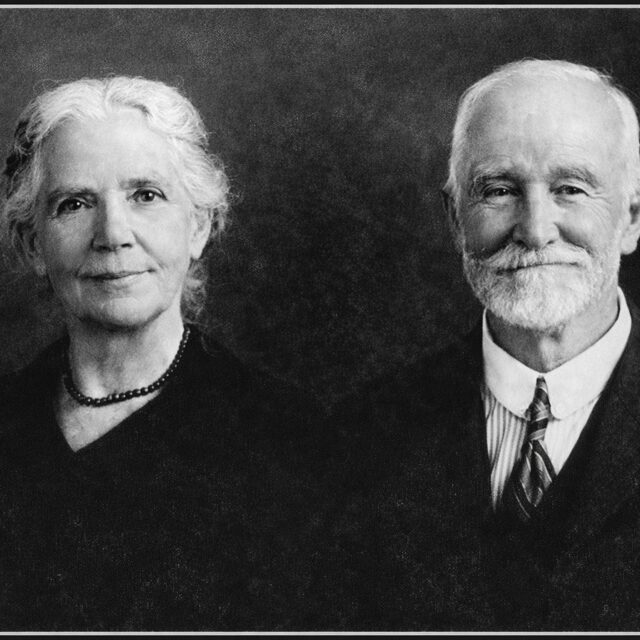
Margaret Elizabeth Adkins-Curtiss (1839-1922) Roswell Carter Curtiss (1833-1934)
“Let us not grow weary in doing good, for in due season we shall reap, if we do not lose heart.”— Galatians 6:9
Green Fields, Thinner Margins
By early summer of 1931, the fields on the Schmieder farm were green again. Cows meandered through pasture grass, corn and potatoes stood in neat rows, and the herd kept its dependable milking rhythm—morning and evening, day after day. From the road, little seemed changed. Work was still done. Milk cans still waited by the barn. Wagons and trucks still traced their way along Allegheny (later Alexander) Road. Only the silences between these familiar motions had grown a little longer and a little heavier than before.
Yet beneath that surface, the ground was shifting.
When the Convoys Came
The extra income George earned hauling gravel for the construction of the Attica Correctional Facility ended when the prison was finished. In June, the massive concrete-and-brick structure formally opened, and inmates were transferred in from other New York state prisons. The road that once hauled milk and hay now carried guarded convoys—a sight foreign to the children, who paused in their chores when the engines rumbled by.
Trucks and buses passed the farm, spewing exhaust and raising dust, carrying men toward Attica. Some sat low and still behind the barred glass windows, while others stared out at the passing fields, where men worked in the open air—at something they could see, but no longer reach. Their escorts were armed, and the road led them on to serve out their sentences behind the secure gray walls of Attica State Prison.
The Price of Milk
On the farm, milk remained the backbone of survival—but it no longer paid as it once had. In Genesee County, a quart of milk might sell for twelve cents at market, yet the farm’s share could be closer to five by the time it left the barn and moved through hauling, handling, and distribution. Whether the cans traveled toward Batavia or Buffalo, the route was steady; the returns were not. Checks came back thinner, sometimes barely enough to cover feed and supplies. Families had less to spend, and there was more milk than the market could absorb, so even as the cans kept moving, the price kept falling.
When Hard Work Was No Longer Enough
In 1930, there was still hope that patience and effort would carry people through. Fields were planted, accounts were closely watched, and neighbors believed the downturn might pass as others had before. But as 1931 unfolded, it became undeniable that hard work alone would not restore what had been lost. Credit tightened. Prices slipped further. What had begun as uncertainty settled into something heavier and more enduring.
And yet, Alexander endured.
Old Home Day
On August 1, 1931, the village gathered for Old Home Day, not merely for celebration, but for remembrance—an act of quiet defiance against the feeling that the present was unraveling. Nearly a thousand people came together as a boulder bearing a bronze plaque was dedicated in honor of Alexander and Nancy Jones Rae, who had purchased seventeen acres here in 1804, cleared land near the Tonawanda Creek, raised a log cabin, and built a sawmill at what would become the heart of the village that carried his name.
A Homestead Begun in Hope
Their story, like so many written into this soil, was not only one of beginnings but also of suffering and loss. Within five years, the frontier had claimed Nancy and two of their three young children. The logs of the drafty cabin kept vigil over Alexander’s grief as the fire in the hearth burned to embers and the room slipped back into cold and silence. In 1814, he, too, passed away—leaving behind one son, George Jones Rae; a homestead begun in hope and sealed in sorrow; and a town that would carry his name: Alexander.
Nearly a Century’s Witness
The driving force behind the memorial to Alexander Rae and the early settlers was Roswell Curtiss, ninety-eight years old, a native son of Alexander and one of its most respected citizens. That day, he stood among the crowd in the August heat as the band played and voices carried across the hills and along the Tonawanda Valley, dust rising underfoot and straw hats shifting in the sun, his own long life quietly folded into the larger story being told.
Born in 1833 in Warren, Connecticut, he had come west as a small boy. His family traveled nine days by horse-drawn barge along the Erie Canal to Brockport, and from there his father walked thirty-four miles to Darien to borrow a team and wagon to carry the family and their furnishings on to new land two miles west of the village of Alexander.
For months, Curtiss had urged his children and neighbors to act, reminding them that their community had been built on the hardships of those who came before—and that those hardships were no less real than their own.
A Day for the Town
Earl Kidder and M. Mortimer Rich chaired the committee, and citizens from the Independent Aid Society, the Dairyman’s League, and across the town joined in, until the work of many hands became, at last, a single stone set in place. The Orpheus Choir of Rochester—thirty male voices—sang several selections between the speakers, including Chief Nicodemus Bailey of the Tonawanda Reservation, their voices rising and settling over the crowd.
Lewis Marsh led the community singing, and the Alexander Band played through the noon hour as six hundred people were served dinner at the Grange Hall. The name Marsh was familiar in the valley. Wolcott Marsh—the early landowner who purchased original parcels in 1813 and 1814 that would later become the Schmieder farm—had cleared the land, built a cabin, and later raised the federal-style house and gambrel-roofed barn. The house the Schmieders lived in, and the barn they worked in, still stood as quiet proof that endurance was woven into the land itself.
The Work We Take Up
Then a fifteen-year-old boy, Norman Dana Moulton—descended from Captain Royal Moulton, one of the village’s earliest settlers and a Revolutionary War soldier—stepped forward to deliver a brief dedication address. He stood atop the hill above the old cobblestone school and the Grange Hall, beside the dedication boulder and its bronze plaque, the grass firm under his shoes and a gentle breeze stirring the leaves of a maple tree, as he looked down upon the crowd that had settled into a listening hush.
His voice carried farther than his years. He reminded those gathered of “the abiding and permanent worth of such traits of character as sacrifice, devotion, industry, and love,” calling them “paramount and worthy of families and the smaller circles of community.” Borrowing Lincoln’s words, he said they had come not “so much to dedicate this piece of granite as ourselves,” knowing that “when a man dedicates himself unreservedly to a cause greater than himself, he becomes a power for that cause.”
He did not speak long, but he spoke with a steadiness that held the hill quiet. He spoke, too, of inheritance—not of land alone, but of duty. “We would give increased momentum today to the forces that have made here, and everywhere, for true progress in all lives,” he said. “This mission is our godly inheritance: to receive it, to add to it, and to pass it on. This is the work to which we give ourselves anew.”
A Rare Sound Across the Fields
When he finished, the crowd stood and sang My Country, ’Tis of Thee, their voices lifting over fields that had known first clearings and long endurance, carrying as far as the Schmieder farm. Some sang with clear voices, others more quietly, and some with tears they did not bother to hide, but the song held them together.
For the Schmieders, such music was a rarity—beyond the hymns and organ at St. Vincent de Paul Church, and the occasional singing and accordion from August Kautz and others at family gatherings, there was little else. They had no radio to bring songs into the house. But as the sound reached them across the fields, they paused in their work and listened, and for a moment the homestead grew still.
The older children—Hilda, Fred, and Arnold—stood there and listened with a kind of ache, knowing how near it was and yet how far, wishing to be there among the crowd—but there was hay to bring in, and George and Rosa couldn’t set the work aside.
Hay to Bring In
And so, that Saturday, August 1, 1931, the family went on loading cured hay, the sun beating down on their necks, chaff stuck to sweat, and dust billowing with each forkful. Iron rims groaned on their hubs, wood creaked as the horses pulled, and the sweet, dry smell of hay filled the air, while, over it all, the band and the voices drifted in from the village like something almost—but not quite—within reach. The work held them in place even as the music lifted their spirits.
What the Stone Could Not Change
Although the ceremony honored the village’s first settlers, it did not change milk prices, restore lost income, or reopen credit lines. But it did something else. It placed the Schmieders—and every family standing there—within a longer story. Others before them had cleared forests, broken ground, and endured seasons when survival depended more on resolve than reward—and when hope itself ended in suffering and loss.
When It Became Real
Looking back, that summer marked the moment when the Depression ceased to feel temporary. By 1931, uncertainty had hardened into reality. The routines of farm life continued, but with narrower margins and fewer illusions. Still, the cows were milked. The fields were tended. Children grew. And life, though its choices had narrowed, went on—rooted in the same soil first worked by those who had come before.
History would later name this period the Great Depression. For the Schmieder family in Alexander, New York, it was the year when hope was tested once more—and they learned to live with less and work with what remained.
On the Same Journey
Roswell Curtiss, nearly a century into his long journey, had helped set a stone in the ground and give thanks for what time had proven: that communities are not held together by ease, but by faithfulness. He had come west as a child, watched forests turn into fields, and now stood near the far edge of his days, still believing that what is received can be tended—and what is tended can be passed on.
George stood much earlier on that same journey, in the midst of his work and his growing family. There were cows to milk, hay to bring in, children to raise, and tomorrow to prepare for. The margins were thinner now, and the choices fewer, but the fields were still green, and the house was still full of life. And so the future did not close. It waited, like a field after harvest, ready for the next season—carried forward by George and Rosa, who chose, again and again, to hope through work and to endure with quiet faith and prayer what had been laid upon them.
Note: This account of George and Rosa Schmieder and their family life weaves together oral history, documented events, and family memory. It reflects the historical record where available and lived experience as remembered and passed down, recognizing that no account can fully capture a life across time.
Frederick Schmieder