

Chapter 26 — Preparing the Heart, Setting the Soul in Order
“Create in me a clean heart, O God,
and renew a right spirit within me.”
— Psalm 51:10
From Preparation to Participation
It was a day set apart from the steady rhythm of farm, family, and school. In a life measured by classes attended, cows milked, dishes dried, and catechism answers recited, this was a morning unlike the others. It did not erase the ordinary; it sanctified it.
For Hilda and Fred Schmieder, it marked a crossing.
Not from childhood into adulthood — that would come gradually, through seasons of labor and responsibility — but from preparation into participation. For months, they had memorized the Baltimore Catechism under the patient instruction of Fr. Bernard Gill at St. Vincent de Paul Church on East Avenue. After the 9:00 a.m. Mass, he gathered them in the pews, reviewing questions and answers while their father, George, waited in the car outside.
They had learned the words carefully.
But more than words, they had learned what the words required.
Saturday Confessions
On Saturday, the church kept its usual confessional hour.
The notice had been given the Sunday before: First Communicants were to come early. There would be no special service — only the ordinary rhythm of Saturday confession, as it had been for years.
The heavy front doors opened and closed with muted weight as parishioners came and went. The sanctuary lamp burned steadily above the tabernacle, its red glow constant against the dim interior of St. Vincent de Paul.
Men removed their caps as they entered. Women moved into the pews and knelt, heads bowed. Near the front pews, the children preparing for First Communion waited together.
Fr. Bernard Gill gathered them briefly before entering the confessional. He reminded them that they had learned the steps. They were to take their time and speak clearly. If they forgot something, they were simply to say so. Confession, he told them, was not meant to frighten them but to free them. God was not waiting to catch them; He was ready to forgive.
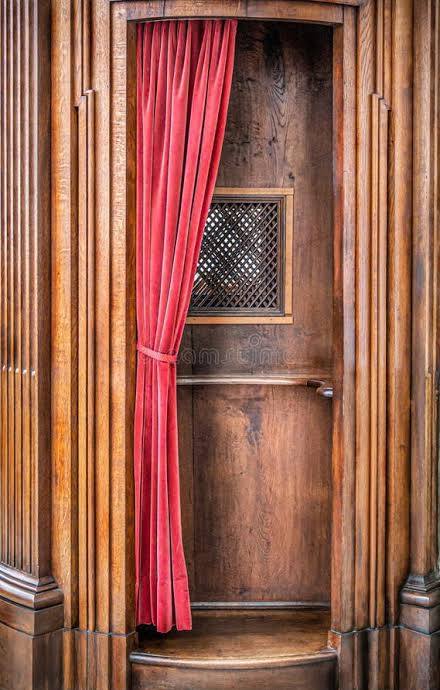
The confessional stood along the back wall beneath the stairs of the choir loft — dark wood worn smooth by decades of use. A heavy curtain shielded the narrow entrance. When one penitent stepped out into the nave, another slipped quietly inside.
Within, the space was close and dim. A wooden kneeler faced the latticework grille, and above it hung a small crucifix. Behind the partition, Fr. Gill sat waiting, his ear attuned to the hushed voices of the faithful. The air held the faint scent of polished wood, touched by the cool trace of spring drifting in through the open church windows.
Hilda went first.
Fred stood directly behind her in line beneath the tall stained-glass windows. Colored light fell across the worn wooden floor and brushed the shoulders of the children waiting their turn. He kept his hands folded and watched as she drew the curtain aside and disappeared into the confessional.
For a moment, the nave seemed quieter.
Inside, she knelt and listened — to her own breathing, to the muffled sound beyond the partition — before the small panel slid open.
“Bless me, Father, for I have sinned…”
Her voice was low but steady. She followed the pattern she had memorized. There were no dramatic confessions — only the small failings of a young girl examined carefully: impatience, a careless word, a moment of disobedience.
When she finished, there was a pause.
Not uncomfortable. Just quiet.
Fr. Gill’s counsel was simple and measured. A modest penance was given. The Latin words of absolution were spoken slowly.
When she stepped back into the nave, her expression composed, something within her had been made clean. She returned to the pew and knelt to begin her penance, lips moving softly.
Fred drew a quiet breath.
He reviewed the steps once more, moving carefully from one to the next as though fastening cows into their stanchions at milking time — each secured before moving on.
Examine your conscience.
Confess them honestly.
Be sorry for your sins.
Resolve not to commit them again.
Make an Act of Contrition.
Perform the penance.
Then he entered.
He lowered himself onto the kneeler and faced the grille. Through the patterned openings, the faint outline of Fr. Gill’s profile and the darker fold of a purple stole could be seen in shadow. The priest’s features were indistinct, yet his presence was steady.
He made the sign of the cross.
“Bless me, Father, for I have sinned. This is my first confession.”
His voice was lower than usual, but clear.
He confessed honestly as he had been taught — simply and without excuse. Once, he paused to search his memory, then continued. When he had finished, he waited.
The silence was not long, but it was complete.
Fr. Gill spoke quietly, offering brief counsel in the same measured tone he used during catechism lessons. A small penance was given.
Fred bowed his head and recited the Act of Contrition slowly, careful not to omit a line.
From behind the grille came the low murmur of Latin. The phrases flowed steadily, unfamiliar in parts yet unmistakable in cadence. At the moment Fr. Gill raised his hand, Fred recognized the essential words:
Ego te absolvo a peccatis tuis, in nomine Patris, et Filii, et Spiritus Sancti.
He bowed slightly at the sign of the cross.
“Amen,” he answered.
The sliding panel closed softly.
For a moment, he did not move. Then he rose and stepped back into the nave. The colored light from the stained-glass windows seemed brighter than before. He returned to the pew and knelt to complete his penance, lips moving steadily.
Yet something within him had been set in order.
Tomorrow They Would Return
The church grew quieter as the last confessions were heard and the faithful drifted toward the doors. The sanctuary lamp continued its steady glow before the tabernacle. Outside, the early evening light softened across East Avenue, and the small town resumed its ordinary rhythm.
Hilda finished her penance and closed her prayer book. Fred remained kneeling a moment longer, then rose. They left the church as they had entered it — quietly, without announcement.
Nothing outward had changed.
Yet something within them had been made clean. Something within them had been set in order.
Tomorrow they would return.
Author’s Note
This account of Hilda and Fred Schmieder’s First Confession draws upon oral history, documented records, and family memory. It reflects the historical record where it is available and lived experience as remembered and handed down, recognizing that no narrative can fully capture a life across time.
— Frederick Schmieder