

Chapter 39—The Lippold Brothers: Building Farms, Homes, and Families
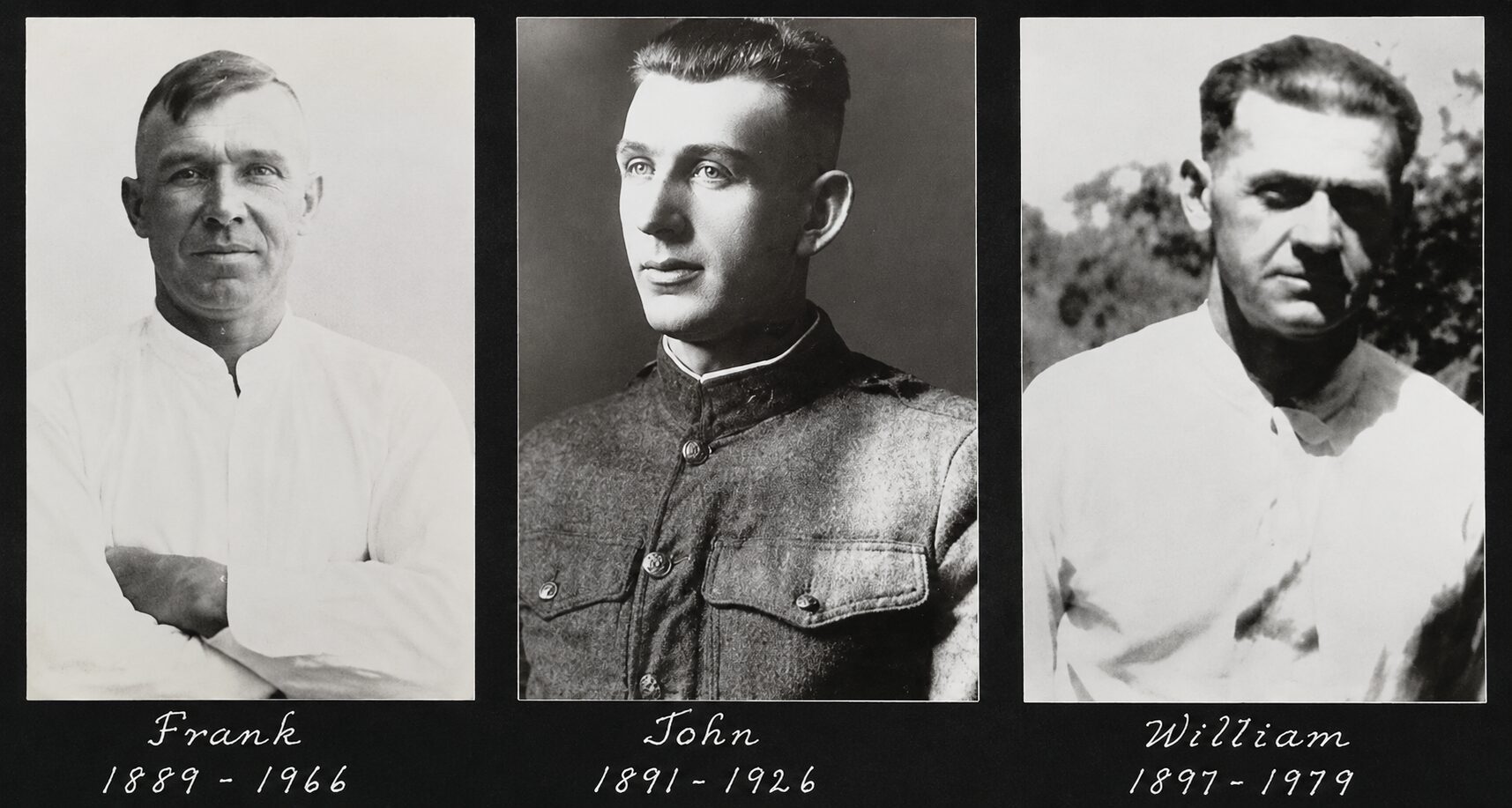
The Lippold Brothers—Frank, John, and William. Skilled carpenters and builders from Darien, New York, whose craftsmanship helped shape farms and communities across Western New York, including the Schmieder farm.
The Lippold Brothers
The Lippold Brothers, whom George Schmieder employed to build additions and improvements to the Schmieder farm and home, originally consisted of three brothers—Frank, John, and William Lippold. Their skill, craftsmanship, and reliability earned them a respected reputation throughout Attica, Alexander, Darien, and the surrounding area.
Raised on a farm in Darien, New York, by their parents, Henry and Johanna (“Jennie”) Distler Lippold, Frank Joseph Lippold (October 18, 1889–1966), John Nicholas Lippold (October 27, 1891–1926), and William Vincent Lippold (March 27, 1897–1979) came of age in a rural world shaped by hard work, self-reliance, and close ties to the land.
Life on Western New York farms demanded long hours and carried no shortage of risks. Farming, logging, and construction were common parts of everyday life, and the brothers became familiar with both the demands and dangers of manual labor from an early age.
In July 1910, while employed at F. C. Stevens’ Maplewood Stock Farm in Attica, John fell from a hay wagon and struck his face against a granary door, suffering a broken nose. Such accidents were accepted occupational hazards in an era before modern machinery and workplace safety standards.
The skills, discipline, and work ethic learned on the farm would later serve the brothers well. Together, Frank, John, and William formed the nucleus of Lippold Brothers, a respected building and carpentry enterprise whose work became familiar throughout Genesee and Wyoming Counties. Over the years, they built barns, homes, and farm structures that became familiar landmarks throughout the countryside.
As the brothers established themselves in the building trade, they also began families of their own. On November 17, 1915, Frank married Clara Graff, daughter of Joseph and Mrs. Joseph Graff of Bennington, at Sacred Heart Church in Bennington Center. Following the ceremony, family and friends gathered for a wedding breakfast for twelve guests at Smith’s Hotel before the newlyweds departed for Michigan on their honeymoon. Upon their return, they settled on Buffalo Street in Attica, where they established their home and raised their family while Frank continued working alongside his brothers in the family building business.
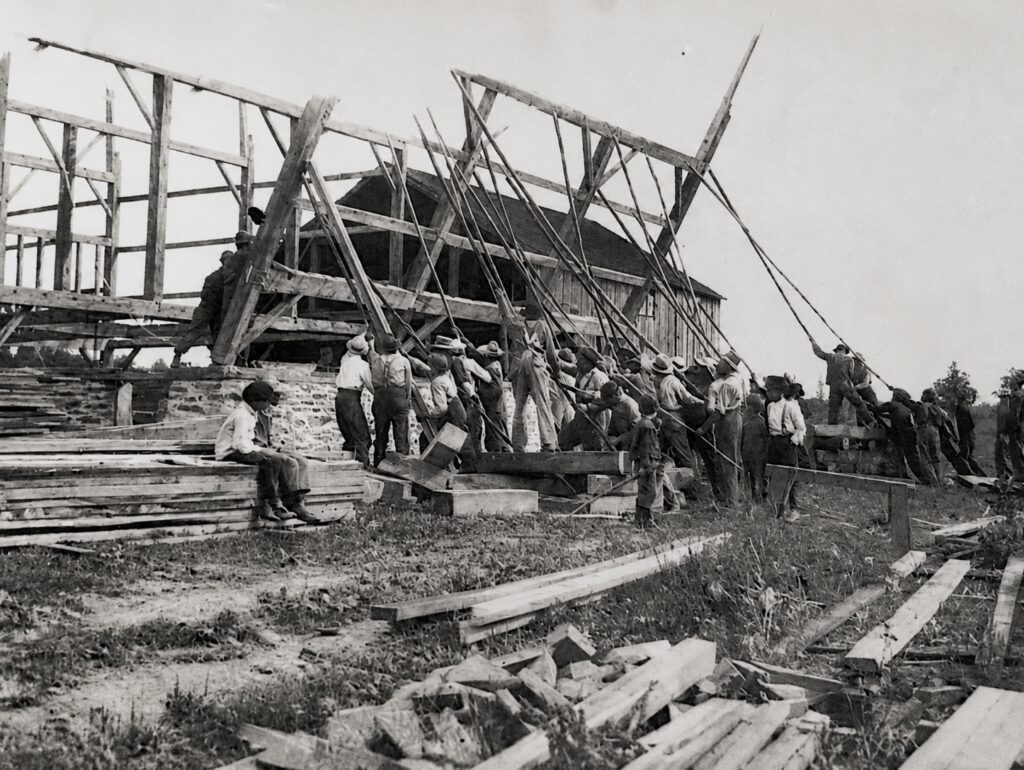
A traditional barn raising for a barn built by the Lippold Brothers for Mr. Fox in 1916.
A photograph from 1916 captures one such project, as workers raise the timber frame of a large barn built by the Lippold Brothers for Mr. Fox. With no cranes or powered lifting equipment available, the massive framework was hoisted into place by teams of men using ropes, pike poles, and careful coordination. The scene illustrates both the physical demands of the trade and the spirit of cooperation that characterized rural barn raisings in the early twentieth century. It was through projects such as these that Frank, John, and Bill Lippold established their reputation as skilled builders.
As the Lippold brothers were establishing their reputations as builders and family men, events unfolding across the Atlantic would soon reach even the farms and villages of Western New York. The First World War touched nearly every community, and the names of local sons serving overseas regularly appeared in the pages of area newspapers. Families followed reports from Europe with a mixture of pride and apprehension, while churches, schools, and civic organizations organized drives to support the war effort. Like countless young men from Genesee and Wyoming Counties, John Lippold would soon find his life shaped by events far beyond the countryside he called home.
From Carpenter to Soldier
Like many young men of his generation, John answered the nation’s call during the First World War. On May 21, 1918, he was among 115 Genesee County men ordered by the county draft board to report to Batavia for military service. Four days later, on May 25, he was inducted into the United States Army and sent to Camp Dix, New Jersey, where he trained with the 155th Depot Brigade before being assigned to Company E of the 346th Infantry Regiment.
On August 24, 1918, John departed for France with the American Expeditionary Forces and spent more than seven months overseas during the final months of the Great War. Promoted to Private First Class while serving abroad, he remained in Europe through the Armistice of November 11, 1918, and the months that followed before sailing home aboard the troop transport Alaskan in the spring of 1919. Honorably discharged on April 10, he resumed his work with his brothers in the family contracting business.
The following year, on April 14, 1920, John married Eva Myers, who had been born in Darien on March 19, 1894. The newlyweds settled in a small bungalow on North View Park in Attica, where they began building a home and raising their family. Their son, Carlton, was born in 1921, followed by their daughter Helen Margaret in 1923.
The Scaffold Collapse
Construction work remained dangerous even for experienced craftsmen. On October 17, 1922, all three Lippold brothers were seriously injured while working on a Krull Brothers building at the corner of Main and Market Streets in Attica. The project carried a family connection, as one of the owners, Frederick Krull, was married to their sister, Mary Lippold.
While the brothers were working high above the street, the scaffold beneath them suddenly gave way, sending all three men plunging approximately thirty-five feet to the sidewalk below. Frank, then thirty-three years old, suffered a fractured pelvis, a broken wrist, and numerous bruises. John sustained injuries to his shoulders and hip, while William, only twenty-five, suffered five broken ribs. Frank and William were taken to St. Jerome’s Hospital in Batavia for treatment.
The severity of the injuries initially left uncertainty about whether all three men would fully recover. Yet all three brothers survived the fall and, after months of recovery, returned to the trade they knew best. Their recovery testified not only to their physical toughness but also to the determination that characterized a generation of craftsmen whose livelihoods often depended upon working in hazardous conditions high above the ground.
A Life Cut Short
Tragedy struck the family in January 1926. After battling scarlet fever and pneumonia for four weeks, John N. Lippold died on January 23 at only thirty-four years of age. In an era before antibiotics, scarlet fever remained a feared disease, and complications such as pneumonia often proved fatal even among otherwise healthy adults. Because the family home remained under quarantine, funeral arrangements were necessarily restricted and held within twenty-four hours. As a result, John’s fellow Legionnaires and other community members assumed a prominent role in the funeral observances.
Despite the severe winter weather, fellow veterans of the Harder-O’Donnell American Legion Post honored their fallen comrade. Led by Commander Leland Clark, twenty uniformed Legion members marched to the Lippold home and escorted the flag-draped casket through a blizzard to St. Vincent’s Cemetery in Attica. Newspaper accounts described the procession as a moving sight, causing many townspeople to pause with tears in their eyes as a mark of respect for the young veteran and family man.
At the cemetery, the Legion conducted military funeral honors. Following a graveside service led by the post chaplain, Rev. John Williamson, a firing squad rendered a final salute, and bugler Walter Motz sounded taps above the grave. Following the military rites at the cemetery amid blowing and drifting snow, mourners sought the warmth of St. Vincent’s Church, where Father Bernard Gill celebrated a solemn Requiem Mass.
John left behind his widow, Eva Myers Lippold, four-year-old son Carlton, and two-year-old daughter Helen Margaret. Well known throughout the community as a member of Lippold Brothers, he was remembered as a devoted husband, father, veteran, and craftsman whose life had ended far too soon.
John’s death left Frank and William to carry on the family business without their brother and partner. Six months later, on June 19, 1926, William married twenty-two-year-old Anna Louise Pfalzer of Darien, marking the beginning of a new chapter in his own life even as the family continued to mourn John’s loss.
The Family Endures
The hardships facing John’s family did not end with his death. On July 28, 1935, after a month-long illness, Eva Myers Lippold died at the age of forty-one. Her passing left fourteen-year-old Carlton and eleven-year-old Helen Margaret without either parent, a burden borne by many families during an era when illness could still alter lives with little warning. Despite the loss of both parents at a young age, Carlton and Helen Margaret Lippold carried forward the legacy of John and Eva and the family they had built together.
The Lippold Brothers Legacy Grows
In the years that followed, Frank and William continued building barns, sheds, homes, porches, and farm additions throughout the area, including many of the improvements later made to the Schmieder farm. Working with little more than sharpened hand saws, framing squares, hammers, and years of hard-earned experience, they carried forward the reputation that the three brothers had built together. Their craftsmanship remained a testament to a generation of rural builders whose work helped shape the farms, communities, and landscapes of Genesee and Wyoming Counties for decades to come.
The Legacy Endures
There was a quiet irony in the story of the two families. During the First World War, John Lippold served with the American Expeditionary Forces, while George Schmieder served in an infantry division of the German Empire far across the Atlantic. Neither could have imagined that one day their families would become one.
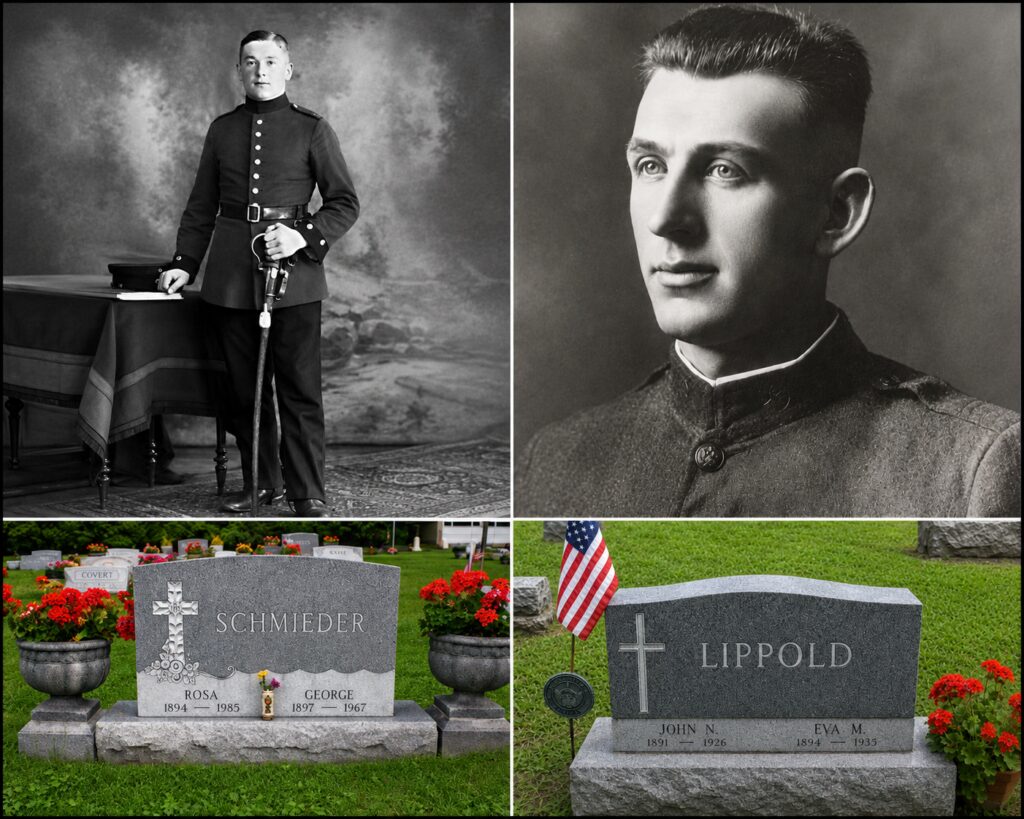
George Schmieder (left) and John N. Lippold (right) during the First World War and at their final resting places in St. Vincent’s Cemetery. Though they served on opposite sides of the conflict, the lives and legacies of the two veterans became forever intertwined through the generations that followed.
More than forty years apart, John Lippold and George Schmieder were laid to rest in St. Vincent’s Cemetery—John in 1926 and George in 1967. Though they had served on opposite sides of the First World War, both left behind families whose lives would later become intertwined. Their greatest legacy would be found not in the war they experienced, but in the generations that followed.
Yet through the marriage of Carlton Lippold and Hilda Schmieder, the son of John and Eva Lippold and the daughter of George and Rosa Schmieder, two families whose histories had once been separated by an ocean and a war were united. In time, the lives and legacies of the two veterans became forever intertwined as the family of the carpenters who helped build and improve the Schmieder farm became part of the family that called it home—a reminder that bonds of kinship often endure long after the divisions of history have faded.
Note: This account of the Schmieder and Lippold families draws upon oral history, family memories, photographs provided by Ann Lippold Shraun, newspaper accounts, public records, and other historical sources. It weaves together documented events with stories and recollections preserved across generations, recognizing that no single account can ever fully capture the richness of a life, a family, or a community. Like all family histories, it represents an effort to preserve the past while honoring the people whose lives shaped it.
Frederick Schmieder