
A Heartwarming Depression-Era Christmas on the Schmieder Farm
On Christmas Eve, during the depths of the Great Depression, the Schmieder family in Alexander, New York, found a way to nurture joy, uphold tradition, and sustain faith—even in the most difficult times
Through the Groaning Barn Doors
The old wooden barn doors groaned as they slid along the rusty metal tracks, echoing through the farmstead’s still, crisp winter air. A rich aroma of summer-cured hay wafted from the second level of the bank barn, where mounds of golden-brown hay towered high above. The sweet scent of the stored hay seemed to whisper to George Schmieder and his brother-in-law, Albert Beck, tales of their summer toil under the hot sun.
A Truck Ride Through Frozen Fields and Memory
George’s 1925 Ford Model T pickup was parked between the hay mows in the bay. He climbed in through the driver’s side while Albert opened the choke mechanism, which was located on the left side, under the radiator. Next, he inserted the cold metal hand crank into the engine and made four half-turns to prime it. Once primed, George turned the ignition key while Albert took hold of the hand crank with his left hand, carefully keeping his thumb clear. With a determined twist, he gave the crank a vigorous half-turn. The four-cylinder engine sputtered to life as they navigated the bumpy, rutted driveway behind the barn on December 24th in the early 1930s. This day before Christmas, they went out searching for a Christmas tree.
The truck bounced along the familiar ruts behind the barn, its frame groaning with each jolt, jostling its occupants as they made their way past frozen pastures and snow-dusted fence lines. These fields, once a dense stretch of forest, became part of a 125-acre tract purchased by Wolcott Marsh from the Holland Land Office in 1811.
A determined Connecticut farmer, born the same year George Washington took office, Marsh cleared the trees, raised a home and outbuildings, and worked the land with tireless resolve until his death in 1849. More than eighty years later, his legacy lingered in every worn fence post and weathered farmhouse board—a quiet reminder of the generations who had poured their lives into this soil, laying the groundwork for families like the Schmieders to carve out their own Christmas memories here.
They stopped by the wooden gate of a back pasture, their breath fogging in the icy air. George’s hand-rolled cigarette glowed faintly as smoke curled upward, dissolving into the stillness of the winter afternoon. Saw in hand, he and Albert straddled the fence and made their way toward the woods, boots crunching over the frozen ground.
As they walked, talk drifted to Germany—the family gatherings left behind, the forested hills they once called home, and the aching absence of their parents. George’s mother, Maria Anna Scheule-Schmieder, had passed in 1927, reconciliation never reached. A year later, Albert and his sister Rosa—George’s wife—lost their father, Jakob Beck. In the quiet woods, grief lingered like frost in the air, each breath a fragile thread connecting love and loss across an ocean.
The Little Tree with Big Dreams
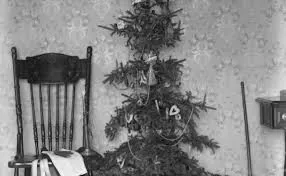
While walking through the woods, they came across a solitary Scotch pine tree. Its long green needles contrasted against the backdrop of leafless hardwood trees. Although its trunk was crooked and its branches spindly, they envisioned the joy it would bring the children as they eagerly anticipated the Christmas tree.
A makeshift wooden stand was quickly built to support the freshly cut Christmas tree, which stood proudly in the southeast corner of the living room. The fresh, fragrant scent of pine filled the air as Rosa and her daughter, Hilda, chatted about the evening’s festivities. At the same time, they transformed the tree into a handsomely decorated holiday focal point.
Long branches of varying lengths held brightly colored homemade ribbons secured to their extended limbs, creating a beautiful contrast with the tree’s green needles. Hilda draped store-bought tinsel from the branches, symbolizing the starry night of Christ’s Nativity. The shiny surfaces reflected the dim light. Historically, tinsel was first used in Nuremberg, Germany, around 1610, when an inventor created long, thin strips of silver to hang on early Christmas trees.
Meanwhile, Rosa cared for baby Erma and gently arranged her cherished hand-carved nativity scene while Hilda added small strands of straw around it.
Whispers of Faith and Hard Times
As the Great Depression worsened, banks failed, businesses went bankrupt, and unemployment soared. Families lost their homes as money became scarce, leaving many struggling to meet their basic needs. Religious and other benevolent organizations in larger cities stepped in to help feed those in need as bread and soup lines became common. George and Rosa also felt the impact of these economic conditions. Fortunately, they had the means to provide food for their family, ensuring that their children always had something to eat. During this season, they made extra sacrifices to offer their children modest Christmas gifts and a sense of hope.
Milking by Lantern Light
As the Christmas adornments were completed, the children were excited about their Christmas Eve celebration. However, the evening still held responsibilities that couldn’t be ignored. The livestock needed tending, and the cows were due for milking. Fred, Arnold, and Uncle Albert grabbed worn milking pails and three-legged stools; the wooden seats smoothed from frequent use. Each settled beside their cow, warming their hands and leaning in to rest their heads against the animal’s warm flank while feeling the gentle rhythm of its breathing. They rushed through their milking, eager to begin the Christmas Eve festivities as Fred, Arnold, and Uncle Albert competed against each other.
The rhythmic splattering of milk into the pails created a soothing melody that contrasted with the muffled munching of the stanchioned cows, which chewed contentedly on their feed. As the evening chores progressed, the barn was filled with a comforting, soft glow of light, a blend of earthy scents, and the harmonious sounds of working in unison with family and animals.
With each squirt, the pails filled with warm, frothy milk and emptied into a 10-gallon milk can before moving on to the next cow. George, assisted by his son George, Jr., fed the animals and provided fresh straw bedding for the cows, horses, pigs, and chickens. When finished, he helped with the milking chores. After the last cow was milked and the tasks were completed, they walked back to the house carrying a jug of fresh milk and a flickering kerosene lantern to illuminate their path as their breaths unfurled in the cold evening air.
The mouth-watering aromas of Rosa’s delicious meal filled the air, bringing joy and a sense of belonging to the milking crew as the family gathered around the table. They admired the beautifully decorated tree while enjoying their meal.
Steps Toward Grace
After a warm supper, George gathered Hilda, Fred, and Arnold into the chilly cab of his pickup truck. They set off into the darkness, driving along the quiet stretches of Alexander, Stroh, and Genesee roads, lit only by the dim glow of the headlights. The children buzzed with chatter and excitement as they approached St. Vincent de Paul Catholic Church at 50 East Avenue for the 6:30 PM Confession—a sacred preparation before receiving the Eucharist at Christmas Day Mass.
A gentle hush fell over them as they stepped into the stillness of the church, constructed in 1882. At the holy water font, they dipped their fingers into the cool water, made the sign of the Cross, and reverently genuflected before the tabernacle. A large crucifix hung high above the altar, a solemn reminder of Christ’s sacrifice. The sanctuary glowed softly, its nativity scene quietly depicting that first Christmas night in Bethlehem. An evergreen tree—symbol of eternal life—stood near the altar, its presence signaling the joy of the coming Masses.
As they waited in line for Father Gill—a kind, older priest with a gentle manner—the children admired the stained-glass windows. Each one illustrated scenes of saints and gospel stories, inviting quiet contemplation. Fred and Arnold, fidgeting slightly, drew a disapproving glance from their father. Slowly, the line inched forward, and one by one, they stepped into the confessional to seek the grace of the Christmas season.
Afterward, George drove the Model T home along the familiar snow-dusted roads, their hearts quietly renewed.
Back at the farmhouse, Rosa tidied the kitchen, warmed by the black cast-iron stove. In the dining room, Albert stoked the wood-burning heater, its steady blaze casting flickering light across the floor. The carefully stacked cords of split wood in the attached woodshed stood ready to keep the house warm throughout the night. Within those humble walls, the stage was quietly set for the evening’s Christmas Eve joy.
The Tap, Tap, Tap of Belsnickel’s Cane
With a glint of mischief in his eye, Albert quietly returned to the woodshed, picked up a sack filled with gifts that Rosa had hidden there, and hurried to the barn. His steps were filled with playful energy as he opened the barn door. His excitement mirrored the children: Hilda, Fred, Arnold, George, Paul, Herbert, and Erma (Shirley hadn’t been born yet).
He donned a primitive disguise, transforming into a cantankerous old man with an overgrown, thick white beard. His clothes were frayed and tattered, and he clutched a hickory stick in one hand while heaving the sack with gifts over his left shoulder, reminiscent of the legendary folklore character known in southwest Germany as “Der Belsnickle.” Albert filled his pockets with handfuls of walnuts the family had gathered earlier in the fall as additional gifts for the children. The frosty night air quickened his steps as he left the barn, focusing on the yellow glow of muted electric light bulbs that twinkled through the frosted windowpanes.
Inside, the children buzzed with excitement; their eyes sparkled with eagerness for the anticipated Christmas Eve visitor. Suddenly, their hearts raced as they heard a tap, tap, tap against the south-facing living room window. The rhythmic tapping sent shivers through the younger children, Erma, Herbie, Paul, and George. Their anticipation, excitement, and nervousness grew when they heard a second tap against the dining room window!
The children gathered in the kitchen and jumped at the loud tap, tap, tap on the porch door, which reverberated through the house. The tapping was followed by jingling bells reminiscent of those used on their draft horses. They heard another clack against the frozen windowpanes, followed by a frantic jostling of the doorknob. The tension and excitement heightened when suddenly, the door flew open, and a character resembling the mythical Belsnickel burst across the threshold, bringing a wave of cold air, jingling bells, a sack, and a hickory stick!
The younger children quivered at the sight of the bedraggled stranger standing before them in his ragged clothes and intimidating presence. With his hickory switch held high and speaking in a commanding German voice, he ordered them to ‘sitzen’ (sit). Without hesitation, they obeyed and sat on the cold, hard floor as he scattered walnuts from his pockets in front of them. He questioned their behavior in recent months and demanded that they pray as he bellowed, “Bette, Bette, Bette!” (Pray, Pray, Pray!).
The small voices nervously recited a German prayer they had learned, supported by the older children who knew the stranger’s true identity. Gently tapping each child on the shoulder, he reminded them that they must behave well. When satisfied with their sincerity, Belsnickle allowed the children to gather the walnuts. They scampered across the floor on their hands and knees, filling their pockets with the treats.
An Orange for Every Child
The Christmas Eve celebration transitioned to the dining room, where the warmth from the corner wood stove created a cozy ambiance. With happy faces and smiles, the family gathered around the large table set with a few festive decorations. George and Rosa distributed the simple treasures from the Christmas sack while Albert quietly exited to the woodshed to remove his disguise. One by one, each child received a bright orange. A cherished delicacy from a distant land was a rare treat reserved for the holiday season. They marveled at the fruit’s shape and savored its unique citrusy fragrance, which enveloped the room.
Practical clothing gifts were taken from a large sack and distributed to each of the children: Hilda, Fred, Arnold, George, Paul, Herbert, and Erma. The items included socks and shirts, which helped enhance their limited and modest belongings while bringing a glimmer of hope and joy during difficult economic times.
Cookies, Cocoa, and the Warmth of Home
As the evening ended and before the children prepared for bed, a delightful surprise awaited them in the dining room. Rosa had placed a beautiful plate of her scrumptious holiday pfeffernüsse cookies on the table. Each cookie was perfectly shaped and dusted with a light powdered sugar coating. Alongside the cookies, steaming cups of hot chocolate were served, made with creamy fresh milk from their Jersey cow. The children’s eyes sparkled with joy as they dipped the fragrant, anise-spiced cookies into the velvety warm drink, savoring the perfect holiday treat on a cold Christmas Eve before bed.
Christmas Dawn: Chores, Prayer, and Mass
Although the sun officially rose at 7:43 AM the following day, the Schmieder family was already involved in their morning activities. The milking chores were almost complete. Rosa prayed her morning rosary, keeping her family members in Schönberg, Germany, in her thoughts. While she prayed, she diligently worked in the kitchen, where the warm aroma of breakfast filled the house, along with preparations for a festive Christmas dinner later that day.
Meanwhile, George gathered Hilda, Fred, and Arnold for the Christmas Mass. They climbed into the old Model T pickup truck, and its engine rumbled to life as they set off along the dry, clear roads. The church was packed with worshippers when they arrived at St. Vincent’s. Father Early stood in front of the altar, welcoming everyone. The sound of the organ filled the air, resonating through the high ceiling, while the choir in the loft sang a beautiful Christmas hymn to begin the Latin Mass.
Savoring Christmas: A Meal Made with Love and Sacrifice
Rosa, with Hilda’s assistance, completed the final preparations for the Christmas meal. The worn pine floorboards creaked beneath their feet as the family gathered around the table, drawn by the fragrance of wood smoke, bread, and spice. The table overflowed with the fruits of their labor and the land’s bounty—an offering shaped by love and quiet sacrifice.
At the center was a richly smoked ham, butchered from their own pig and cured in the smokehouse by Albert with steady patience. Creamy mashed potatoes, hand-peeled and whipped to perfection, shared the table with tangy sauerkraut, which had been fermented in the cool basement for weeks.
Rosa’s golden-crusted bread, still warm from the oven, melted under generous spreads of hand-churned Jersey cow butter. Beside it, a bowl of deep brown applesauce—sweetened and spiced from their orchard’s fall harvest. George poured a glass of his crisp, amber cider.
Before a single bite was taken, the family bowed their heads. A reverent prayer of gratitude filled the room, followed by the symphony of clinking forks, shared stories, and laughter.
A Taste of Schönberg: Christmas Desserts and Memories of Home
When the final bites of ham and sauerkraut had been savored and the room filled with the hush of full bellies and glowing hearts, Rosa returned from the kitchen with the grand finale—her tray of Christmas desserts. She carefully unveiled an assortment of traditional German treats, each one prepared in quiet hours over the past week, each carrying memories of Christmases long past.
There were large, soft pretzel rings, their golden crusts sprinkled with coarse salt and still faintly warm from the oven. At the center of the table sat the Linzer torte, its buttery lattice crust glowing atop a ruby-red berry filling. The stollen—rich with candied fruits, almonds, and warm spices—was sliced and dusted with icing sugar that caught the light like fresh snow. And nestled beside them, a modest plate of pfeffernüsse cookies—crisp, spiced, and familiar.
A Legacy of Love: Remembering Christmas Through the Eyes of a Child
Despite the family’s financial struggles, long hours of labor, and the ever-present fear of bankruptcy and losing the farm, George, Rosa, and Uncle Albert sacrificed their own comforts to give the Schmieder children a Christmas they would never forget. The children would later recall the modest tree that stood proudly in their drafty living room, adorned with handmade decorations and simple strands of tinsel. The family gathered around it for a warm supper, their hearts turned quietly toward the coming Confession that evening.
Uncle Albert delighted the children by appearing as a folkloric gift-bearer, and together they recited a traditional German prayer passed down through generations. Afterward, they sipped chocolate milk and nibbled on Christmas cookies by the soft glow of the fire. On Christmas Day, they attended Mass and returned home to enjoy Rosa’s lovingly prepared feast.
But it wasn’t the tree, the food, or the gifts that made the holiday truly magical. It was the strength of their family bond, the gift of presence, and the gentle peace that filled their home.
Years later, the Schmieder children often spoke of those Christmases during the Great Depression. Though money was scarce and life was hard, they never fully grasped the weight of their parents’ sacrifices. What stayed with them was the warmth of togetherness, the quiet strength of resilience, and the memory of joy born not from abundance, but from love. Those simple, sacred moments became treasured heirlooms of the heart—etched into the story of their family and carried on with every Christmas that followed.
A Blessing Remembered
“May the Christ Child bless this home and all who dwell within it.”
So prayed many German families on Christmas night, just as Rosa once did in her quiet kitchen.
Though George, Rosa, and their children—Hilda, Fred, Arnold, George Jr., Paul, Herbert, Irma, and Shirley—are no longer with us, their legacy of faith, hard work, and sacrifice lives on: in every prayer we whisper, every tradition we honor, and every quiet act of kindness we pass down.
Their Christmas joy is now part of ours.
Note:
This account of the Schmieder Family Christmas in the early 1930s is a tapestry woven from historical fact and treasured memory, blending documented events with personal reflection and interpretive storytelling.
—Frederick Schmieder