
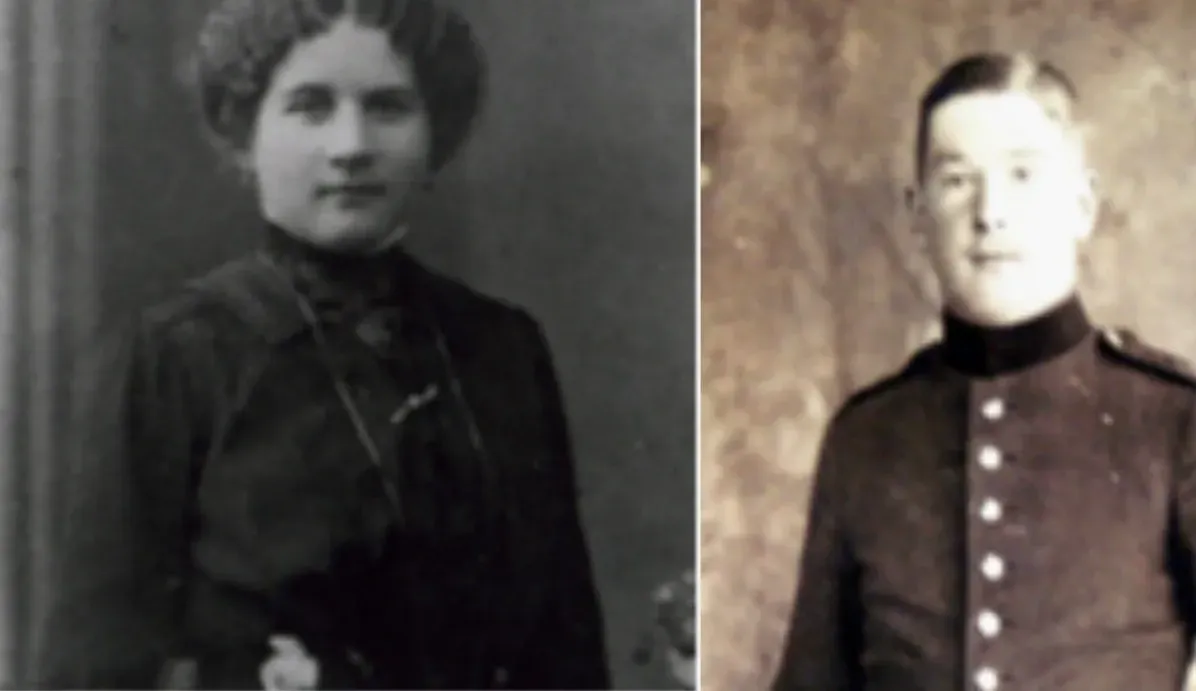
Bound by Love and Defiance: The Marriage of George and Rosa
Rosa Beck and Georg Schmieder
Dedicated partners in life and legacy
(1894–1985) (1897–1967)
Dawn at the Station
As the sun rose over the small city of Lahr’s train station on an early November morning, its gentle rays cast a golden glow on the waiting crowd. A cold November breeze mingled with the soft chatter of early travelers as Georg and Rosa, hearts pounding with both anticipation and apprehension, joined the line in front of the destination board. Their eyes met in a shared moment of silent promise, each aware that the journey to Freiburg would intertwine their futures.
Boarding the Train
The station buzzed with activity and hushed conversations. Amid the shuffling of luggage, bags, and coal smoke, the conductor’s call of “Alle einsteigen” urged passengers to board the train, eager to begin their journey. Georg and Rosa stepped onto the coach, using its worn steps. Once settled into their seats—Rosa chose the window seat as the train’s whistle sounded a piercing farewell to the familiar.
A Changing Landscape
The countryside lay stretched before them, unveiling tranquil farms, rolling fields, and clusters of small villages. Telegraph poles stood as silent sentinels along the tracks. Georg’s hands held Rosa’s—a wordless affirmation of their shared hope amid the uncertainty of the future.
Echoes of Conflict
Yet, even as the serene landscape moved past, echoes of a painful memory lingered in Georg’s mind. His mother, Maria Anna, had harshly declared, “Kein Fabrikmadchen wird meinen Sohn heiraten!” — “No factory girl will marry my son.” The words stung deeply.
This painful declaration arose as Georg’s family was arranging a marriage between him and a farmer’s daughter who had no sons to inherit his land. The union aimed to secure Georg’s future land ownership and elevate his status through this arrangement. However, this choice starkly contrasts with the love that blossomed between Georg and Rosa. Rosa’s modest upbringing on a rented farm in Schoenberg with her father, Jakob, her mother, Monika, and her siblings set her apart from the land-owning families that Georg’s parents envisioned. Her work in a cigar factory further distinguished her from them.
The Heart’s Decision
In the quiet moments between the train’s clatter, Georg was resolute in choosing the passionate and authentic connection he felt for Rosa, an attractive, slender twenty-six-year-old with dark, wavy hair, over the promise of prosperity offered by an arranged marriage.
They reminisced about their first meeting at Poche, a charming local village pub and restaurant known for its hearty cuisine, refreshing drinks, and lively dancing. After Sunday Mass at St. Stephan’s Catholic Church in Reichenbach, they would gather with family and friends at Poche, where they spent their afternoons and evenings together.
As the weeks passed, their connection grew more substantial, and they began to crave the serene solitude found among the tall firs and pines of Eichberg Mountain. In these quiet moments, they discovered a peaceful sanctuary- a refuge from the stresses of the outside world as their love bloomed.
Driven by a deep love, Georg openly discussed his commitment to Rosa with his parents. The confrontation was fraught with tension; his and his mother’s anger ran deep, resulting in an irreparable widening of the rift between them and leaving their relationship strained and unresolved.
Driven by rising anger and deep frustration, he left Zipperhof, the family home that had been his life and part of his family for generations. During this challenging time, he found solace in working on various other farms. Yet, amidst the turmoil, the bond between Georg and Rosa remained strong, fortified by their unwavering support for one another.
Arrangements were made with the parish priest for a marriage ceremony at St. Martin’s Church in Freiburg on November 7, 1920. Yet behind the hopeful anticipation of that day lingered the sorrow of a life lost too soon—their first child, never born, whose quiet absence served as a tender reminder of both love’s depth and life’s uncertainty.
Journey to Freiburg
The screeching of the train’s brakes jolted the passengers in their wooden seats. The conductor’s voice echoed through the carriage, announcing their arrival at Freiburg Train Station after a scenic forty-mile journey. They navigated through the bustling crowd, drawn to the resonant sound of the cathedral bells and the promise of new beginnings.
The City’s Embrace
As they navigated Freiburg’s cobbled streets, the scent of fresh bread wafted from open bakery doors, mingling with the rhythmic clip-clop of horses’ hooves and the low hum of passing motorcars—a city alive with both the old and the new, welcoming yet bittersweet.
These warm aromas stirred something tender in Georg and Rosa: the comforting familiarity of home, and the quiet sorrow that those they loved most would not be there to share in their joy.
As they made their way toward St. Martin’s Church, the solemn toll of cathedral bells echoed through the cobbled streets. The Freiburg Cathedral rose before them, its 400-foot Gothic spire piercing the sky like a celestial arrow, a testament to faith reaching heavenward since the Middle Ages.
The Church of St. Martin
St. Martin’s, situated a short distance from the Cathedral, was constructed in 1226 by the Franciscans. In the plaza near the church, a monument honors Friar Berthold Schwartz, who is credited with the invention of black powder (gunpowder). Here, where invention once sparked fire, love now kindled a sacred union.
The Church’s grand, intricately designed stained glass window above the entrance bathes the choir loft and nave in a soft, colorful glow. Majestic arched columns flank the outer rows of wooden pews, soaring upward to meet the flat wooden ceiling. Beautiful religious artwork, including 14th-century paintings, adorned the church.
The Sacred Ceremony
As the ceremony began, Rosa knelt at the altar, George by her side, gently adjusting the delicate mantilla that covered her head. The stained-glass windows above the sanctuary cast vibrant rays of red, blue, green, and yellow light, illuminating the holy scenes they portrayed.
The couple could feel a warm, celestial glow enveloping them, deepening their sense of the divine love surrounding them. In front of them stood a priest in white vestments, a stole draped over his shoulders, holding a black leather prayer book as he initiated the sacred ceremony.
Rosa blinked away tears as their eyes met and exchanged heartfelt vows in that sacred moment, the incense mingling with their whispered prayers.
Their hands, calloused from hard work and marked by the evidence of daily struggles, spoke volumes about their life journey. Each whispered promise and shared glance affirmed that their love was a light capable of guiding them through any darkness.
Despite the hardships and familial discord, that shared flame would light the way through the darkest valleys of their future.
A New Beginning
With the priest’s final blessing—“In nomine Patris et Filii et Spiritus Sancti. Amen.”
The past, with its anger and estrangement, was laid to rest—at least for that sacred moment. United in love, Georg and Rosa stepped into a future of their own making, bound for Der Schweizerhof, the farm-restaurant they would call home in Wagenhausen. Together, they were ready to face the uncertainties of tomorrow.
______________
Note: This account of our grandparents, Georg (George) and Rosa Schmieder, and their marriage in November 1920 includes factual events and personal perspectives. It reflects individual interpretations and subjective insights while acknowledging the challenges of accurately capturing details of past events.
—Frederick Schmieder
Additional note: St. Martin’s Church, where Georg and Rosa were married in 1920, was tragically destroyed in an Allied bombing raid in 1944. It was rebuilt in the postwar years as a symbol of renewal and resilience.