

Chapter 11: A Winter Morning: Memories Before the Auction
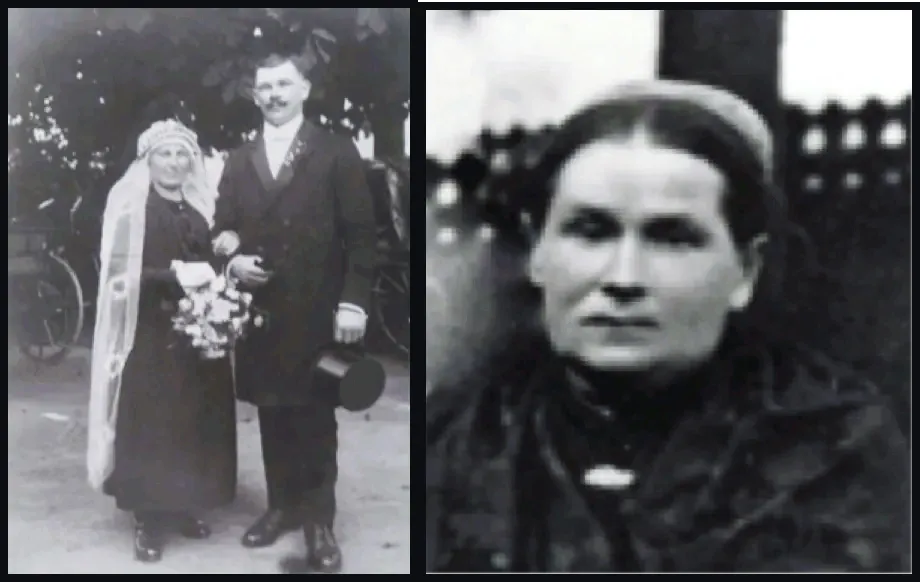
Wedding photograph of Louise Willman and Xaver Schmieder (George’s brother), 1926 — also pictured Maria Anna Schüle-Schmieder, mother of Xaver and George.
This chapter examines George and Rosa’s reflections on December 7, 1928, as they recount their experiences living on the rented Kreutter Farm, which later became the home of the Kautz Family, situated on Hall’s Hill in Alexander, New York. Through these narratives, we witness the hardships and triumphs they faced, marked by anticipation for the auction of the neighboring Phelps Farm on this pivotal day.
Restless Sleep, Weighty Thoughts
George and Rosa woke early, their sleep restless and filled with unease over the upcoming auction of the neighboring Phelps Farm. Thoughts of the impending auction had disturbed their sleep, and now the weight of uncertainty lingered heavily on their hearts. George stoked the round wood stove, adding split logs that sparked to life, casting a warm orange glow that gradually dispelled the chill in the living area. He dressed for the morning chores, the soft flicker of the fire illuminating the quiet solitude of the room.
Meanwhile, Albert Beck, Rosa’s brother, and Benny Feist, the hired hand, reached for their coats hanging on hooks near the door before stepping out into the sharp, biting cold of the morning. The stillness of the early morning was broken only by the crunch of snow beneath their worn work boots—the only sound in the predawn silence—as the flickering lanterns lit their path through the dark.
Before First Light: Chores and Cold Resolve
Winter had quieted the field work on the farm, leaving it still, with the land seemingly at rest. Yet, the rhythm of the farm continued as George and his men tended to the animals that depended on them. The barn stood against the cold, sheltering the livestock from the harsh winter winds. Inside the barn, the cows stirred restlessly in their stanchions, and the sounds of their movement filled the warm, golden glow cast by the kerosene lanterns.
The lanterns hung from overhead hooks, their light stretching across the oak beams and concrete floor. Shadows danced across the barn as each man moved silently, focused on the work at hand, their thoughts heavy with the anticipation of the auction yet rooted in their tasks. The quiet camaraderie of the morning served as a reminder of the stability they had found in the hard work of the farm.
Loose hay was tossed from the upper floor, and silage, along with ground grain, was given to the eager cows. Water from a deep well was pumped into the barn. The draft horses, chickens, and pigs were all fed before George took his three-legged milking stool from its hook on the wall and carried a pail to the stanchioned cows.
Milking Time Reflections
As George milked the cows, the rhythmic motion grounded him in the present. Resting his head against the cow’s flank, the warmth of the animal offered a small comfort in the still, cold barn. Despite the calm of the task, his mind wandered.
He reminisced about the day he purchased his first cows from Louis Shreder, a trusted friend, mentor, and respected cattle dealer from Attica. He also acquired cows from a farmer near Varysburg or possibly East Aurora. Lacking the luxury of a cattle truck, George transported the cows on foot, walking them mile by mile along country roads, their hooves kicking up dust as they moved steadily through the open landscape.
The journey had taken most of the day, each mile marked by quiet contemplation. The wind whispered across the fields, and George walked alongside the animals, a solitary figure in the vast countryside. His thoughts drifted inward, carrying the weight of his past: the brutal memories of the Great War, the lingering pain of estrangement from his mother, the loss of their beloved farm in Wagenhausen, and little Fred’s scald injury, along with the weeks spent in a hospital at St. Jerome’s in Batavia.
George had crossed the vast Atlantic Ocean alone, fueled by a relentless desire to create a better life for Rosa and their children. Although the weight of his past pressed heavily on his heart, his resolve grew stronger with each passing mile. Every step represented a departure from loss and a quiet march toward renewal. George continued onward, not out of comfort or certainty, but because he had no other choice. He held onto the faith passed down through generations, trusting that, just as his forefathers had before him, hard work and God’s grace would ultimately pave the way for a rewarding life filled with purpose and abundance.
Pride of the Farm
As George poured the milk into a 10-gallon galvanized steel milk can, which had a narrow neck and side handles, he couldn’t help but reflect on the modest herd he had invested in when he first moved to Kreutter Farm. The steady flow of milk into the can reminded him of the sacrifices he and Rosa had made, as well as the long journey from uncertainty to the quiet pride he now felt for his animals and the possibility of owning a farm of his own if the auction was successful.
In the sturdy, weathered barn, George saw not only a shelter for his cattle but also a powerful symbol of hope and possibility, standing firm amidst storms and shifting seasons, much like the many challenges he had overcome in his own life. He felt deep gratitude for the opportunity to house his livestock in such a well-crafted structure. Each beam and timber seemed to resonate with the legacy of hard work and dreams, while the barn now quietly stood as a witness to George’s own aspirations for the future.
Echoes of the Past
The farm was rich with history, shaped by the hands of those who came before. After the deaths of Dr. Jonathan Hall—Revolutionary War veteran in 1812—and his son, Jonathan Hall, Jr., a War of 1812 veteran in 1852, and his son, James C. Hall, the “Alexander Hermit” and Harvard graduate, in July 1903, the property was sold to Edward Ernst Timm from Attica in September of the same year for $2,500.
The young man, just 26 years old and newlywed to Lula Mae Roberts of Alexander, was eager to create a legacy of his own. Together, they devoted time and effort to building a new barn—a structure that would once again echo with the sounds of family and community.
The L-shaped barn stood as a piece of history. Its timbers and fine craftsmanship told tales of the past. Inside, thirty cow stanchions lined the main floor, while sturdy pens housed prize-winning bulls and calves from an earlier time. Separate living quarters were built for the hired men. Two metal silos loomed outside, gleaming like silent sentinels beneath the shifting skies. Even in the quiet of the morning, the barn possessed a certain majesty, an unspoken pride in its legacy and the labor that had gone into making it a centerpiece of the farm.
Upstairs, a spacious oak floor stretched like a quiet ballroom, bordered by wooden benches that hugged the walls. During the warmer months, the driveway filled with buggies, and the barn came alive with the sounds of fiddles, stomping boots, men in their suspenders, and women in their long dresses dancing the Virginia Reel and square dances. Laughter echoed as friends, neighbors, and members of their local Methodist Episcopal Church gathered for a fun-filled evening, enjoying a variety of baked pies, apple cider, and punch.
More than mere celebrations, these gatherings were affirmations—that life, despite its hardships, still held joy, laughter, and the warmth of community. Even now, in the stillness of winter, the walls seemed to echo the memories of those vibrant nights.
The Timm Legacy: Joy, Tragedy, and Change
Edward and Lula Mae Timm, née Benedict, were an ambitious young couple with a future full of promise. They had two daughters: Lula B., born in 1905, and Esther, born in 1907. The Timm family was deeply involved in their local church, and their farm became a vibrant hub for the community. In addition to hosting lively barn dances, they organized summer church picnics in their grove—an event that became a cherished tradition. Lula Mae also hosted the Monterey Prayer Meetings at their farm, further strengthening the bond between the Timm family and their neighbors.
But tragedy struck when Lula Mae contracted tuberculosis. In an era with limited treatment options, her health rapidly deteriorated. Known as “consumption,” the disease took a slow and devastating toll on her body. She passed away in 1912 at the age of 33, leaving behind her husband and two young daughters, aged seven and five. The once-vibrant home, filled with laughter and the warmth of the community, was now marked by the heavy silence of grief.
In the spring of 1913, Edward’s sister, Rose Timm, married and moved in with him, along with her husband, to help care for the children and assist with the farm. Despite their efforts, by 1919, the farm, once a symbol of hope and possibility, had to be sold, leaving behind memories of unfulfilled dreams.
Edward and Lula Mae had devoted their hearts to their family, their farm, and their community. Their commitment to creating a lasting legacy resonated deeply with George, stirring his own aspirations for his children. Yet, despite their dreams, fate dealt them a tragic hand. The farm, once a beacon of potential, now stood in shadow from grief—a stark reminder of how quickly life can change.
Chores and Choices: The Morning of December 7
After feeding the animals and milking the cows, George gathered the eggs. The familiar task offered a moment of calm, yet his thoughts churned with unease. That morning’s auction loomed ahead—an uncertain chance to secure a farm and home for which they had sacrificed.
As the egg basket began to fill, his thoughts began to drift. He hadn’t intended to think of Reichenbach, but it pulled him back there.
George’s Silent Journey
George remembered the scents of fresh-cut pine timber from their farm, the Zipperhof, the rhythmic hum of the sawmill, and the feeling of Sundays—slower, with the bells of St. Stephan’s announcing Mass. Unfortunately, staying wasn’t an option. The war, post-war hyperinflation, and the loss of their home and farm meant he could never return. This was his new home now, and with it came the quiet promise that he would work and rebuild for the sake of his children.
He envisioned his brothers, Xaver and Paul, helping their father, Georg, tend to the homestead in the Gereut Valley, which had been in their family for over ninety years. The photo Xaver sent after his wedding to Louise Willman in 1926 came to mind—his brother stood tall, his expression proud, and he wished he could have been there.
George began anew on this windswept hill in Alexander, New York, in early 1926. Although it wasn’t his own, he managed its productivity. With hope in his heart and calluses on his hands, he carved a new beginning from hardship. Now, he prayed—not just for a successful bid—but for a farm of his own, a place where his children could work alongside him and inherit something more than memories.
A Letter Across the Silence
The image of Xaver stirred another memory—one not as joyful. George’s face tightened as his thoughts turned to his mother. His marriage to Rosa six years earlier had fractured their relationship. The silence between them had stretched too long. However, with Rosa’s gentle encouragement, he finally wrote to his mother that Christmas—words of reconciliation, hope, and love. When he sent it, a weight lifted from his chest. For the first time in years, he felt the cold grip of regret beginning to loosen.
Too Late for Forgiveness
Weeks passed. Then, the letter arrived.
George opened the envelope with a slight tremble—not from the cold, but from the faint flicker of hope. However, that hope quickly dissolved into horror as he read the words: his mother, Maria Anna Scheule-Schmieder, had died. She had collapsed suddenly at home on Tuesday, January 11, 1927. Her lifeless body was discovered on the cold tile floor.
“A heart attack,” they said. She was only 54.
Maria Anna never read the letter George had sent. His words of reconciliation, filled with hope, arrived too late. The chance for healing was lost. Instead, George was left with the hollow ache of unspoken words—his mother’s anger, now buried with her. The opportunity for closure and forgiveness slipped away. He only knew he had waited too long.
Grief in the Quiet Hours
Rosa sat silently beside him that night, her hand gently resting in his. Outside, the wind stirred against the old house, its creaking a mournful accompaniment to the heavy weight of loss that settled over them.
Walking Toward the Unknown
As the early morning chores came to a close, George’s thoughts drifted back to the auction ahead. He felt a thrill of possibility, yet his mind remained clouded with uncertainty. Would the farm provide the security he longed for, or would it slip away like the land in Wagenhausen?
As George walked back to the house, he realized that today would present both challenges and decisions that would have a lasting impact on their lives. The path ahead, as uncertain as it was, would require not only hard work but also unwavering faith.
Note: This family history account of George and Rosa’s years on the rented Kreutter Farm blends oral history, factual events, and personal perspectives. It reflects documented facts and individual interpretations while acknowledging the challenges of fully capturing past experiences.
Frederick Schmieder