

Chapter 15: When the Homestead Became Their Own
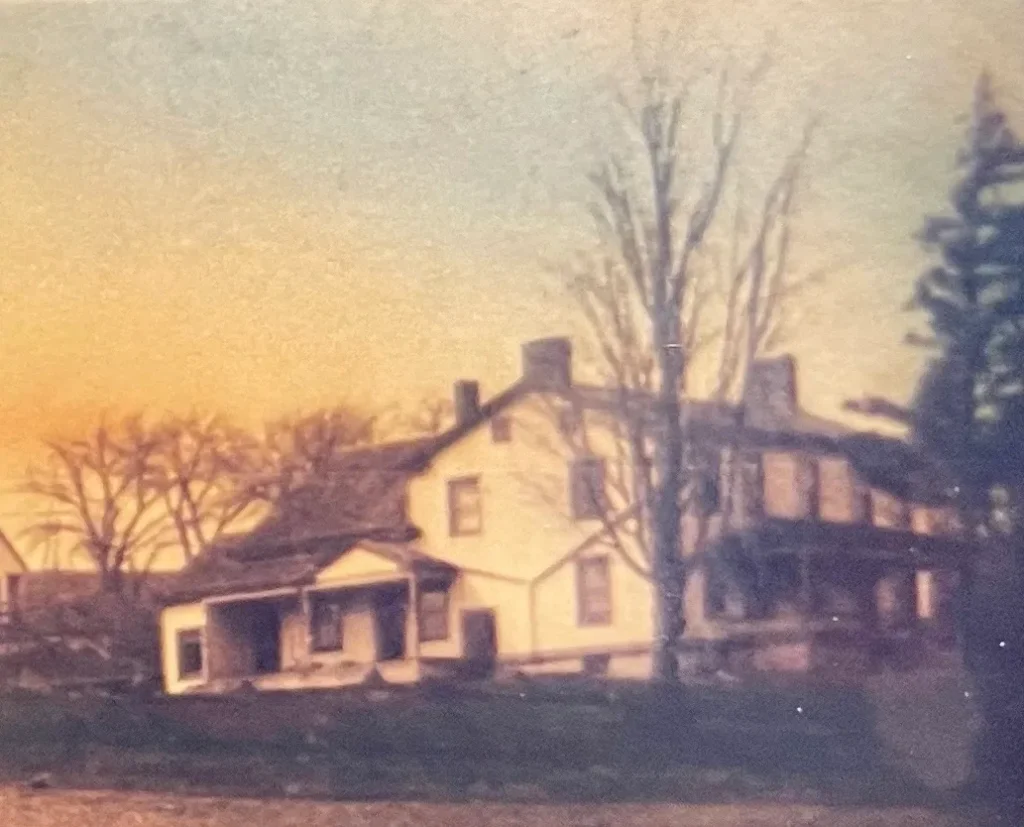
The House That Became Home — Schmieder Homestead, Alexander, New York
A Legacy Ends
Cold, gray December skies hung low over the Phelps Farm as the final moments of the auction approached. It marked the closing chapter in the long legacy of the Marsh, Smith, and Phelps families—generations who made a living from this land while raising their children in the small farming community of Alexander, New York. Now, their animals, tools, and household goods are gone, and their descendants, no longer connected to the soil of their forebears, have moved on to seek other paths.
The Barn Remembers
The auctioneer’s voice rang out, cutting through the crisp winter air as a crowd gathered inside the gambrel-roofed barn. Overhead, a metal hay track hung silent, like a relic suspended in time—a witness to decades of labor, life, and laughter. The haymows, once filled with fragrant fresh-cut hay, echoed with the sounds of children at play—climbing the wooden mow ladders and leaping into piles of hay below.
As George observed the thick oak beams supporting the barn’s structure, he could almost see the men of the 19th century at work: calloused hands guiding hand saws, sweat-soaked brows bent over sharp chisels, fitting each beam into place with painstaking care. Their craftsmanship turned hewn timbers into a cathedral of agrarian life.
The barn’s L-shaped design revealed its history—an original structure later expanded to meet the growing demands of a thriving farm. Its fieldstone foundation stood firm, a quiet testament to the skill and grit of its builders. Inside, the first floor of the original barn once housed sturdy draft horses in wooden-floored stalls, while the newer addition accommodated a milking area fitted with six cow stanchions.
George’s Vision
In George’s mind, calculations raced as he weighed the costs of transforming the farm into a profitable enterprise. The repairs and upgrades required to support a larger herd of cows would demand both labor and substantial capital. Despite these challenges, he could envision a future shaped by hope and hard work.
He envisioned replacing the aging wooden silo at the barn’s northeast corner with a modern concrete one, essential for proper feed storage. The well beside the barn, approximately 15 to 20 feet deep, would need to be drilled deeper to meet the growing water demands of dairy operations. Additionally, the barren fields, whose fertility had been exhausted after years of overuse, would require careful restoration through crop rotation, manure spreading, and reseeding—a long and patient journey back to vitality.
As the auctioneer launched into a description of the property—the house, barns, outbuildings, and 308 acres—George stood still. To the outside world, his face betrayed little. However, inside, his heart pounded. This wasn’t just a land sale; it was a lifeline, a vision, a home for Rosa and the children, who was likely praying silently at the farmhouse her rosary beads gently passing through her fingers, and a second chance. Their life had already seen so much upheaval. This was an opportunity to reconnect with themselves once more.
The Bidding Begins
The bidding commenced. Voices rose and fell. George stood beside Louis Shreder, who had agreed to bid on his behalf. Shreder’s voice was calm, deliberate, and never rushed—a steady counterpoint to George’s racing thoughts.
With each call and counteroffer, the tension grew. Louis responded without hesitation, his confidence unwavering. As the price increased, some bidders began to drop out, either unwilling or unable to keep up. However, one competitor remained steadfast, matching each bid with relentless determination.
The quick-paced, rhythmic actions of the auctioneer ensured that the bidders were attentive to every bid. The auctioneer’s rhythm quickened, his chant sharp and clear, commanding complete attention. The numbers climbed: $4,500, $4,600, $4,700, then $4,800.
George’s pulse pounded. He stared at the auctioneer as Louis raised his paddle again, silently signaling $4,900. A heavy silence fell over the crowd.
Going Once… Going Twice…
The auctioneer paused, scanning the room. No one else raised a hand. He repeated the bid, his voice hanging in the still air.
“Going once!”
The barn seemed to hold its breath.
“Going twice!”
A hush settled over the crowd. George stood motionless, breath caught in his chest. This wasn’t merely a sale—it was the handoff of history.
Then, with a sharp crack of the gavel, the auctioneer called out, loud and clear:
“Sold! To George Schmieder and Louis Shreder for $4,900!”
A Future Secured
A wave of relief and exhilaration surged through George. He turned to Louis, their eyes locking in a quiet exchange—part triumph, part awe. George clasped his friend’s hand, offering heartfelt thanks in his native German. It was Louis who had made this moment possible. Around them, the mood lightened. Neighbors stepped forward with handshakes and congratulations, their words warm and sincere.
After meeting with the officials to finalize the deal, it was official—the land was theirs. Yet, George knew this was only the beginning. Ownership was just the first step. The real work—rebuilding, restoring, and planting—still lay ahead. But George, no stranger to hardship, welcomed the challenge. This was his chance to shape something lasting and create a future for his family.
The Messenger
Next to George was his brother-in-law, Albert, who watched the auction unfold. After the successful bid, he hurried home across Hall’s Hill. When Rosa glanced out the window and saw him approaching, she dashed to the door, her eyes focused on his face.
No words were necessary.
Her expression ignited with understanding, the weight she had carried for so long quietly lifting. The uncertainty, the waiting—it was over.
They owned a farm, and with it came the promise of a new beginning.
Note: This family history account of George and Rosa’s purchase of their farm on December 7, 1928, in Alexander, New York, at auction weaves together oral history, factual events, and personal perspectives. It presents documented facts and individual interpretations while acknowledging the challenges of fully capturing past experiences.
Frederick Schmieder