

Chapter 16: From Kreutter’s Fields to Their Own
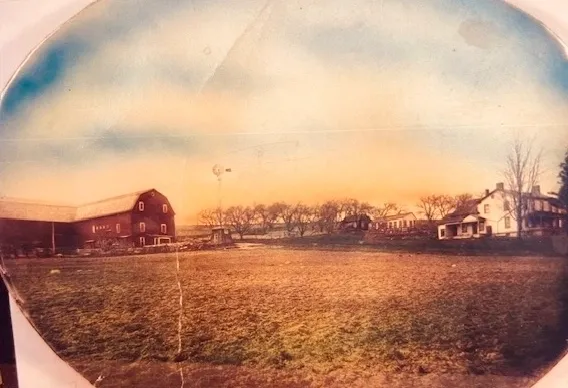
Schmieder Homestead, Alexander, New York — as it appeared before the Schmieder family acquired the property in 1928.
Note: This family history chapter recounts the story of George, Rosa, and the family’s move to the new home and farm they purchased at auction on December 7, 1928, in Alexander, New York. It weaves together oral history, factual events, and personal perspectives. It presents documented facts and individual interpretations while acknowledging the challenges of fully capturing past experiences.
The Arrival
The sled, weighed down by the cast-iron cookstove, lurched forward as George snapped the reins. Frosty breath curled from the draft horse’s nostrils while its sturdy hooves searched for traction on the frozen ground. The metal runners glided over the hard-packed snow, echoing softly through the stillness of the December morning.
Their short journey began at the rented Kreutter farm atop Hall’s Hill and crossed a windswept, stubbled field blanketed in snow. Now, it culminated at the threshold of something hard-won: their own homestead, purchased at public auction on December 7, 1928, for $4,900. The land and buildings, worn and weary but still standing, now carried the hopes of a young immigrant family determined to create something lasting.
As the sled approached the farmhouse, the cookstove rattled softly, its iron sides cold to the touch. George could see the quiet chimney, the bare windows, and the sagging porch roof—all waiting to be restored. But in just a few hours, it would glow once more, its warmth heralding the rebirth of a home, their home.
Unloading the Cookstove
Albert Beck, Rosa’s brother, and Benny Feist, the hired hand, steadied the stove as George wrapped the reins around a porch post. Together, the three men lifted the cast-iron behemoth off the sleigh’s wooden bed. It groaned under its weight as they maneuvered it up the front steps and into the silent, frigid kitchen. Their boots thudded on the bare floorboards while tufts of snow lay quietly on the window sills.
They placed the stove under the east wall flue. George collected wood and kindling, paused to let the moment settle in, and with a spark, the fire caught, crackling sharply as heat radiated through the iron. Smoke spiraled up the stovepipe, and the chimney let out its first exhale. Wisps of smoke floated into the slate-gray sky, then caught the northwest wind and drifted away, a welcoming sign of the Schmieders’ new beginning.
The Children Walk “Home”
The men returned and filled the sled with another load. Rosa gathered the children in preparation for their walk across the field to their new home. She bundled three-month-old Herb in layers of blankets, pressing him to her chest beneath her shawl. Paul, just sixteen months old, was also tightly wrapped in a blanket and held in George’s arms. Hilda (7), Fred (6), Arnold (5), and little George (3) tugged on their mittens, buttoned their wool coats, and pulled their knit caps down over their ears.
The wind stung their cheeks as they crossed the snow-covered field. The sleigh, creaking under the weight of bedding and household goods, moved slowly while Albert and Benny guided it with steady hands. The children, bundled in layers, felt a thrill of adventure. Each step brought them closer to something extraordinary: a place that, for the first time in their lives, would truly belong to them.
Crossing the Threshold
Crossing the threshold, George and Rosa paused for a moment, feeling the quiet weight of years of work—and the grace of a long-awaited prayer answered. The pine floorboards creaked underfoot, as if waking from sleep. The older children spread out through the rooms, their laughter echoing off the bare walls, until Rosa gently called them back to help. They gathered in the kitchen, which was more spacious than the one Rosa had left behind.
Settling In
The comforting radiance of the cookstove softened the lingering chill that permeated the house. Hilda took care of Paul, George, and baby Herb, while Fred and Arnold assisted Rosa in stocking the pantry shelves with their modest supply of flour, sugar, coffee, and an assortment of Rosa’s canned jars filled with summer produce.
In the dank, dark basement, burlap sacks of potatoes, dried beans, and boxes of apples were stored for winter, along with a crock filled with fermenting sauerkraut. In the attic above the kitchen, George and Albert hung smoked hams from their fall pig butchering.
The men carried bedding—including a coarse, heavy horsehair blanket and straw-filled mattresses encased in tightly woven fabric sacks with thin blue stripes, known as ticks—to the four bedrooms upstairs and the one bedroom downstairs.
The upper rooms were cold and drafty. The original fireplaces—now considered unsafe—stood silent beneath sagging wallpaper, peeling away to reveal cracked, brittle plaster. An overhead bulb flickered dimly, casting shadows across the bare walls. Scattered throughout were relics of gaslight fixtures from the late 19th to early 20th century, souvenirs from a time before electric wiring was installed. The double-hung windows showed signs of long neglect: faded, blistered paint and warped wooden sashes that rattled with the slightest breeze.
The Bedrooms
Fred and Hilda each got one of the smaller rooms upstairs, while Arnold, George, and Paul shared a larger bedroom. Albert and Benny Feist had the other, all of which were unheated. George and Rosa occupied the first-floor bedroom, which had a small adjoining nursery for baby Herb.
The chipped, white enamel chamberpots with black trim along the edges sat in each bedroom, their worn surfaces indicating years of regular use and the family’s quiet routines.
The well and the Woodshed
Outside the kitchen window, next to the attached woodshed, stood their primary water source: a hand-dug well lined with field stones, its opening covered by weathered boards and topped with a squeaky, rusted hand pump.
Inside the woodshed, on a low wooden rack, sat a row of old glass-cell storage batteries—thick, dust-covered jars filled with sulfuric acid electrolyte. Their copper wires, now frayed and exposed, showed signs of long disuse. These lead–acid cells, once powering the house’s sparse electric lights—and perhaps a radio—were charged by a sputtering gas engine. Now, the silent battery bank remains abandoned, while the home draws power from modern public electric lines.
Additionally, in the woodshed, a modest stack of cut wood was left for heating. Standing inside the same structure was the outhouse—a simple, separate privy whose proximity to the well posed a health concern. While the woodshed protected its users from the elements, it was uncomfortably close to their drinking water. It needed to be relocated behind the house, away from the well, to prevent contamination.
The Kitchen and Dining Room
The kitchen, though spacious, lacked cabinets. A dry sink without a running water source sat beneath the window, with a metal bucket placed below its drain to collect wastewater. At the north end of the kitchen was a large pantry for food storage, but Rosa envisioned that it could eventually be turned into a proper bathroom. However, that change would not happen until the 1940s.
In the dining room, the pine floorboards showed scuffs from years of wear, and in the corner stood the main source of heat: a black, cylindrical wood stove. It rested on four cast-iron legs, with its stovepipe rising vertically before turning horizontally above the kitchen doorway, connecting to the shared central chimney with the cookstove. The stove’s comforting glow drew the children close, while the men paused in passing, extending their chilled hands toward its radiance in a quiet gesture of homage.
The First Supper
That first evening, they gathered around their simple, long wooden table, lacking polished silverware or decorative centerpieces—just plain dishes holding a modest meal. The children chattered and laughed, their voices dancing around the table as the mingled aromas of hearty ham, potatoes, and fresh-baked bread filled the air, creating a feast for a poor immigrant family.
George and Rosa exchanged a gentle glance, quietly celebrating a new beginning and feeling grateful for owning a family farm and home for the first time since acquiring their farm-restaurant, the Schweizerhof, in Wagnehausen, Germany, in late 1920—a dream they tragically lost in the summer of 1922 amid Germany’s post–World War I economic collapse.
Despite their happiness, deep worries hid beneath the surface—mortgage payments, fields to restore, barns to repair, a house to revive, and children to raise.
Frederick Schmieder