

Chapter 17: Where Hope Took Root: The Schmieder Homestead Begins
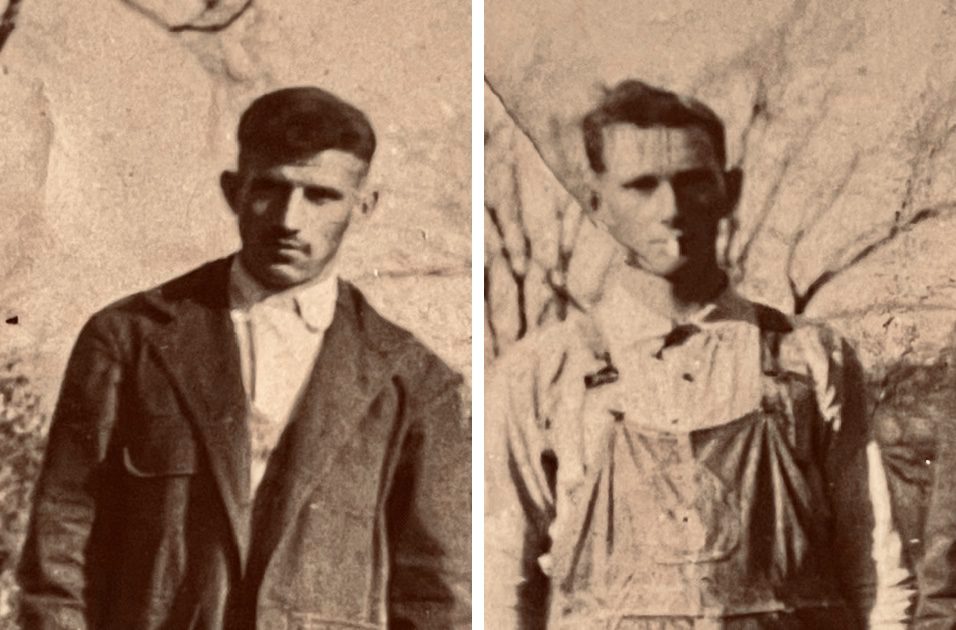
Albert Beck (Rosa Beck Schmieder’s Brother) – Alexander “Benny” Feist (Hired man)
“The family built the future not all at once, but in humble labor — load by load, loaf by loaf, and the laughter of their children—until hope became home.”
Before the cows could be moved from the rented Kreutter Farm on Hall’s Hill to the newly bought Phelps Farm — perched on the hill’s south side above the icy stretch of Tonawanda Creek and its frozen flats — every load of hay, straw, grain, corn, and beans had to be transported first. Every forkful of feed and sack of seed was a lifeline: essential for keeping the livestock fed through winter and for providing seed for spring planting.
Strong and sinewy, his face weathered by war and seasons in the fields, George Schmieder worked alongside his brother-in-law, Albert Beck, whose thick, wavy dark hair was already dusted with chaff, and their steady hired hand, Benny Feist. The three men moved quietly in the shadowed loft of the haymow as pale winter light filtered through the open barn doors.
With sharp-tined pitchforks and wooden handles worn smooth by calloused hands, they loosened and lifted the sun-dried hay in a steady, practiced rhythm. Each forkful landed with a soft rustle onto the open-sided wagon standing below. The warm, fragrant scent of summer’s dried grasses—clover, timothy, and alfalfa—hung in the barn air as the load rose, forkful by forkful, higher and higher.
Dust motes drifted lazily through beams of light above the smooth oak floor—the same floor where, years earlier, fiddle tunes and laughter had risen into the rafters when neighbors gathered for barn dances. Frances Amanda Brainard-Smith had opened the doors on those nights, carrying forward a tradition rooted in the land itself. Born in 1853 and raised on the Brainard Farm along the southern boundary of what would later become the Schmieder place, she was rooted in land her family had held since her great-grandfather, Col. Sebe Brainard, first purchased the tract in 1811.
In the 1910s, widowed and resolute, she bought the Hall’s Hill farm from Edward Timm, renamed it Highland Hall Farm, and built a modern dairy barn to raise purebred Holsteins and prize bulls. On those long evenings, boots stomped the oak floor, reels spun, and joy carried late into the dark—sounds settled into the grain of the wood.
Now there was no music—only the hush of quiet voices and the soft swish of hay falling onto the wagon. No fiddles, no dancers—just the steady work of packing up a life, one forkful at a time, to begin again.
Lingering Reminders of the Great War
After tossing the last forkful of hay onto the wagon, George paused, leaning on his pitchfork and rubbing his elbow—an old ache that had never fully left him since the Great War.
On June 9, 1918, amid the chaos and thunder of battle, twenty-one-year-old Georg Schmieder—a soldier in the 8th Battery of the 55th Field Artillery Regiment of the Kaiser’s Imperial Army—was hit in the elbow by machine-gun fire, narrowly avoiding a fatal wound. Medics treated him at a field hospital behind the front lines, where the groans and dying breaths of wounded comrades echoed around him—men whose bullet-riddled bodies would not survive the day.
Though George considered himself lucky, the wound caused him constant pain, along with increasing stiffness that made even simple movements painful. Sixteen days later, on June 25, he was transferred to a reserve military hospital in Lübben for further treatment and recovery under the care of Ward Physician Dr. Hoffmann. He remained there until he was discharged on August 16, 1918.
Lübben, nestled in the Spreewald district—a region renowned for its winding waterways and shadowed forests—offered a rare peace far from the front lines. Today it lies in the state of Brandenburg, near the Polish border.
George would never forget the long rows of narrow iron beds beneath tall windows, the harsh sting of disinfectant, or the quiet murmur of wounded men—each carrying pain no doctor could fully mend.
Despite his injury, George found moments of unexpected calm. He came to cherish the warmth of the Lübben summer — the rustle of wind through the trees, the slow drift of the streams, the steady rhythm of farmwork during rehabilitation, and the quiet camaraderie of men briefly spared the horrors of the front.
In that peaceful village, he recovered with gratitude, breathing in the soft breezes that drifted through the open windows — a gentle contrast to the biting barn air and the heavy burden of loading hay on that cold winter day.
The memory of that sterile, silent hospital never faded. Each time the pain returned, it reminded him not only of his own wound but also of the millions who never came home—more than two million German soldiers killed and over four million wounded, including himself and his brother Xaver. The ache in his elbow was more than a lingering injury; it was a shadow of war that would follow him always, regardless of how many wagons he loaded or fields he plowed.
A Wagon Toward Home, One Load at a Time
The steel-rimmed wheels of the hay wagon groaned and creaked under the weight of the load as the team of draft horses leaned into their harnesses. Their thick winter coats shielded them from the biting wind, while soft plumes of breath rose into the cold, clear air. With every jolt, the steel-rimmed wheels ground over the frozen ruts, biting into the hardened earth of the barren fields stretching from the rented Kreutter Farm to the new Schmieder homestead. Perched high atop the wagon, George held the reins steady, guiding the team forward — step by step—toward a life they were building anew.
Inside the house, Rosa paused at the frosted kitchen window, one hand resting on the sill warmed by the cook stove’s gentle heat. She wiped a clear circle on the pane and motioned for the children to join her. Arnold, George Jr., and little Paul scrambled up beside her, their breath fogging the glass as they pressed small hands to the icy surface.
Together, they watched as George drove the team past the house, the wagon piled high with golden hay, the harness bells jingling faintly in the stillness of the winter morning. Rosa caught sight of him lifting one gloved hand in a wave—a quiet promise that, despite the cold and the uncertainty, they were moving forward, load by load, step by step, into whatever hope awaited beyond those frozen fields.
Stacking Hope Under the Barn Roof
At the new farmstead, Albert and Benny, bundled in their worn wool coats, pulled open the heavy barn doors and set to work adjusting the ropes and pulleys of the hayfork, which rattled along its steel track above. George guided the team forward as the hay wagon creaked into place beneath the double-harpoon fork hanging from the rafters.
With practiced ease, Albert released the fork, its sharp tines plunging deep into the loose hay. George and Benny steadied the load, packing each forkful tight to keep it from slipping.
Outside, another draft horse leaned into its harness. The rope pulled taut, lifting the hay skyward. The trolley clattered along the overhead rail, carrying the load toward the waiting loft. With a swift tug on the trip rope, the fork sprang open, releasing their first mound beneath the barn’s peaked roof — the first of many.
Each load became a quiet act of gratitude — laid down not only for the winter ahead, but for the long road behind them: the lean years, the cold Atlantic crossings, and the war that nearly claimed George’s life on June 9, 1918. Beneath the roof of George’s barn, every forkful felt like a silent acknowledgment of divine providence.
Breaking Bread, Savoring the Warmth of Home
With the hay wagon emptied, the men brushed the chaff off their coats and headed toward the house. At the door, they were greeted by the warm, yeasty smell of Rosa’s fresh rye bread and the cheerful shouts of the children, who ran to meet them. Inside, the scent lingered on the cookstove’s warming shelf, blending with the steam of a midday soup.
At the table, Rosa sliced the thick, crusty loaf as George went up the creaking attic stairs. In the cold shadows beneath the rafters, he carved a piece of Speck — cured pork fat wrapped in linen and aged in the stillness above.
Down in the damp cellar, Benny drew a jar of tart, hard cider from the barrel. Soon, they gathered around the table, layering thin slices of smoked Speck onto warm rye bread — a simple meal, full of comfort and rich in memories of the old country. The clink of cider jars mingled with the children’s laughter and lively playfulness, filling the house with warmth and the quiet happiness of a fresh start.
Harvests Yet to Come
Outside, the fields lie frozen and bare, yet a quiet hope stirs in their hearts — that with every load of hay stacked high, each loaf of bread pulled warm from the oven, every burst of laughter from the children, and each hour of honest labor within their corner of God’s creation, something is taking root. Not only in the soil, but in the living roots of family — where the inheritance of faith, hope, and resilience will one day blossom — quietly, steadily — through the generations to come.
Note: This account of George and Rosa Schmieder’s lives weaves together oral history, documented events, and thoughtful interpretation. It reflects both historical fact and family memory, while acknowledging the limits of fully capturing lived experience across time.
Frederick Schmieder