

Chapter 21 – The Crash on the Hill and the Birth of Erma Rosa
The Storm
Two days after Easter, on April 22, 1930, winter returned. Overnight, a sharp north wind swept across the fields, and by morning the temperature had plunged to a record low of 23 degrees. Before dawn on April 23, an out-of-season storm blew in suddenly—driven by strong winds and blinding snow. It caught farmers off guard. Plows sat idle in the fields, fresh furrows turned white under the quickening drifts, and ice rimmed the edges of Tonawanda Creek. Field work ground to a standstill.
Inside the house, George carried in split logs from the woodshed—the winter pile running low—and fed the woodstove against the unexpected cold. At the sink, Rosa watched the snow thicken across the yard, her worry rising for the children who would soon be walking home from school in such weather.
The delay in planting weighed on everyone’s mood. Oats, potatoes, corn, and beans still needed to be sown, yet the land lay frozen again under April snow. George, Albert, and the hired men sat down to their midday dinner, with George Jr., Paul, and Herbie gathered close as the storm rattled the windowpanes.
Afterward, Albert shoveled a path to the barn, and the men set about cleaning stalls before the evening milking. Manure was scooped into a cart that ran along an overhead track; the rail extended fifty feet outside into the pasture, where each load was dumped into growing piles. Fresh straw was forked into the stalls, bedding smoothed, and buckets set out for milking. Their talk was quiet as they worked in the shelter of the barn from the weather outside.
They were finishing the stalls when the barn door banged open, and a neighbor stepped inside, snow crusted on his cap and shoulders, breath hanging white in the cold air. He spoke in a low, shaken voice: a plane had crashed on a hill a couple of miles southwest of the Schmieder farm. With no phone or radio, the story had passed from mouth to mouth—that three men were dead. The barn fell nearly silent beneath the lowing of cows shifting in their stanchions.
The Newspaper Account
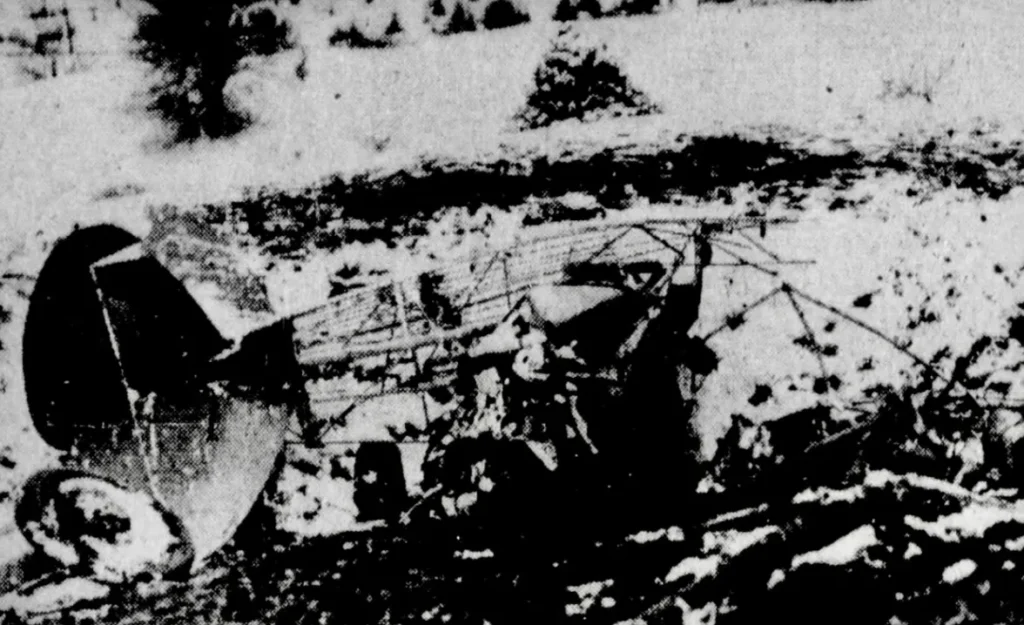
The next day, The Buffalo News reported that a blinding snowstorm led to a fatal plunge into a hillside when the pilot’s final attempt to turn failed. The article reported that three airmen met instant death at 1:02 p.m. on April 23 when their plane crashed into a steep hillside on the Arthur Green farm, just above the Attica & Arcade rail line south of the village of Attica.
The aircraft, a Verville Air Coach (registration NC-70W), was a modern civilian airplane of its era. Designed by aviation pioneer Alfred V. Verville, the Air Coach marked a shift from open-cockpit biplanes to safer, enclosed-cabin cross-country travel. Introduced in the late 1920s, it featured a high-wing monoplane design for stability, a fully enclosed cabin seating three to four passengers, and a welded steel-tube fuselage covered in fabric. Its fixed, rugged landing gear made it suitable for farm fields and improvised airstrips—common realities of early aviation.
The dead were:
Capt. Lionel M. (“Woolfsohn”) Woolson, 42, Detroit — world-renowned aeronautical engineer for the Packard Motor Car Company and designer of the Packard diesel aircraft engine; survived by his wife and two young daughters.
Carl B. Knight, 23, Detroit — test pilot for the Verville Aircraft Company.
Harold B. Scutt, 39, Douglastown, Long Island — pilot; survived by his wife and two children.
Their Verville Air Coach, registration NC-70W, was en route from Detroit to New York City for an aviation exhibition and then on to Boston. After refueling in Buffalo, they continued eastward but encountered a sudden snowstorm.
According to Harry Tenhagen, foreman of the Attica–Arcade Railroad crew, the plane approached low from the west, its engine straining, before banking sharply eastward—likely searching for a landing field. Visibility vanished in the blowing snow. Just fifty feet short of a safe clearing, the aircraft struck the hillside at nearly 100 mph, somersaulting down the slope and into a ravine.
When rescuers reached the wreckage, the fuselage was a twisted mass of metal. The watches on Knight and Scutt had stopped at 1:02 p.m., the moment of impact. Dr. W. D. Preston, the first official on the scene, helped remove the bodies, and County Coroner Dr. John Kneller determined that Scutt had been at the controls, his restraint still fastened.
Crowds gathered quickly, and before police and state troopers could secure the site, fragments of the plane were taken as souvenirs.
Birth of Erma Rosa
On Thursday, April 24, the thermometer barely touched thirty-five. The cold settled hard across the farm, icing the pump handle. Inside, the house grew still with expectation. Water rolled in the big kettle on the stove; clean sheets lay ready, and the doctor was sent for. Whether he could come was uncertain— Dr. Kneller had spent the previous day at the crash site and at the undertaker’s, identifying the three men and notifying their families.
Rosa gripped the edge of the table, her breath catching with each tightening. George and Albert kept the younger children occupied while Magdalena prepared the room. Across the Tonawanda Flats, the whistle of a distant train drifted over the fields. Rosa’s labor gathered into its final, familiar rhythm.
Magdalena worked steadily beside her, calm and practiced, while George kept the stove fed, glancing often toward the road for any sign of the doctor. Inside, the room glowed with a soft, dim light and quiet urgency. Doctor or no doctor, the work of birth pressed on.
The house was hushed except for Rosa’s breathing and the low murmur of the children. In the bedroom off the dining room, Rosa delivered a healthy baby girl—Erma Rosa—her seventh child in ten years. For a brief moment, the sorrow of the crash on the hill gave way to the quiet wonder of new life. Inside the farmhouse, warmth gathered again.
As the day unfolded, they received fragments of news from Attica—details of the wreck, whispers of the families now left behind. The shock of it weighed on everyone, settling over the community like the cold itself. Yet within the Schmieder farmhouse, the hours took on a different shape. Rosa rested with baby Erma in her arms, the other children moving softly around her, their voices low as they peeked in to see their new sister.
Outside, the snow melted in slow patches across the yard, leaving the ground dark and shining. The plow furrows began reappearing one by one. Life on the hill had been marked by sorrow only the day before, but now, in that house, hope had returned in the shape of a child. In the midst of loss beyond their home, the Schmieders received the quiet blessing of new life—Erma Rosa.
Note: This account of George and Rosa Schmieder’s lives weaves together oral history, documented events, and thoughtful interpretation. It reflects both historical fact and family memory, while acknowledging the limits of fully capturing lived experience across time.
Frederick Schmieder