

Chapter 23 — Every Wagon Counted
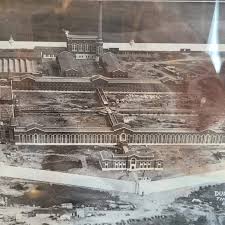
Photograph of Attica Prison Construction, 1930s
In 1930, the construction of Attica Prison reshaped life across Genesee and Wyoming Counties. Alongside it, this chapter follows how one family navigated a year of tightening demands, from gravel hauling to new dairy inspections and quiet household adaptations.
That spring, talk across Genesee and Wyoming Counties turned to the massive new project rising just south of the village of Attica—the construction of the state prison, begun in 1929. Men said it would take forty-one million bricks. Already, hundreds of laborers were pouring into the growing site—masons, stonecutters, carpenters, and inmates brought in from Auburn—while rail lines were added, roads filled with wagons and dump trucks, and steam shovels bit into the glacial hillside. Men said the prison was built to last, meant to stand for generations, long after the wagons and teams were gone.
For many, it meant wages and steady income; for others, a quiet unease about an inmate population close by. They worked in plain denim trousers and heavy shirts, caps pulled low as they moved under the quiet supervision of guards in dark wool uniforms, who stood apart, watchful and still.
When time permitted and money grew tight on the farm, George took on work hauling gravel from the pits. He and Albert took Lonny and Topsy from their stalls, fitted the collars and leather harness, set the singletrees and evener, and hitched them to the wagon, the tongue running between the pair.
George took hold of the reins, a cigarette held between his lips. The steel wheels screeched across the highway on the way to the pits. He and Albert shoveled steadily into the high-sideboard wagon, then pulled the load toward the prison site, the team breathing hard, nostrils flaring. The state paid by the load; every wagon counted.
From the road, the prison’s rising walls came into view—a skeleton of steel and concrete against the midday sky, already climbing some thirty feet and stretching for more than a mile, thick and formidable even before the work was finished. The gravel-fed walls meant to stand massive and permanent, sunk deep into the earth and built thick against time. The extra dollars went where they were needed most: to keep the mortgage paid.
By midsummer, the work had drawn the state’s direct attention. On Tuesday, July 22, 1930, Governor Franklin D. Roosevelt passed through Alexander on his way to Attica to inspect the progress of the new prison. A small group of residents stood along the road waving flags, among them two of the village’s oldest men—A. B. Harrington, ninety, and Russell Curtiss, ninety-seven.
By the fall, the scale of the project drew scrutiny as well as labor. A Buffalo Evening News reporter sent to investigate complaints circulating in Attica found the construction camps orderly and well supplied, housing free laborers brought in through employment agencies—many from Buffalo—who worked long hours for steady pay, meals, and lodging. Alongside them were inmate crews under guard, and beyond both were local men like George, hauling gravel from the pits by the load. Farmers, hired laborers, and prisoners all fed the same rising walls, each layer of work governed by different rules, wages, and expectations, yet bound together by the same unfinished structure pressing upward from the hillside.
Inspection — Regulations
As the state asserted its authority in the construction of a new prison at Attica, it was also extending its reach into the daily work of the farm. By late spring, as milk prices remained low, word spread that New York would tighten oversight of dairy production. Beginning July 1, 1930, dairies were to operate under expanded sanitary standards and stricter grading requirements for both milk and cream, part of a statewide public-health effort to improve quality and bring inspection under more uniform control. Inspection trucks equipped with mobile laboratories began collecting samples directly from farms, while local health officials were charged with continued enforcement. George knew of area farmers who had lost a load to inspection.
Milk had long been subject to regulation, but cream was now fully brought under the same sanitary and bacterial standards. The measures used to judge raw milk applied equally to raw cream, while pasteurized cream was divided into graded classes based on bacterial counts and handling. The regulations also sought to prevent the diversion of milk or cream intended for manufacturing into household use, closing practices that had long existed in quiet gray areas of farm life.
With the new requirements in place, George did what he could to keep his milk and cream from being downgraded. He scrubbed the cans more carefully, scalded them more often, and paid closer attention at the barn: cleaner hands, cleaner udders, quicker cooling once the cans were filled. Milk was hauled sooner, shaded when possible, and watched closely when word spread that inspectors were on the road. Even so, the price was never certain, and a load could still be marked down. The gravel hauling helped steady things, paid by the load and not the grade, filling the gaps when the milk check came up short.
Albert’s Still
Not all of the state’s reach into farm life was visible, as Albert kept another kind of work going quietly at the house. In the basement, out of sight, he tended a small still where shadows of dim light fell against the stone walls. The door to the outside was closed and locked. His recipe included a mash of cherries, peaches, pears, plums, and sugar, allowed to ferment.
When readied, he boiled the mixture in a closed copper wash tub on a small gas burner. He watched over it with gentle patience, late into the night, as the vapors condensed in the coiled tubing and cooled into liquid. It was work done mainly in the fall, meant to last through the year, and spoken of only when it needed to be.
For many, it was considered medicinal when the work ran long, and bodies wore down, taken quietly for sore backs, stiff hands, and the wear that settled where rest alone could not restore. Gus cut his with fruit juice. Albert took his straight.
In those years, families were still permitted to make cider and fruit wine for their own use, and in rural places, small household distilling—especially when kept quiet and spoken of as medicinal—was seldom questioned.
Anniversary
On November 7, 1930, the calendar marked George and Rosa’s tenth wedding anniversary. Ten years earlier, they had been quietly married at St. Martin’s Church, in the shadow of Freiburg Cathedral. Neither could have foreseen the years that followed—the lean years and the work they carried—marked now with a glass of cider between them.
Christmas Eve Escape
At St. Vincent’s Christmas Mass, George heard word of an escape from the prison camp at Attica, sharpening the unease some already felt living so close to the works. The night before, on Christmas Eve, four prisoners had slipped away during a holiday gathering at the camp, their absence not discovered until roll call. People said the men made it into the village and took a car before leaving the area. State troopers and police from surrounding communities were called in to search the countryside.
All were short-term men, eligible for parole, and they were soon accounted for. Still, the episode lingered—a reminder that the prison, rising and unfinished on the hill, was not yet the settled institution it was meant to become.
Note: This account of George and Rosa Schmieder and their family life weaves together oral history, documented events, and family memory. It reflects the historical record where available and lived experience as remembered and passed down, recognizing that no account can fully capture a life across time.
Frederick Schmieder
———————————————————————
____
Family Notes — Prohibition, Cider, and Household Use
Prohibition began nationwide in January 1920, banning the manufacture and sale of intoxicating beverages under federal law. The Volstead Act defined “intoxicating” very broadly, but it also included limited household exceptions that mattered in rural homes.
Families were permitted to make non-intoxicating cider and fruit juices for their own use, and fermented fruit kept for household or medicinal purposes often occupied a tolerated gray area. What counted as “non-intoxicating” under the law did not always match how people understood cider or wine in everyday life.
Distillation, however, was treated more strictly, which is why such work—when it occurred—was kept quiet and spoken of carefully.
In New York, enforcement shifted over time. The state adopted strict enforcement in 1921 under the Mullan–Gage Act, then repealed it in 1923, leaving much enforcement uneven and largely federal. In rural communities, what was kept for family use and not sold was often left alone.
This was the legal and moral landscape in which Albert’s work took place—careful, contained, and understood within the household rather than advertised beyond it.
Family Notes — Prison Escape
The four men who escaped the Attica Prison Cantonment on Christmas Eve were tracked through the snow to the village. Their tracks were lost on the snow-covered roads. The inmates took Sylvester Grass’s 1926 Ford Coupe on North Street and drove out of town. A statewide manhunt ensued.