

Chapter 25 — Broadway Pilgrimage
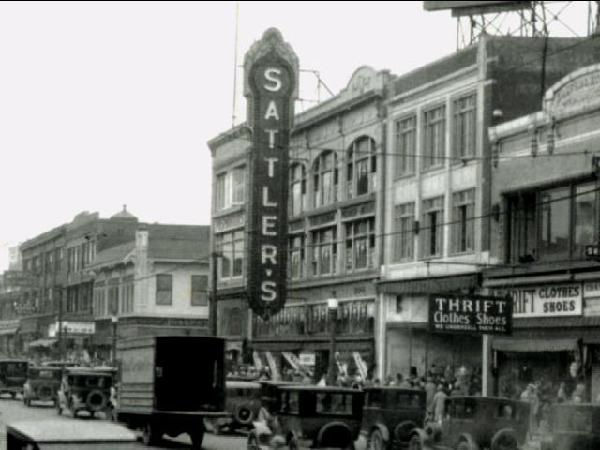
Sattler’s Department Store, 998 Broadway, Buffalo, New York — Broadway–Fillmore District
A Season of Counting
It was a season when coins were counted carefully, and grace was awaited even more so.
Throughout late winter and early spring, Rosa Beck-Schmieder set aside pennies earned from maple syrup, eggs, and butter — quietly saving for the day when Fred and Hilda would kneel at the altar to receive their First Holy Communion. In the early 1930s, such preparation required more than prayer and sacrifice. It called for a small pilgrimage beyond the farm.
The Milk Platform
One Saturday morning, weeks before the sacrament, Rosa, Hilda, and Fred walked down the long driveway and stood on the east side of Allegheny Road — later called Alexander Road — beside the wooden platform George had built for setting out the milk cans.
It was a place of routine and labor, now briefly transformed into a place of departure.
Hilda and Fred climbed onto the platform as the sun rose over the Tonawanda Creek valley, peering south with bright expectation. Rosa checked her bag once more — coins counted, directions folded inside — her thoughts already weighing the day, the distance, and all that must go well.
The Road to Batavia
“The bus is coming!”
Hilda and Fred sprang from the platform as the coach drew near, gravel shifting underfoot. The brakes gave a long, high squeal and then fell quiet. The driver, neat in uniform and cap, pulled a lever, and the door folded open with a soft mechanical flap. Warm air drifted outward, carrying the faint scent of motor oil and wool coats.
Rosa reached into her bag, counted the coins carefully, and placed the exact fare in his hand.
Inside, the coach felt like a narrow room set in motion — rows of broad seats upholstered in tough brown mohair, windows shaded halfway against the early glare. The engine deepened as the driver shifted into gear. The floorboards trembled beneath their shoes as the bus began its slow climb up Hall’s Hill.
Hilda pressed close to the window.
Rosa chose a seat near the aisle and folded her hands over her handbag. In her mind, she moved ahead of the wheels: Alexander to Batavia. Batavia to Buffalo. The car changes. The return fare counted and tucked safely inside.
She had studied the timetable the night before, tracing each stop with her finger, and had also reviewed Gus Kautz’s directions. Gus, who worked for the International Railway Company, had explained where to change lines once they reached the city. Rosa repeated it all silently now, steadying herself against the hum of the engine.
The farm fell slowly behind them.
Hilda sat up straight, studying the passing houses and the telephone poles strung with green glass insulators flashing in the morning sun. Fred felt the bus’s vibration through his whole body as he fixed his gaze on the driver, watching him lean into the long gearshift and listening to the rise and fall of the engine’s hum.
The Blue Bus Line
When they reached the Batavia station, the brakes sighed, the door folded open, and they stepped down to change buses for Buffalo.
The regional coach — the “Blue Bus,” as people called it — waited near the corner of Ellicott and Court Streets, its paint dulled by road dust but its lettering still proud. It ran the old Main Street road east and west, long before anyone imagined a Thruway. For farm families traveling toward Buffalo, this was the dependable line.
Rosa guided Hilda and Fred up the narrow steps. The seats were firmer than those on the first bus. The windows were taller. The engine carried a deeper, steadier sound — built for distance.
The bus followed Route 5. Villages passed more quickly now. Telephone poles marched in straight lines beside the road. Fred listened to the engine settle into its rhythm.
By the time they reached Buffalo, the buildings rose higher and stood shoulder to shoulder. The Blue Bus pulled into its terminal on Main Street, where engines idled and passengers stepped down into the layered noise of the city.
Here, Rosa tightened her grip again.
They walked to the streetcar stop beneath humming electric lines.
The car they needed bore a simple sign: #4 Broadway.
The cream and green streetcar arrived with the clear ring of its bell and a brief flicker of sparks where the trolley pole met the wire overhead. The doors folded open.
Under the Trolley Wire
Inside, the car was narrower than the bus but taller. Sunlight filtered through wide windows, falling across varnished wooden seats worn smooth by thousands of riders. The slats curved gently at the back, polished by years of coats and shoulders shifting forward with each stop.
Rosa stepped in first.
Near the entrance, the conductor stood steady against the sway of the car. A leather change carrier hung across his chest, its brass tubes lined with nickels and dimes. In his other hand, he held a small steel punch.
Rosa counted the fare carefully and handed it to him. He dropped the coins into the metal fare box, where they rang with a clatter. With a practiced squeeze, he punched their paper transfers; the sharp metallic snap carried briefly through the car.
“Broadway,” he said with a nod.
They moved down the aisle.
Overhead, the trolley pole hummed against the wire — a steady electrical murmur that powered the car’s motion. Every few blocks, a soft crackle released the faint scent of heated metal.
Hilda read the painted signs as they passed — grocers, tailors, bakeries with loaves stacked in careful rows. Laundry lines stretched across narrow alleys. The buildings pressed closer together now, storefronts crowding the sidewalk as the street narrowed toward the East Side.
Each time someone boarded, coins clicked into the changer. The conductor’s fingers moved without hesitation — select, release, return. The punch snapped again. Another transfer. Another rider. The rhythm repeated.
Fred studied the mechanism overhead, the slender metal arm pressing upward against the wire. The entire car moved because of that single, narrow contact point.
Outside the window, the rhythm changed.
Where Saints Marked the Streets
Closer to downtown, older surnames could still be found carved into stone lintels — quiet traces of the German families who had first built these streets. West of Jefferson Avenue, church towers marked neighborhoods shaped by their labor.
When the streetcar slowed, passengers swayed gently in unison. When it accelerated, the hum deepened. Automobiles rolled briefly alongside, then fell back.
At the stops farther east, more passengers boarded, and the language shifted.
Polish rose in steady conversation from the seats behind them — quick and warm in cadence, unfamiliar to Hilda and Fred’s ears.
They had reached Broadway–Fillmore now.
Different language. Same faith.
From the window, church towers marked the boundary more clearly than any street sign.
To one side rose the copper domes of
St. Stanislaus Bishop and Martyr Church.
Farther still, the Gothic lines of
St. Adalbert Basilica cut into the pale sky.
Behind them, nearer the older German quarter, stood
St. Louis Church and
St. Ann Church — older sentinels of an earlier wave.
You could tell where you were by the names of the churches.
At last, the conductor called out, “Fillmore.”
The brakes engaged with a low, grinding sigh. The hum overhead softened.
The doors folded open.
And the three of them stepped down at Fillmore and Broadway, one of the busiest intersections in the state — second only, people said, to Times Square.
998 Broadway
Crowds edged through the crossing. Automobiles idled nose to nose. Streetcars rang their bells and slid past. Voices overlapped — English, Polish, laughter, bargaining. The air carried coal smoke, bread, and the faint metallic tang of wires overhead.
The church towers remained visible beyond the rooftops as the crowds thickened at the corner of Fillmore and Broadway.
There it stood — Sattler’s at 998 Broadway, its vertical sign rising straight and tall above the street.
Inside Sattler’s
Rosa pushed open the heavy glass door, and the noise of the street softened behind them.
Inside, the store moved with steady purpose.
Conversation carried across the counters in quick exchanges. Overhead, coded chimes sounded — three tones, a pause, two tones — summoning someone unseen. Along the ceiling, narrow metal tubes ran in deliberate lines toward the central cashier’s office above. At the counters, brass cylinders were sealed and dropped into round stations, then vanished with a hollow rush of air — drawn upward through the pipes before returning with a firm, answering thump.
The air carried the faint scent of machine oil from the elevator motors and pneumatic machinery, mingled with the starch of new garments and the warm trace of smoked sausage drifting up from the basement market.
Hilda turned slowly, taking in the height of the ceiling and the counters crowded with folded linens, gloves, and neatly stacked goods.
Fred’s gaze lifted to the narrow metal tubes overhead. He followed the path of a carrier as it vanished into the pipe and returned again with a muted thump. The store seemed to run on hidden lines of motion, everything traveling somewhere unseen before coming back confirmed.
Rosa stood steady between them. For a moment, her gaze lingered on the new electric appliances — refrigerators, stoves, washing machines — their polished enamel promising lighter days at home. She let the thought pass.
For a moment, neither child spoke. It was nothing like Zwetch’s General Store in Alexander, with its high shelves and single counter.
The Upper Floor
Rosa asked a clerk quietly, her English careful and deliberate, where she might find Communion attire. The woman gestured toward the elevators at the center of the floor.
They joined a small cluster of families waiting beneath a polished brass indicator dial. When the doors opened, an attendant in white gloves stood inside, one hand resting on a slender lever.
“Second floor — women’s dresses and children’s wear,” she announced as they stepped in.
The doors folded shut. The car rose with a gentle hum, the floor steady beneath their feet. Hilda felt the slight lift in her stomach as the indicator crept upward. Fred watched the operator’s hand on the lever, fascinated by the precision of it.
The doors opened again.
Here, the light seemed softer.
Hilda turned slowly, taking in the sweep of white before her. Lace collars. Folded gloves. Veils resting in tissue. She had never seen so much brightness gathered in one room.
Dresses stood in patient order — organdy over satin, taffeta skirts holding their shape. Some were simple. Others nearly bridal.
A small card, discreetly pinned to one sleeve, read $6.50. Another: $9.75.
Across the aisle hung boys’ suits — dark wool knickers most common, trousers gathered neatly below the knee. Crisp white shirts were stacked in folded piles. Narrow ties rested in shallow boxes. A few white suits hung in careful ranks.
A tag on one read $8.00.
Gloves — twenty-five cents. Veils in paper sleeves — seventy-five. Small prayer books bound in white — less than a dollar.
Hilda touched the sleeve of one dress lightly, as if testing whether it were real. Fred stood straighter near the suits, suddenly aware of how tall he wished to appear.
She had counted carefully. Milk prices had not returned to what they once were. Maple syrup and eggs only stretched so far. Dress. Veil. Shoes. Suit. She reckoned the total and nodded once.
Rosa examined the stitching, the seams, the weight of the cloth between her fingers. Hilda stood before a long mirror while a dress was held against her shoulders. The veil was placed lightly atop her hair. For a moment, she did not recognize herself.
Fred’s suit was chosen with less ceremony but no less care. Rosa pressed the wool between her thumb and forefinger, checked the stitching along the seams, and asked that he try the knickers for length. The jacket sat squarely. The trousers gathered just below the knee as they should. It would serve not only for this day, she thought, but for Sundays yet to come.
When the garments had been set aside for purchase, they returned to the elevator. The attendant drew the doors closed and eased the lever forward. The car descended with a steady hum. Hilda watched the brass indicator lower one notch at a time. Fred kept his eyes on the operator’s gloved hand.
Wrapped in Brown Paper
Back on the main floor, the shoe department lay near the front windows. Rows of polished leather lined the shelves — sturdy lace-ups for boys, strap shoes for girls. Rosa selected white ankle-strap shoes for Hilda, modest and secure, their leather stiff with newness. For Fred, she chose dark oxfords with firm soles and clean stitching, suitable for Communion and for school afterward.
The clerk knelt to measure their feet against a metal sizing scale, then returned with boxes tied in twine. Rosa counted her bills carefully as the payment was prepared for the central cashier.
The clerk opened a small brass cylinder lined with felt at each end. She tucked Rosa’s cash and the sales slip inside, twisted the cap tight, and placed it into the round mouth of the tube station mounted beside the counter.
With a firm push, it vanished.
A hollow rush of air followed — a swift, unseen pull upward through the pipes. Somewhere beyond the ceiling, a muted thump answered.
Fred’s eyes lifted instinctively.
For a moment, the counter stood still.
Then, from within the pipe, came the returning sound — a growing whoosh, a soft descending rush — and the cylinder dropped neatly back into its cradle with a solid knock.
The clerk opened it and counted the change into Rosa’s hand.
Fred felt the satisfaction of it — the order, the certainty. Nothing was left loose. Nothing misplaced. Everything traveled out of sight and came back accounted for.
When the parcels were wrapped in brown paper and string, Rosa gathered them close. Suit and dress above. Shoes below.
Everything needed now lay folded and boxed in her arms.
Outside, Broadway continued in its restless motion.
Rosa paused at the doorway, Hilda and Fred beside her, before stepping back into the street. In her arms lay wool and voile, leather and lace — ordinary things, purchased with care.
Within them waited a morning at St. Vincent de Paul Church — quiet, white, and holy.
Author’s Note
This account of Rosa, Hilda, and Fred Schmieder’s journey to Sattler’s in Buffalo, New York, weaves together oral history, documented records, and family memory. It reflects the historical record where available and lived experience as remembered and passed down, recognizing that no narrative can fully capture a life across time.
Frederick Schmieder