

Chapter 28 — On Hall’s Hill
The Passing of Highland Hall Farm
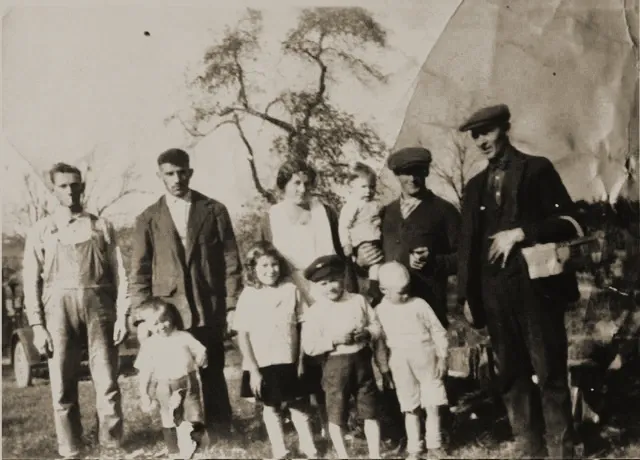
Front row (left to right): George Jr., Hilda, Fred, and Arnold.
Back row (left to right): Benny Feist (hired hand), Albert Beck (Rosa’s brother), Rosa Schmieder holding Paul, George Schmieder, and Max Rauscher (family friend).
A Fire Across the Frozen Fields
On the morning of Sunday, February 21, 1932, George Sr., Albert Beck, Fred, and Arnold stepped out of the warmth of the barn after finishing the morning chores, a pail of fresh milk and a basket of eggs in hand for breakfast. The winter air was sharp—eighteen degrees across the frozen fields of the Schmieder farm.
Then came the sound—the long, rising wail of the Attica fire siren, echoing across the quiet countryside.
Across the open farmland of Gulf Road, a faint trace of smoke rose above the buildings of the Attica Prison Farm nearly two miles away.
At about 7:50 a.m., a fire broke out in a small wooden building used to store harnesses and farm equipment. When the State purchased the property during construction of Attica Prison, the structure was converted into a bathhouse and laundry facility before eventually returning to its original use as a storage shed.
The alarm carried across the frosted hills and valleys, summoning the village’s volunteer firemen.
Only the previous autumn had the department acquired a new motorized fire truck. This morning’s alarm marked the first time the Ford engine, equipped with a pumping apparatus, was sent out on an actual fire call. Within minutes it was heading up Gulf Road toward the prison farm, its tires gripping the winter road as the men rode out to meet the smoke rising above the building.
When the firemen arrived, their equipment rattled toward the farm building. Flames had begun to spread inside the structure, likely sparked by an overheated stove in the bitter winter weather. Fire Chief Frank Timm and his men worked quickly, pulling equipment from the building while others directed streams of water into the smoldering interior. Within a short time the blaze was under control. Damage was limited, and the building survived.
For the Schmieder family, the place held deeper memories.
Only a few years earlier, the farm that would later become the prison farm had been the first home of George and Rosa as they began their new life in America. The fields surrounding the buildings had once been part of their daily work and routine—the place where the quiet rhythms of farm and family life slowly took root in their new country.
On many mornings, George had walked to that same building to lift the harness and collars from their wooden pegs, the familiar smell of leather and neatsfoot oil filling the room before the teams were hitched for the day’s work. Not far away, the railroad line leading into and out of Attica crossed the countryside, and the whistles of passing trains often drifted across the fields.
But on the morning of February 21, 1932, the smell drifting from the building was not leather and oil, but smoke.
Rosa’s First Winter
Memories of the farm returned readily. It had not been an easy beginning. Rosa often remembered the stark winter of 1924 when she first arrived, scarcely two weeks before Christmas, with Hilda, Fred, and little Arnold.
The unfamiliar surroundings, the dark and drafty house, and the bitter wind sweeping across the open fields deepened Rosa’s loneliness in those first weeks. The farmhouse felt barren and strange—far removed from the villages and familiar customs of the old country.
That first Christmas in the new world felt lonely and uncertain. Rosa looked into the faces of her children, tears in her eyes, her heart aching at the starkness of the season so far from the home they had left behind.
The day passed quietly, marked more by homesickness than celebration. Yet Rosa quietly resolved that the Christmases to come would be different—filled with warmth, family, and the joy she hoped to build in this new land.
During their time on the farm, the family faced a near tragedy. Young Fred accidentally fell into a large wash boiler filled with boiling water used for the prison farm laundry and suffered severe burns. For weeks, he lay in a small ward at St. Jerome’s Hospital in Batavia, the quiet ward lined with iron beds and white linens, while Rosa prayed for the life of the child she had brought across the ocean as the Mercy Sisters tended his bandaged wounds.
Even years later, the cry of a child could stir those memories—of hardship, fear, and the fragile hope with which their life in America had begun.
Highland Hall Farm
On a rise south of the village of Alexander stood a farm on Hall’s Hill, once known as Highland Hall Farm, a place that had gained national attention for its breeding of Holstein-Friesian cattle in the 1910s.
Around 1926, George and Rosa Schmieder rented the property after leaving the farm that would later become part of the Attica Prison lands. The farmhouse, later the home of the Kautz family, stood on the crest of the rise, while the large barn below, once built for the purebred Holstein herd of Highland Hall Farm, remained a familiar landmark along the Alleghany Road (later Alexander Road). By then, however, the earlier prestige associated with Highland Hall Farm had largely faded.
In the late autumn of 1928, after purchasing the neighboring farm, George and Rosa moved their family from the property. The farm itself belonged to Henry Kreutter and his wife, Adelia, of Alden, New York, who had rented it to the Schmieders. The Kreutters then settled into the aging farmhouse and continued working the land.
Hard Times on Hall’s Hill
By the winter of 1932, the Great Depression had left the farms surrounding Alexander in a difficult season. Milk prices had fallen sharply, and many farmers struggled to keep pace with taxes, mortgages, and rising operating costs. The prosperity that once seemed within reach now rested on uncertain ground.
For the twenty-nine-year-old Henry Kreutter, his wife Adelia, and their three young children, the pressure of holding on to the farm grew heavier with each passing month. On Hall’s Hill, the years of promise surrounding Highland Hall Farm had long since passed. The property that had once drawn national attention with the sale of a record Holstein bull now faced the same economic realities confronting farms across western New York during the early years of the Great Depression.
In March 1932, Kreutter appeared before a Genesee County Court jury in Batavia, charged with issuing a worthless check for $196.49 in payment of his town taxes—an amount that represented a heavy burden for a struggling farm. Kreutter and his attorney, Bradford J. Burroughs, maintained that he had asked Fred Brown, the tax collector, to hold the check and not present it for payment until sufficient funds were available. The case, reported in the local newspapers, briefly placed the young farmer and his family under public scrutiny and carried the frightening possibility of jail.
The jury ultimately returned a verdict of not guilty, sparing Kreutter the threat of imprisonment. Yet the verdict did little to alter the farm’s harsh financial reality. With only a few dollars left in the bank and debts continuing to mount, the strain proved too great, and Kreutter could no longer afford to continue operating the property.
The property passed from Henry Kreutter’s hands into those of his father, Gottlieb Kreutter, who assumed the farm and its mortgage.
Henry eventually moved to another farm on Creek Road across Tonawanda Creek, where he continued farming and raised his family. Gottlieb rented out the farmhouse on Hall’s Hill, while portions of the surrounding land were rented to George Schmieder, who worked some of the fields in the years that followed.
But in 1937, tragedy struck again when the great barn burned to the ground.
Shortly thereafter, George Schmieder purchased the farm on Hall’s Hill and later sold the farmhouse to Rosa’s sister and brother-in-law, Theresia and August Kautz.
Across the countryside, the troubles of those years appeared in many forms—fires in farm buildings, falling milk prices, and the mounting debts that brought farmers before the county courts. Yet the land itself endured, carrying forward the memory of the families who had worked its fields.
The fields of Hall’s Hill had known both success and hardship. In earlier years, the barns of Highland Hall Farm drew breeders and dairymen from across the country in search of prized Holstein bloodlines. By the winter of 1932, those days had passed, and the farm stood among many others facing the uncertainties of the Great Depression.
Yet life on the surrounding farms could not simply stop. Even as milk prices fell sharply—dropping to little more than a dollar per hundredweight in some markets—the daily work continued. Many families, including George and Rosa, carried a quiet worry that they, too, might lose everything, just as they had ten years earlier, when their life in Wagenhausen had slipped away.
On the neighboring hillside, George and Rosa Schmieder toiled to build their own future from the same soil, milking cows, raising children, and carrying forward the steady work of farm life through the hard years of the Depression, long after headlines and fortunes had faded from Hall’s Hill.
Note: This account of George and Rosa Schmieder and their family life weaves together oral history, documented events, and family memory. It reflects the historical record where available and the lived experience remembered and passed down through the family, recognizing that no single account can fully capture a life across time.
Frederick Schmieder