
Chapter 29 — On Hall’s Hill
The Rise and Passing of Highland Hall Farm (Brainardhurst)
In 1811, Jonathan Hall Jr. purchased a forested tract of land in the newly formed town of Alexander, New York, aided by his father, Dr. Jonathan Hall of New England. Jonathan Jr.’s son, James C. Hall, a Harvard graduate, would later withdraw from society after his parents’ deaths, becoming known locally as the Hermit of Alexander, as his home, land, and barns gradually fell into disrepair.
Over time, the farm on Hall’s Hill passed through several hands. In 1903, it was purchased by Edward Timm. In 1912, his thirty-three-year-old wife, Lulu, died of tuberculosis, leaving two young daughters. The loss lingered over the household. Not long after, the property would pass again, this time to Frances A. (Franc) Brainard Smith.
Frances, known as Franc, was born in 1853 on the Brainard farm, originally purchased by her great-grandfather, Col. Sebe Brainard, an officer in the Revolutionary War. The farm lay to the south of what would later become the Schmieder farm. In time, the Brainard farm would be purchased by George Schmieder as he expanded his operation, and in the years that followed, three of George and Rosa’s children—Hilda, Fred, and Herbert—would build homes there.
Franc married Flint Penefield Smith. They lived in Flint, Michigan and he became a successful businessman and banker. Together, they raised two children. After his death in 1909, she assumed responsibility for their substantial estate and commissioned the construction of a nine-story building in downtown Flint in his honor.
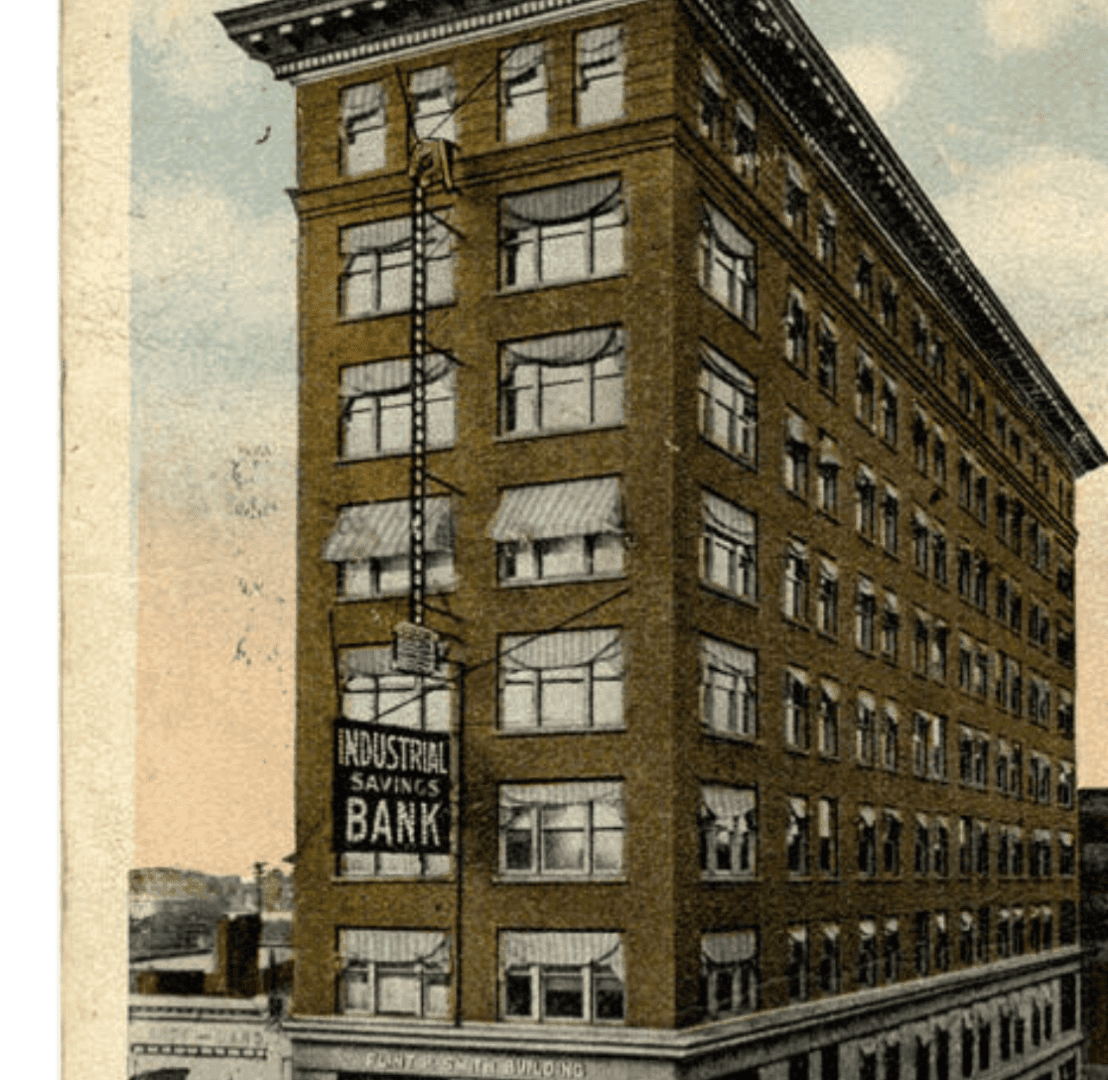
Flint P. Smith Building, Flint, Michigan, c. 1916. Built by Frances A. Smith in honor of her late husband.
Her years in Flint had not been without difficulty. In February of 1898, a fire destroyed the Smith residence, though some personal belongings—including china, diamonds, and a piano—were saved. A few years later, in January of 1906, another fire destroyed a large barn on the property, resulting in the loss of horses, carriages, and vehicles, including two Buick automobiles—one owned by Smith, the other by D. D. Buick of the Buick Motor Company.
In the years that followed, she returned to Alexander, to the farm of her childhood and to her widowed mother, Luretta Baldwin Brainard (1828–1921).
From there, her attention turned again to the land she had once known.
In the years before the Depression, Franc A. Smith developed the farm into one of western New York’s most notable Holstein breeding operations. The barns and rolling pastures of Hall’s Hill became known among dairymen for the quality of the herd raised there—cattle shaped not only by labor, but by intention.
At the same time, across the Atlantic, George Schmieder served as a soldier in the German Army during the Great War—a reminder that while the land here was being cultivated and refined, much of the world was passing through a very different trial.
Her newly built dairy barn was considered among the finest in the country. From the barns of Highland Hall Farm—also known as Brainardhurst—the herd carried forward the strongest blood of the breed—Segis, Pontiac, and the deep maternal lines of Pietertje—into the expanding national herds of the early twentieth century.
A Record Bull on Hall’s
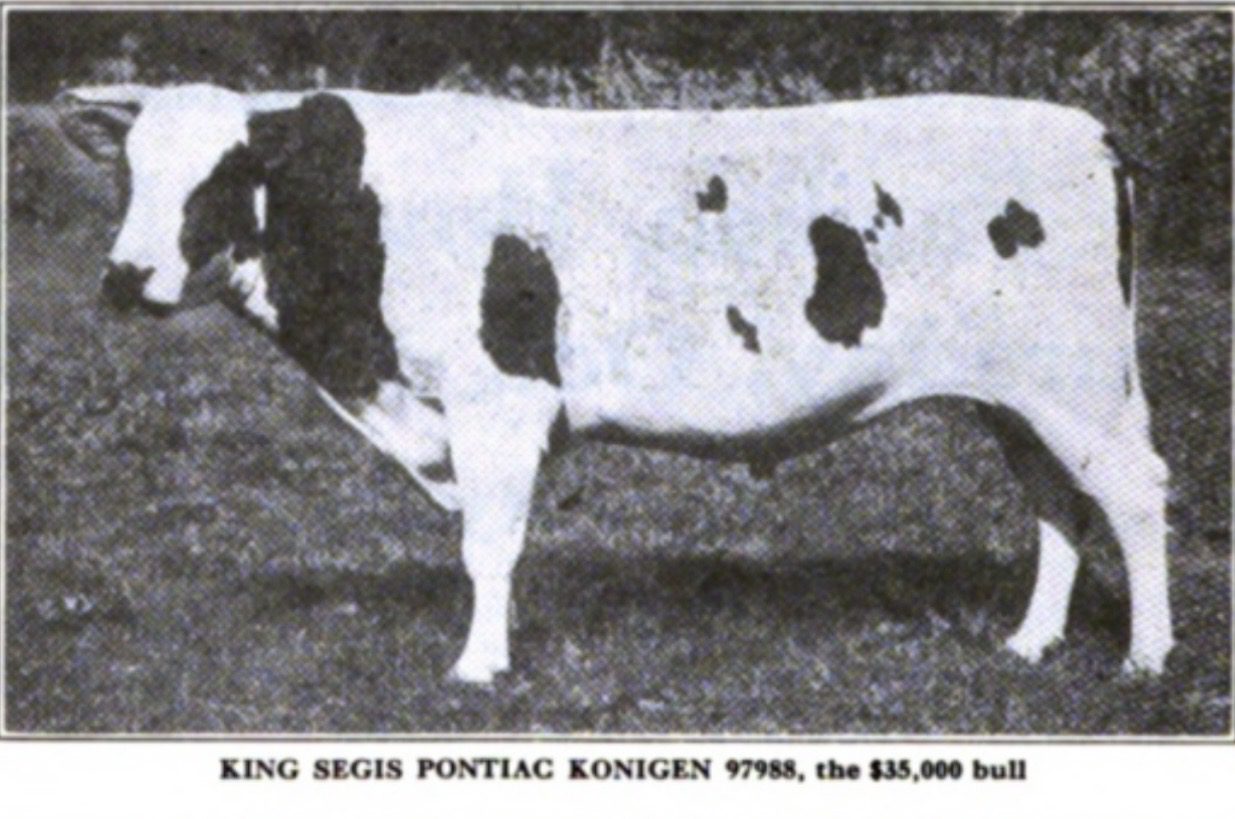
In September of 1916, the Holstein sire King Segis Pontiac Konigenstood at Highland Hall Farm, his pedigree already recognized among breeders for its strength and promise.
He was a powerful, well-balanced animal, his black-and-white frame bearing the marks of careful selection. In those years, the value of such a sire was measured not only in form, but in what might follow. A single bull could shape herds for years to come.
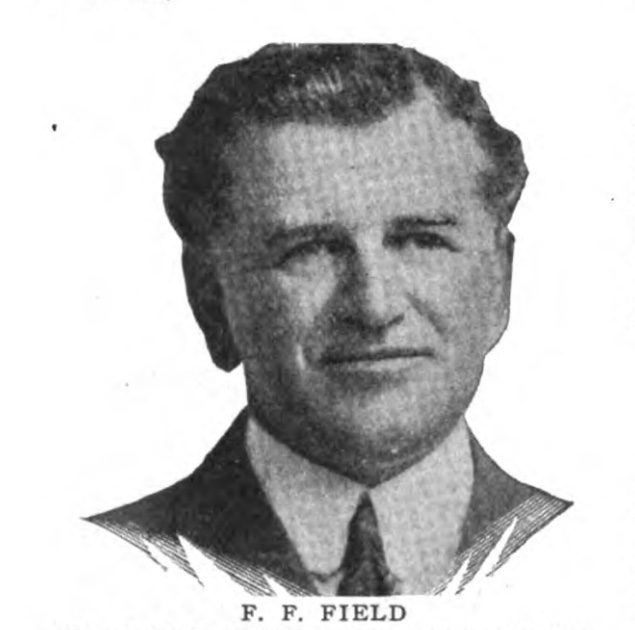
Fred F. Field of Brockton, Massachusetts, purchased King Segis Pontiac Konigen for $35,000—the highest price ever paid for a dairy bull at that time.
That late summer, he was sold to shoe manufacturer and breeder Fred F. Field of Brockton, Massachusetts, for thirty-five thousand dollars—the highest price ever paid for a dairy bull at that time. The figure quickly spread through agricultural journals and by word of mouth, and for a time, the farm above Alexander was at the center of the American Holstein world.
Transported east in a special express rail car, the animal carried with him not only extraordinary value but also the reputation of the farm he came from. The sale brought national attention to the farm on Hall’s Hill, marking a brief moment when the quiet fields of Alexander were known far beyond Genesee County.
When King Segis Pontiac Konigen left Alexander by rail, he carried with him not only extraordinary value but the quiet imprint of the sixty-three-year-old woman who had brought him to that moment.
The Segis Bloodline and Its Influence
During the late nineteenth and early twentieth centuries, one of the most influential families of Holstein cattle descended from a sire known as King Segis. Imported from the Netherlands, he became known among breeders for transmitting both strength of form and consistent milk production.
As herd books expanded and milk records were kept with increasing care, breeders turned more deliberately toward animals whose qualities could be measured and trusted. Cattle bearing the Segis name appeared often among the highest-producing herds.
The pedigree of King Segis Pontiac Konigen reflected this union of inheritance and selection—bringing together the Segis line, the strength of Pontiac breeding, and the enduring maternal line of Pietertje. In such animals, breeders saw not only present worth, but the promise of what might follow.
Highland Hall (Brainardhurst) at Its Height
At its height, Highland Hall Farm stood among the most regarded Holstein operations in the country, where barn dances brought together friends and neighbors. Its pastures and barns reflected a steady, intentional work, guided by Frances A. Smith. Her name often appeared in print alongside the pedigrees of the Holsteins she bred, and the sale of 1916 brought that reputation into wider view.
Dispersal and Passing
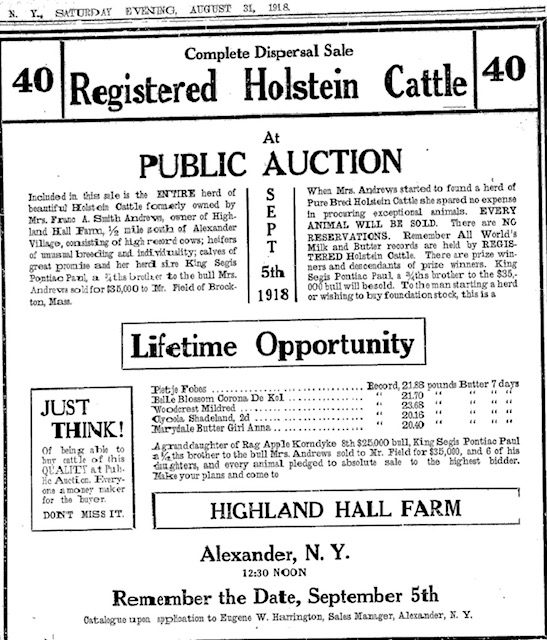
Two years later, in 1918, after her remarriage to Truman Andrews, Smith held a dispersal sale of the Highland Hall herd. Forty registered Holstein cattle were offered at auction, described in advertisements as a “Lifetime Opportunity,” and buyers came to acquire animals descended from the farm’s carefully built lines.
In those same years, she had taken an active role in the newly formed Alexander chapter of the Red Cross, serving as an officer and contributing to the local wartime effort. The demands of the war reached even the quiet fields of Hall’s Hill. Reliable farm labor had become increasingly difficult to secure, and the steady work required to maintain a breeding operation of such scale grew more uncertain.
Across the Atlantic, George Schmieder had already passed through the hardships of that same war, under very different conditions.
The herd was scattered. The work, as it had been known, came to an end.
The barns remained. The fields remained.
But the particular moment—the one in which Highland Hall stood at the center of a wider Holstein world—quietly passed.
The End of the Highland Hall Legacy
On June 22, 1936, the large dairy barn that had once stood as a centerpiece of Franc A. Smith’s Highland Hall Farm—built during the years of its greatest promise—was destroyed by fire. Sparks from a hay press owned by Roy Glor of Varysburg ignited loose straw, and the structure was lost.
It was not the first time fire had touched the Smith holdings.
George Schmieder, working the land of owner Gottlieb Kreutter, had stored hay and straw in the barn at the time of the fire. In its destruction, he and Kreutter lost nearly forty tons of hay and thirty tons of straw—stores gathered through the season, gone in a single afternoon.
The barn, with its scale and modern design, collapsed as flames and smoke rose above Hall’s Hill.
On October 12, 1937, George Schmieder purchased the farm from Gottlieb Kreutter, bringing that same ground into his care. In time, he sold the house and a portion of the acreage to August and Theresia Kautz.
Frances A. Smith Andrews died on November 18, 1941, in New Scotland, New York, at the age of eighty-eight, closing a life that had, for a time, shaped the fields of Hall’s Hill.
Note: This account of the Schmieder family’s connection to Highland Hall Farm (Brainardhurst) and the life of Frances A. Brainard Smith draws upon oral history, documented events, and family memory. It reflects the historical record where available and the lived experience as remembered and passed down through the family, recognizing that no single account can fully capture a life across time.
Frederick Schmieder
Additional Note: Advertisement published in the Batavia Daily News, August 31, 1918.