
Chapter 3: Journey of Sacrifice – George Leaves for America, 1923
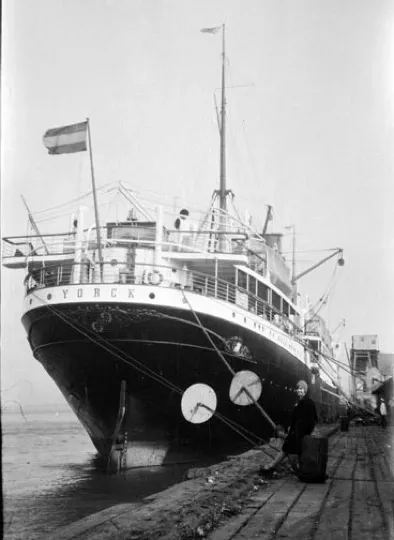
SS Yorck – George’s Voyage to America, 1923
Back to the Beck Family Home
It was a restless night. The winds howled outside, mirroring the inner turmoil that churned in the hearts of George and Rosa Schmieder. They had recently moved from a small third-floor apartment in Radolfzell to Rosa’s family’s rented home, a historic homestead dating back to 1605. This house was once part of the grand Geroldseck Castle, which met its demise at the hands of the French in the late 1600s. The homestead then came under the guardianship of the village of Schönberg.
Monika, who was sixty-one, had shoulders hunched from years of hard work. As she lit the cookstove, warmth spread through the kitchen, its dark walls telling stories of smoking meats that had left them cloaked in soot. The hearty aromas from breakfast filled the air, teasing everyone with the promise of a satisfying meal ahead. Meanwhile, Rosa’s sisters, Magdalena and Theresia, busily assisted their mother while also caring for Hilda and Friedrich, whose laughter infused the morning routine with cheerful energy.
Meanwhile, her brothers—Albert, Jakob II, and Wilhelm Beck—were busy tending to the morning farm chores, their youthful strength contrasting with the somber atmosphere in the house. In the corner, her father, Jakob, aged seventy-one, sat with faltering health and trembling hands, a stark reminder of the toll that time and labor had taken on his once robust frame, making it increasingly difficult for him to contribute to the family’s daily toil.
A Final Embrace
As George’s departure time drew near, Rosa’s brothers hitched the horse to the wagon. The soft light of the early morning wrapped around Rosa and George as they clung to each other, their fingers woven together like threads of a fragile tapestry. In that fleeting moment, the weight of their imminent separation sank in, filling the space between them with silent promises and a profound longing. They both understood this would be their final embrace for the foreseeable future, their hearts heavy with uncertainty yet intertwined in love.
With a gentle caress, George rested his hand on Rosa’s protruding belly, a gesture overflowing with love and an unspoken blessing for their soon-to-arrive third child. The moment was bittersweet, a profound sorrow enveloping his heart and gnawing at his soul. It intensified the ache of longing within him, knowing he would miss the opportunity to hold his newborn child and witness the growth and playfulness of Hilda and Friedrich.
At every turn, life seemed to wield a heavy sword against him, striking with relentless blows: the chaos of war, the loss of his cherished home and farm in Bolstern, the anguish of a child suffering from rickets, and a deep, unresolved rift with his mother. Could leaving his homeland, burdened with these seemingly insurmountable problems, usher in a fresh start, a new beginning? Or would the weight of his fate crush his spirit even further?
He held Hilda and Friedrich one last time, whispering assurances that their family would soon be reunited. In that final embrace, the weight of their love hung heavily in the air, filled with unspoken hopes and dreams. George stood on the brink of a life-altering journey—a treacherous voyage across the Atlantic to an unknown world. With every ounce of his heart and a hint of divine grace, he believed he could create a new life for himself and the family he cherished deeply. Even as dawn broke, shadows continued to envelop their world, reflecting the bittersweet nature of sacrificial love for family.
The Wagon Ride to Farewell
The six-mile wagon ride to the train station in Lahr felt heavy with unspoken emotions. The wheels creaked under the burden of George’s trunk and luggage, each jarring movement pulling him further away from the only home he had ever known. As they journeyed through the Geuertal, the familiar valley of Zipperhof—his family’s cherished home—flashed by like a bittersweet memory. He passed by St. Stephan’s Church, where echoes of his childhood prayers lingered, and the Poche, a place that cradled the tender beginnings of his love for Rosa. Each landmark felt like a farewell, leaving him with a profound sense of loss for the family he might never see again and the dreams that now seemed impossibly distant.
Northbound Through a Broken Germany
George stepped aboard as the train’s whistle pierced the crisp morning air, a sound that cut through the stillness of dawn. The first leg of his journey carried him from Lahr to Offenburg, a bustling railway hub in Baden-Württemberg. Here, he transferred to a northbound train laden with travelers searching for hope and solace amid the turmoil engulfing Germany. The wooden seats creaked beneath him, a trivial discomfort compared to the urgency of his situation.
As the train rumbled through Karlsruhe and Mannheim, George gazed out the window, captivated by the ever-changing landscape. The majestic, dense woodlands of the Black Forest gradually gave way to the sunlit, expansive farmlands of Hesse. However, George had little money for food, as rampant hyperinflation had rendered the German mark worthless. The economic crisis was so severe that thousands of Germans emigrated for better opportunities.
Reports from that time indicated that the price of a loaf of bread had soared to 200 billion marks, a pound of meat reached an astonishing 1 trillion marks, and a glass of beer cost around 20 billion marks, highlighting the staggering economic collapse that defined Germany during this period.
His journey, woven by the sacrifices of relatives in America, was supported by the precious dollars, currency that still held its value in a collapsing world.
Upon arriving at Frankfurt Hauptbahnhof, one of Germany’s busiest stations, George maneuvered through the throngs of people, each with their own story etched on their faces. He was determined to board the correct northbound train. The final leg of his expedition took him through Kassel and Hannover, with brief moments that allowed him to stretch his weary legs on the platform, breathing in the mingled scents of sweat and hope. Nearly 18 hours after he departed from Lahr, he finally arrived in Bremen, a step closer to a future unknown but desperately yearned for.
Bremen – Last Stop Before the Unknown
Bremen was the point of departure for countless emigrants from Germany and Eastern Europe, each leaving behind their homeland for a brighter future. Exhausted from the arduous train journey, George arrived at a modest immigrant lodging house near the bustling docks, where he would spend a restless night before embarking on the SS Yorck.
The harbor at Bremerhaven buzzed with urgency. Longshoremen loaded cargo while children clung to their mothers’ skirts, filled with fear and excitement. At the same time, young men like George nervously smoked, their faces reflecting anticipation and anxiety as they embraced a new beginning.
The SS Yorck, a majestic German passenger liner under the banner of Norddeutscher Lloyd, loomed ahead, readying itself for the perilous transatlantic voyage. With a third-class ticket in hand, George’s passage would be the steerage section of the ship, sharing cramped quarters with a throng of fellow hopeful emigrants, all united by their dreams of opportunity. Although the accommodations were not ideal, it was an improvement over the foxholes he had become accustomed to during the Great War.
Stepping Onto the Ship of Hope
On Saturday, October 27, 1923, George stood before the towering ship that promised to take him to America, a heavy weight of uncertainty pressing against his chest, amplifying his resolve. Familiar questions churned relentlessly in his mind—Would he find meaningful work in this new land? How would he communicate without knowing the language? Would his family be safe from uncertainty? Would he earn enough to bring Rosa and their children, still caught in a world of hardship, to join him? Would he ever see his parents and siblings again and the places that held the essence of his roots?
With these pressing concerns swirling in his thoughts and no clear answers, he tightly gripped his travel documents and resisted the temptation to return to his family. He inhaled deeply to calm his racing mind and crossed the threshold into a new world fueled by unwavering faith, hope, determination, and perseverance. He knew his family depended on him, and he was resolved to succeed.
Crowded Quarters and Rough Seas
Upon boarding, George was directed below deck to the steerage section of the SS Yorck, a common experience for many immigrants during the early 20th century. The steerage accommodations were notoriously cramped and uncomfortable; third-class passengers were crammed into large dormitory-style rooms that featured rows of metal bunks. These rudimentary sleeping arrangements were often inadequate, with rough wool blankets draped over straw mattresses that were infrequently cleaned, leading to unsanitary conditions that could quickly become breeding grounds for fleas and bedbugs.
Rats were a common sight on steamships, particularly in the cargo holds and food storage areas, where they accessed provisions meant for passengers and crew. To combat these infestations, shipowners introduced ship cats, which were often selected for their hunting prowess. These animals helped to control the rodent population, becoming a familiar presence on board.
The third-class steerage sections of steamships were typically located below the waterline, contributing to poor ventilation and elevated humidity levels. Passengers traveling in these cramped quarters endured stale air that was a mix of seawater, lingering body odors from fellow travelers, and a faint trace of coal smoke from the ship’s engines, as many vessels of that era were coal-powered.
Dining in the communal hall was basic, reflecting the economic status of steerage passengers. Meals were often simple and unvaried, consisting mainly of boiled potatoes, thin soup, bread, and coffee—foods that were easy to prepare but lacked nutritional value. Moreover, sanitary conditions on these ships were substandard; a few washbasins available for hundreds of passengers highlighted the challenges of maintaining hygiene in such crowded environments. This led to the potential spread of diseases during voyages, making life at sea particularly difficult for those in steerage.
During the perilous journey across the cold, stormy expanse of the North Atlantic Ocean in November, third-class passengers faced significant discomfort, often succumbing to debilitating seasickness. The ship’s relentless rocking and limited ventilation in the cramped steerage quarters exacerbated their suffering. The first two to three days of this tumultuous adjustment period were especially grueling as passengers tried to acclimate to their confined surroundings. To manage the widespread nausea, vomit buckets were strategically placed throughout the steerage section. Unfortunately, the sight of one person succumbing to seasickness frequently triggered a distressing chain reaction among others. Desperate for relief, many passengers chewed on ginger or hardtack biscuits, common remedies believed to alleviate their symptoms.
Many travelers were fellow Germans, but there were also Eastern Europeans—Poles, Russians, and Czechs—seeking the same promise of opportunity. Some fled the dire grips of poverty, while others sought refuge from political upheaval in their home countries.
During their two-week journey, friendships blossomed among the travelers. They formed quick bonds, frequently extending a helping hand and offering emotional support to those facing challenges. Laughter and camaraderie filled the air as some passengers spent their evenings engaged in spirited card games, sharing stories and laughter that turned acquaintances into lasting memories.
Lady Liberty in Sight
On Friday morning, November 9, 1923, with temperatures at 30 degrees, the sun began to rise over the horizon, and a muffled yet palpable murmur spread among the eager passengers aboard the SS Yorck: “Land in Sicht!” (“Land in sight!”). George, filled with anticipation, rushed to the upper deck, joining the crowd of fellow travelers pressing against the railings for a better view. As the vessel glided into the harbor, its hull slicing through the waters, anticipation rippled through the crowded deck. Passengers gathered, exchanging glances filled with hope and trepidation as they eagerly awaited their first glimpse of the “land of opportunity.”
And there she was—Lady Liberty, the iconic symbol of freedom and hope, her majestic torch burning brightly, a beacon standing 305 feet above the waters of the Hudson River.
Emotions swelled around him; some wept tears of joy, while others whispered fervent prayers. Many stood in awe-filled silence, absorbing the breathtaking sight. For many, this symbolized a geographical arrival and the first realization of the American Dream—a tangible manifestation of opportunity and promise that lay before them and their future generations.
The SS Yorck had safely carried them across a vast and mighty ocean. However, the journey was far from over; Ellis Island loomed ahead, where one last formidable obstacle awaited them: the immigration inspection.
As the vessel glided into the harbor, its hull slicing through its waters, anticipation rippled through the crowded deck. Passengers gathered, exchanging glances filled with hope and trepidation as they eagerly awaited their first glimpse of the “land of opportunity.”
Ellis Island: The Final Hurdle
After docking at the East Pier, George and the other third-class passengers were gathered onto a ferry headed for Ellis Island. Unlike the wealthier travelers in first and second class, who were processed swiftly upon arrival, steerage passengers faced a stringent screening process designed to ensure they were healthy, financially capable, and not a burden on American society.
As the ferry neared Ellis Island, the imposing red-brick immigration station appeared. The atmosphere was charged with excitement and anxiety, symbolizing hope for some while marking an end to dreams for others.
Upon entering the facility, George joined a lengthy queue of immigrants tightly gripping their travel documents and scant belongings. Their first stop was the Registry Room, a vast hall with soaring arched ceilings and rows of weary travelers resting on wooden benches. George waited anxiously as doctors clad in white coats navigated the lines, performing swift medical examinations.
Medical Examination
The Ellis Island doctors were known for efficiently examining thousands of immigrants daily. Georg’s height and weight were measured, and his eyes were checked for trachoma, a contagious disease that could lead to deportation. The physician also assessed his overall health, checking for signs of tuberculosis or other illnesses.
When the doctor nodded and moved on, George exhaled in relief—he had passed the medical inspection.
Legal Inspection & The Final Questions
Next, he climbed the stairs to the Registry Room’s second floor, where immigration officers waited to verify his identity and eligibility to enter the U.S. Georg had heard stories of immigrants being detained or sent back if their answers didn’t match their paperwork.
The officer, seated behind a wooden desk, asked questions through a German interpreter:
- “What is your name?” – “Georg Schmieder.”
- “Where are you from?” – “Schönberg, Germany.”
- “Do you have family in America?” – “Yes, my uncle Anton Schmieder in Attica, New York.”
- “Do you have work arranged?” – “I will work on a farm.”
- “Do you have money?” – “Yes, I have some savings.” (He presented the small sum he had managed to bring.)
The officer scribbled notes in his ledger and nodded approval, clearing George for entry into the United States!
The Journey to Attica, New York
After successfully passing through Ellis Island, George purchased a one-way train ticket to Batavia, New York, and on to Attica. At the Ellis Island ticket counter, he received the rail passes and detailed instructions for his journey. Along with fellow immigrants, he was ferried across the Hudson River to the Jersey Central Railroad Terminal, where powerful steel locomotives awaited. The bustling station was filled with travelers, families reuniting, and porters skillfully handling an array of luggage—much more activity than George had ever witnessed in his quiet village in the Black Forest.
Inside the train, the air was thick with the smell of coal smoke from a coal-burning stove, wooden seats, and the faint scent of oil lamps. The rhythmic clatter of the wheels against the tracks quickly became a comforting lullaby as the train journeyed northwest through the diverse landscapes of New Jersey, heading deeper into the heart of New York State. He sat by the window, watching the unfamiliar scenery unfold—vast expanses of farmland, quaint small towns, and plumes of factory smoke rising in the distance. Each stop brought new faces to the train; he occasionally caught snippets of English conversations floating past him, words that were still beyond his understanding.
Arriving in Attica: A New Beginning
After a grueling fourteen-hour train ride, George finally arrived in Batavia. He quickly hopped on the New York Central Line, heading toward Attica Station. Within an hour, the conductor’s voice cut through the air: “Attica Station—next stop, Attica!”
George sprang to his feet, his heart pounding with anticipation. He gathered his belongings and rushed to the door, peering anxiously through the window for any sign of his uncle. As the train decelerated, hissing steam escaped from its iron wheels, and George stepped onto the platform, his eyes sweeping the crowd for a familiar face.
Amidst the throng, he finally spotted him—Uncle Anton Schmieder. Anton stood alongside Wilhelm Pfaff, the kind-hearted man who had agreed to sponsor him. A decade older, Anton’s weathered skin bore the marks of long labor on the farm, yet he greeted George with a warm, inviting smile and a firm, reassuring handshake.
“Willkommen, Georg!” Anton exclaimed, pulling him into an embrace that felt like a reunion between long-separated kin.
A wave of relief flooded over George. After weeks of arduous travel, he had finally reached his destination.
They eagerly climbed aboard the horse-drawn wagon and engaged in deep conversation as they started their five-mile journey to Wilhelm Pfaff’s farm on French Road amidst the cold and wind. Unfortunately, George lost some of his luggage, including his passport, during the trip.
Note: This account of the lives of our grandparents, George and Rosa Schmieder, in 1923, and George’s journey to America contains factual events and personal perspectives. It reflects individual interpretations and subjective insights, recognizing the challenge of accurately capturing every detail of past events.
Frederick Schmieder