

Chapter 34 — The Outhouse Behind the House: Necessity and Order on the Schmieder Farm
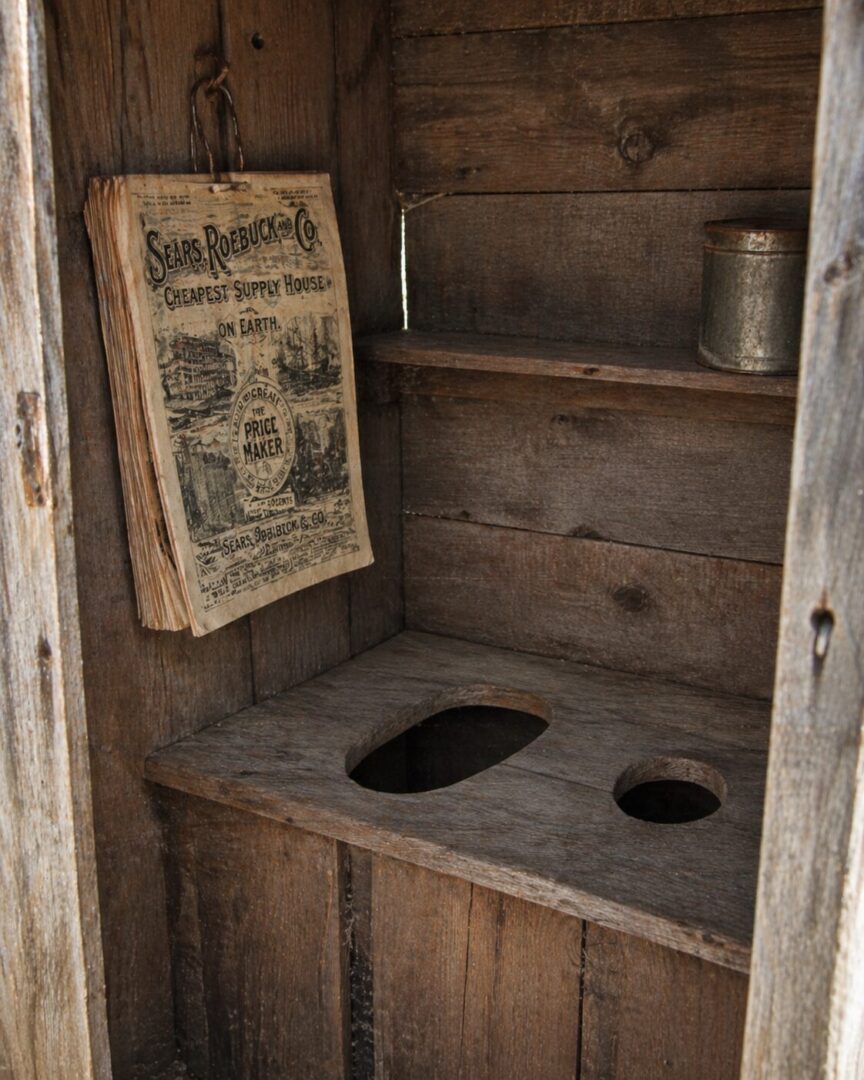
A worn Sears, Roebuck and Co. catalog hung within reach, its pages serving a second purpose—as in an outhouse much like the one behind the Schmieder home.
Before the Outhouse
When the Schmieder family purchased their farm in 1928, life was not easy. The house stood cold and drafty, its walls and loose, chattering windows offering little protection against the wind that swept across Hall’s Hill. It lacked many of the conveniences that would later come to define modern living—there was no running water, no indoor plumbing, and none of the electric appliances that would transform daily life: no refrigerator, no electric stove, no washing machine.
Despite the hardships, there was still reason for gratitude. An electric line had already reached the house—an uncommon advantage for a rural farm at the time. Bare lightbulbs, suspended from yellowed ceilings, cast a steady glow through the rooms, where not long before candles, kerosene lamps, and even natural gas fixtures had pushed back the darkness for the Marsh, Smith, and Phelps families who came before.
Yet beyond that single thread of progress, life remained rooted in older ways. It demanded ingenuity, endurance, and a quiet acceptance of their circumstances. Every task, no matter how ordinary, required effort and intention.
None was more routine—nor more revealing—than the simple matter of sanitation.
At the time of their arrival, the outhouse was not a separate structure but was housed within the woodshed attached to the home. It was a practical arrangement—offering shelter from wind, snow, and rain—but its proximity to the well posed a risk to the water upon which the household depended.
A New Structure Raised
George Schmieder, Albert Beck, and DeForest Christ—the hired man—soon set about improving it.
With shovels and picks, they broke into the earth on the north side of the house, cutting down several feet through clay and rock to form a new pit. From the bed of Tonawanda Creek, gravel was hauled by horse and wagon, then mixed by hand with cement and carefully set in place, lining the pit with permanence.
Weathered boards and straightened nails were used to construct the modest structure—roughly four feet by five feet. A slanted roof shed rain and snow, while small screened openings allowed air to circulate, keeping insects out and helping to manage the persistent odors. The old two-seater board from the original structure was set in place above the open pit.
Inside the Two-Seater
Inside, the structure reflected both practicality and family life. The two-seater arrangement—one larger for the adults, one smaller for the children—was common on rural farms. When the door closed, it gave a dull wooden sound, the latch settling into place and offering a brief moment of dignity and solitude.
Winter Paths and Cold Seats
Winter brought its own discomforts. Snow gathered at the door of the cold outhouse, sometimes needing to be brushed aside before entry. As the drifts deepened, George took to his shovel, cutting a narrow path from the woodshed to the outhouse so it could be reached by all.
The seat held the night’s cold against exposed skin, the air within the small enclosure still and biting. For the younger children, the walk in the dark carried its own quiet trial, each step beyond the doorway a small act of courage, often aided by Rosa or Aunt Magdalena.
Paper, Catalogs, and Economy
There was no manufactured paper kept for regular use. Newspapers and pages from Sears, Roebuck and Co. or Montgomery Ward catalogs were put to use instead, their thin sheets given a second life. Across rural America, such catalogs offered a glimpse of what could be had, though not always what could be bought. Wish lists were quietly formed, only to be set aside for more practical purposes.
A roll of toilet paper, though available at Zwetch’s General Store for five to ten cents, was considered an unnecessary expense for George and Rosa during the Depression, particularly when the milk check came light.
The Work That Fell to the Boys
Maintenance was a regular task, eventually entrusted to the older boys, Fred and Arnold. During the cooler months, when the work was more tolerable, they emptied the pit using buckets fixed to a long pole, holding their breath as they worked. The contents were poured into a large wooden barrel set upon a stone boat. When full, the load was drawn by horse out to the fields and returned to the earth, completing a cycle tied to the family’s labor and the land itself.
Summer Heat and Flies
In the heat of summer, the small building held the warmth of the day, the air heavy and lingering within its walls. Flies gathered despite every effort to keep them at bay, and in the evening, mosquitoes were swatted away. At times, when the warmth brought both odor and flies, a small measure of lime was kept at hand and cast into the pit as needed.
The Ways of Men and Boys
For the men and boys, however, life introduced its own variations on necessity. The barn offered a certain freedom; the gutter provided a quick and convenient place during chores. At night, for the boys, opening a window was often easier than venturing outside. These small adaptations spoke of the rhythms of farm life, where ease and necessity shaped behavior.
Indoors, chamber pots provided a nighttime solution. Each morning, they were carried out and emptied—a quiet task that often fell to the children under Rosa’s watchful care, maintaining order within the home.
And as boys will be boys, even this aspect of life found its way into play. There were contests—informal and unrecorded—to see who could reach the highest mark along the side of the house. It was a fleeting mixture of competition and childhood play, set against the unvarnished backdrop of rural living.
What Endures
Taken together, these details form more than a description of an outhouse. They offer a window into the world of the Schmieder family during the Depression years, revealed through life’s most ordinary necessities. The systems were simple yet demanded effort, and even the smallest daily acts were shaped by resourcefulness, routine, and the small habits formed in daily life.
The old outhouse served the family into the 1940s, when they converted the kitchen pantry into a bathroom, marking a meaningful step toward the modern comforts that would gradually reshape daily life. What was once a daily necessity has passed, yet something of it endures. For it is often in such hidden places, and in such unnoticed tasks, that the deeper character of a family is formed.
Note: This account of the Schmieder family weaves together oral history, documented events, and family memory. It reflects the historical record where available, alongside the lived experience remembered and passed down through the family, recognizing that no single account can fully capture their lives across time.
Frederick Schmieder