

Chapter 35 — For a Season: The Life of DeForest “Chrissy” Christ, Hired Man
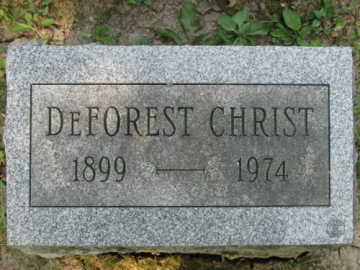
Gravestone of DeForest “Chrissy” Christ (1899–1974).
The Hired Man’s Room
The hired men slept in a room above the main floor of the Schmieder house. The furnishings were spare—a creaking bed, its mattress filled with straw, and little else. The pillows, which Rosa had filled over time with feathers saved from the butchering of chickens, rested unevenly beneath worn cases. When a head turned in the night, they gave a faint sound, almost like the stirring of dry leaves.
In winter, the room held the cold. In summer, it gathered the heat. Their work shoes were kept in the washroom just off the kitchen, set aside at day’s end and taken up again before it began. Morning came early. Long before first light, they were already moving—rising to the work that would carry them through the day, earned at forty dollars a month.
Those Who Came and Stayed
Some stayed only a short while. Others, from the surrounding area, came for day work or a season. A few remained longer, their presence—and their particular ways—gradually becoming familiar within the household.
DeForest Christ was one who remained. He had come into George Schmieder’s employ during the years on Hall’s Hill, when George rented the farm—formerly known as Highland Hall Farm, with its renowned barn built by Franc Brainard-Smith for her Holstein breeding—from the Kreutters, who then owned the property. He stayed in the hired man’s quarters within the barn.
The house on Hall’s Hill would later become the home of August and Theresia Kautz, Rosa’s sister and brother-in-law.
DeForest, known as “Chrissy,” was a smaller man, standing about five feet five inches tall, with dark brown hair and blue eyes. He was born on September 30, 1899, in nearby Orangeville, New York. His father, William Christ IV, had come to the United States as a child from Germany and worked as a farm laborer. His mother was Bernice Mabel Hay. DeForest was named for his maternal grandfather, George DeForest Hay, and was the fourth of ten children.
Early Loss
On February 6, 1910, DeForest’s mother, Bernice, gave birth to her tenth child, Laurence. Two months later, on April 9, she died at the age of thirty. The loss fell heavily upon the Christ family. It came after earlier sorrows—the deaths of two daughters at birth, Charlotte in 1903 and Sylvia in 1908—and the weight of it lingered.
The infant, Laurence, was taken in and raised by an aunt and uncle, Mary Louisa Christ and her husband, James Emery Merrifield—an arrangement born of necessity, as so many were in those years.
At a young age, DeForest was already at work, having completed only the fifth grade, helping to support what remained of the family. Then, on October 12, 1914, when he was fifteen, his father, William, died at the age of forty-six.
Those early losses remained with him, though they were not spoken of.
The Work and the Team
DeForest knew the work well. What was asked, he did. What was set before him, he carried through. He was patient and caring and could be trusted with the horses, often taking charge of the larger team—Lonny and Topsy. They answered to his hand without strain, the lines held firm but never harsh. He kept the pace even, the furrows straight, the work of the day moving forward in its proper order. Their harnesses were kept in good repair, and he took some care in their appearance, adding small touches—an ivory ring among them—that set the team apart.
Small Allowances
There was a quiet understanding between him and the team, shown more in how he handled them than in anything he said. To meet the long demands of the day, a jug of hard cider or wine was often his small allowance.
On one occasion in the spring of 1928, while plowing a field across from the rented house on Hall’s Hill, he asked Fred to bring him a jug of dandelion wine from the barrel kept in the cellar. A siphon was used to draw the wine. As Fred worked it, he drew in a mouthful by mistake, and the basement began to spin. He steadied himself against the barrel, the sharp sweetness catching him off guard.
From the field, he looked toward the house, waiting for Fred to return—but he did not. Chrissy never got his wine.
Evening Habits
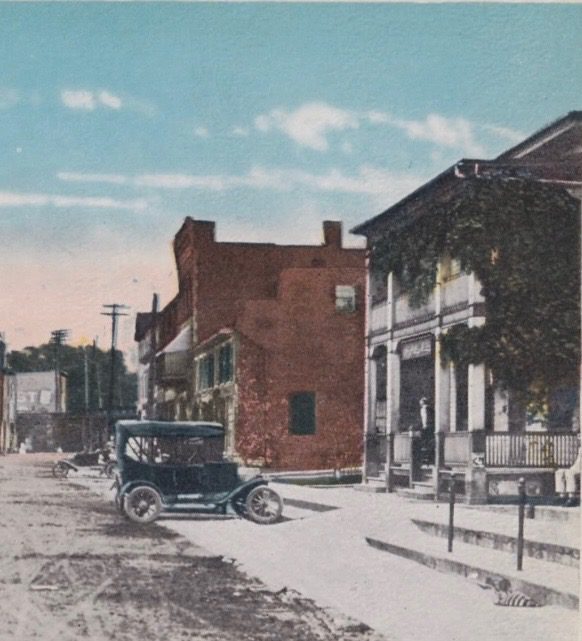
St. James Hotel, Market Street, Attica, New York, c. 1930.
In the evenings, after the work was done, the older boys—Fred, Arnold, and George—would sometimes help him roll his cigarettes, while the younger boys, Herbert and Paul, looked on. The dry tobacco scent rose faintly as it was worked between their fingers and twisted into paper under the dim kitchen light.
He had a fondness for drink. It was reported in the January 2, 1929, edition of The Buffalo News that he had forfeited his license due to intoxication, not long after the Schmieder family had purchased their farm.
At times, after supper, he would take his Model T into Attica, driving to the St. James Hotel. Some nights, he returned late, unsteady on his feet, the climb up the stairs to his room taken one step at a time.
The Boys
It was said that the Schmieder boys had jacked up the rear of his car, setting wooden blocks beneath the axle so it would not move when he tried to drive. They worked quickly, the blocks set in place, a suppressed laughter passing between them as they glanced now and again toward the house and barn before slipping away. The car was left resting just high enough that the wheels turned without taking hold. He stepped from the car, muttering under his breath as he bent to remove the blocks.
What Was Not Spoken Of
In March of 1935, he was convicted and served a four-month sentence in the Genesee County Jail on a statutory charge. It was not often spoken of.
After the Schmieder Farm
After leaving the Schmieder farm, he worked on the dairy farm that Reuben Glor rented from Edward Stroh. In the 1950s, George Schmieder purchased the same farm, which his son Paul operated. DeForest also worked on other farms in and around Warsaw.
For a Season
He never married. His life’s work was that of a farm laborer. In 1974, he passed away, his life marked by loss, hardship, and quiet endurance.
He was not a man who drew attention to himself, nor one whose life was marked by outward distinction. Yet for a time, he shared in the work of the Schmieder farm—rising before dawn, caring for the livestock, and laboring in the fields. What he left behind was not easily measured, but it remained—in the memory of a man who, for a season, lived and worked among them.
Note: This account of DeForest “Chrissy” Christ weaves together oral history, documented events, and family memory. It reflects the historical record where available, alongside the lived experience remembered and passed down through the family, recognizing that no single account can fully capture a life across time.
Frederick Schmieder