

Chapter 36 — The Hired Man on the Schmieder Farm: The Life of Henry Vollmer
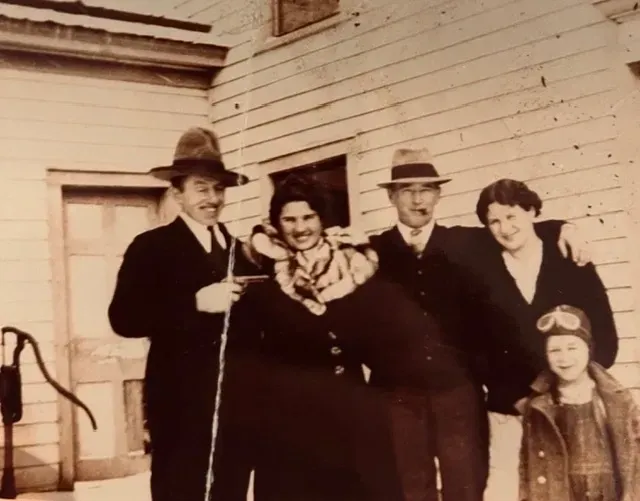
Henry Vollmer (left) and Magdalena Beck (center) on the Schmieder farm, early 1930s, prior to their departure for New York City. Also pictured: George and Rosa Schmieder with their son, George Jr.
Arrival from Ahrensmoor
Among those who passed through the Schmieder farm in its early years was a man who left behind not a long story, but a lasting impression.
Henry Vollmer—born Heinrich Vollmer on August 16, 1901, in Ahrensmoor, in northern Germany—came from a place shaped by the land itself—low, damp, and often unforgiving. The moor yielded only to steady effort, and life there was hard. Like many villages in northern Germany, it offered little beyond what could be drawn from the earth. For young men such as Vollmer, the path forward often led away.
He arrived in the United States in the late summer of 1929, leaving behind his parents, Peter and Sophie. He came by way of Hamburg aboard the Thuringia, landing in New York with little more than a modest sum of money and the intention to remain. Like many who crossed the Atlantic in those years, he carried with him the quiet hope of work and, perhaps, a life more settled than the one he had left behind.
Upon his arrival, he listed a man named Johannes Mathies of Attica, New York, as his contact in the United States. Mathies himself had come to Attica a year earlier, in 1928, where he worked for Ainsworth Spink on Creek Road and soon became acquainted with George Schmieder and Albert Beck. Through Mathies, Vollmer secured his first work on the Leo Stedman farm along Exchange Street Road, where he boarded with Leo, his wife Minnie, and their four children, before later being hired onto the Schmieder farm.
A Reserved Presence on the Farm
Vollmer was remembered by the Schmieder children as a stern man, at times difficult to read. He spoke when necessary and worked as required, yet there remained a distance about him—not unfriendly, perhaps, but unmistakable. The children, sensing it, kept their own distance in return.
There were small habits that marked him as different. One remembered detail was his practice of parking his car inside the barn. Whether it was caution, habit, or preference, no one quite knew, but it added to the quiet sense that he carried his own way of doing things.
At times, that distance gave way to tension—though, in the way of children, it was answered not with confrontation, but with mischief. One day, George Jr. later recalled, he and his brothers, irritated by Vollmer’s manner, placed nails beneath the tires of his car—a small act of rebellion that spoke as much to their spirited nature as to the distance between them and Henry.
A Quiet Gesture of Christmas
And yet, like many who appear one way, Vollmer was not without contradiction.
Each Christmas Day during his time on the Schmieder farm, he set aside his reserve and, in his own way, opened his heart. Without announcement, he would coordinate with Rosa’s cooking and bake sweet buns for the family. At the wood cook stove, its steady heat filling the kitchen, he worked quietly at a nearby table, his callused hands pressing and turning the dough upon the worn wooden surface, the soft crackle of the fire a steady presence amid the quiet work around him, its warmth settling into the still winter air. The scent of yeast and baking bread slowly drifted through the house, mingling with the heat of the stove and the stillness of the winter day.
It was a simple Christmas offering, but one not easily forgotten. In a time when families felt the weight of the Great Depression—when little was to be had and nothing was wasted—such a gesture carried quiet meaning. It revealed a kindness not often spoken; perhaps it was in these small acts that his truest character was glimpsed.
A Departure from the Farm
By the mid-1930s, Vollmer, now in his mid-thirties, felt an inner call to move on. Magdalena Beck, Rosa’s sister, who had also been part of the Schmieder household, felt a similar stirring. It was a search for purpose—for new work, and perhaps for a love that might yet take hold of the heart.
After much thought and quiet planning, their path turned toward New York City in search of a better life. They gathered their sparse belongings and loaded them into Vollmer’s car. Rosa prepared a basket of homemade bread and provisions for the journey. She embraced Magdalena, tears clouding her eyes as she said goodbye to a sister who had been a steady support to both her and the family.
The family stood and watched as the car made its way down the driveway and disappeared over Hall’s Hill.
Yorkville: A World Apart
They boarded with Veronika Beck Crapanzano, a relative of the Beck family who had been born in Rosa and Magdalena’s hometown of Schönberg and had come to the United States from nearby Triberg, Germany, in 1922—sailing on the same ship George would take a year later, the SS Yorck. Veronika, a diminutive woman with light hair and hazel eyes, stood five feet tall and had a slight frame. She settled in New York and in 1926 married an Italian immigrant, Charles Crapanzano. Their marriage was brief and childless.
Veronika’s small apartment was at 247 East 93rd Street in Manhattan, in the Yorkville section of the Upper East Side—a neighborhood long shaped by German immigrants, where familiar language and custom still lingered among the crowded streets and tenement buildings.
Yorkville, in those years, bore the marks of the old country. Along its streets, the German language could still be heard in conversation, in shop windows, and in the quiet exchanges of daily life. Bakeries offered dark breads and familiar pastries, while modest taverns and small shops served a community shaped by shared memory and tradition. The buildings rose close together, their facades lined with fire escapes, as the sounds of traffic, elevated trains, and many languages filled the narrow corridors between them. Within these walls lived laborers, tradesmen, and families who had carried their lives across the Atlantic and rebuilt them, piece by piece, within the crowded rhythm of the city.
Here, life was far removed from the open fields of the Schmieder farm in the rural countryside of Alexander. Brick buildings stood close, the air filled with the constant movement and sound —a world apart from the quiet rhythms of farm and field.
Life in the City
Vollmer transitioned from agricultural labor to construction work in the stone trade, and later to employment in a meat locker.
He remained a man of modest means and few recorded words. He became a citizen, continued his labor, and lived out the remainder of his days in New York. He died there in June of 1969, far removed from the farm where his memory would quietly persist.
Veronika remained in the New York City area for the rest of her life, living quietly within the same world that had first received her. She died on May 25, 2000, at the age of ninety-nine, her life spanning nearly a century of change.
A Life Remembered in Fragments
Within the story of the Schmieder family, Henry Vollmer occupies only a small space. He was not kin, nor did he remain long. Yet his presence endures in fragments—a car kept in the barn, a handful of nails beneath its tires, a stern nature, and the quiet offering of sweet buns at Christmas.
These fragments, though small, carry the memory of a man whose life might otherwise have faded from one generation to the next.
For in them is found not a full life, but a glimpse of one: a man shaped by distance, work, and circumstance, who passed through the lives of others, leaving behind just enough to be remembered.
Henry Vollmer never married and never returned to the farm. Many years later, Magdalena would return to Alexander and Attica with a heavy heart, her own path marked by disappointment in a marriage built on false pretenses.
Note: This account of Heinrich “Henry” Vollmer’s life weaves together oral history, documented events, and family memory. It reflects the historical record where available, alongside the lived experience remembered and passed down through the family, recognizing that no single account can fully capture a life in its entirety.
Frederick Schmieder