

Chapter 37— Music, Memory, and Fellowship on the Schmieder Home Place
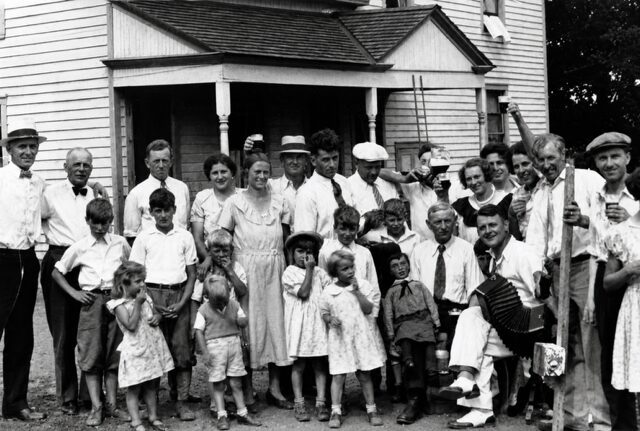
Picture of a Schmieder gathering during the Depression years in the 1930s. Pictured in the back row are Rosa and George Schmieder. Standing in front of George is Albert Beck. In the second row on the left are Arnold and Fred Schmieder. Seated in the first row on the right are Max Rauscher with his ventriloquist dummy, Gus Kautz holding the accordion, and John Matthies beside his homemade “Devil’s Harp.”
Sunday Gatherings at the Schmieder Farm
The gatherings held at the Schmieder farm during the Depression years reflected something deeper than entertainment alone. In a time marked by the labor of the changing seasons, uncertain milk prices, a growing family, and the hardship of an unpredictable future, these gatherings offered a reprieve from the daily rhythms of work, along with friendship, laughter, and continuity with the old German traditions that many families had carried with them to America.
The parties were often tied to a special occasion or family milestone, such as First Communion, baptism, or a holiday, and were usually held on Sundays about the house and yard, depending on the season. Neighbors and German friends gathered at midday after the morning chores were finished and Mass had been attended, arriving in automobiles, or on foot along the roads leading to the farm.
Men came dressed in pressed shirts, ties, dark suits, and at times top hats, carrying themselves with a formality that reflected both old-country custom and respect for the occasion. Women arrived in neatly ironed dresses carrying covered dishes and desserts prepared especially for the gathering, while children moved excitedly among the arriving guests as voices, greetings, and laughter slowly filled the yard.
The girls often wore carefully sewn homemade dresses fashioned from brightly patterned feed sacks, the floral prints and neatly pressed fabric revealing the skill, thrift, and quiet determination of mothers who transformed ordinary farm necessities into clothing while finding ways to bring beauty and dignity even to hard times.
Food, Cider, and the Old Traditions
Food and drink stood at the center of these gatherings. The women prepared dishes especially for the occasion and brought traditional German foods to share. Kuchen, cookies, tortes, fresh breads, potato salads, sausages, and smoked cured meats filled the tables that had been extended wherever room could be found.
The aroma of coffee simmering upon the cookstove drifted through the house, mingling with the scent of baked bread, tobacco smoke, and summer air flowing through the open windows. Conversation moved easily from room to room and outward into the yard, where small groups gathered beneath the shade of the trees while children wandered between the adults, lingering near the tables in hopes of another piece of kuchen.
From the cellar came George Schmieder’s homemade cider, drawn from barrels that rested in the cool darkness below the house. Its tart fermented sweetness flowed from pitchers into waiting glasses and passed freely among the guests. Bottles of Max Rauscher’s homemade wine and Albert Beck’s specially distilled schnapps loosened conversation and laughter, and before long, the yard and farmhouse rang with music, storytelling, and the familiar sounds of German songs remembered from another generation.
Songs from the Black Forest
Voices rose together into the midday air, some strong and confident, others softened by drink and memory, carrying melodies that had crossed an ocean years before and still endured among family and friends gathered at the Schmieder home place.
At times, as the singing carried on and the accordions swelled with familiar tunes, Rosa’s thoughts drifted quietly back to her younger years in Schoenberg and to the Poch in Reichenbach. The music and laughter recalled evenings there during her courtship with George, when the two of them, still young and unmarried, would join friends in singing, dancing, eating, and drinking deep into the night. Beneath the warm glow of the hall lamps and the sound of stomping feet upon the wooden floor, they had laughed together in a world still healing from the Great War, unaware then of the separation, hardship, and uncertainty that would later follow.
Now, years later and an ocean away, those same melodies drifted once more across the yard on the south side of Hall’s Hill in Alexander, carrying with them memories of youth, of Germany, and of the early days of their life together.

Gus Kautz entertained family and friends with old songs from the homeland, played on his accordion, during the gatherings at the Schmieder home place.

Albert Beck entertained family and friends with his singing and accordion playing.
Gus Kautz contributed to the musical festivities with his accordion. The children gathered nearby as his lively, animated playing filled the yard with music and song, watching in awe at the speed and ease with which his hands moved across the instrument while the bellows stretched and folded rhythmically back and forth beneath his arms.
Soon Albert Beck joined in song, his voice carrying familiar melodies remembered from earlier years in the villages and homelands of Germany’s Black Forest while Gus accompanied him on the accordion. Others soon joined in, some confidently and others only after a mug of George Schmieder’s hard cider had loosened their reserve. The songs became part memory, part celebration, and part longing for the places and people left behind across the ocean years before.
Albert Beck entertained family and friends with his singing and accordion playing during the gatherings held at the Schmieder home place throughout the Depression years.
The “Devil’s Harp”
Among the guests was John Matthies, who immigrated from Germany in 1928. During those years, he boarded and worked on the farm of Ainsworth Spink along Creek Road in Attica.
Family members later recalled that Matthies fashioned a homemade musical instrument from wooden boards, baling wire, and improvised materials gathered about the farm, which he proudly called the “Devil’s Harp.” When played, it produced a sharp twanging rhythm accompanied by a low humming vibration that carried across the yard. The lively, unusual sound drew laughter and attention wherever it was heard, and children often drifted closer, clapping along to the rhythm as they watched the wires quiver beneath his hands. Matthies and his curious invention soon became a memorable part of the Schmieder gatherings.
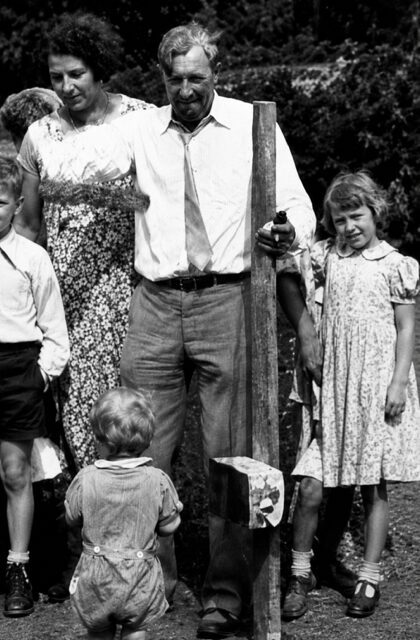
John Matthies posing beside his homemade “Devil’s Harp,” a handcrafted musical instrument.
Though somewhat crude in appearance, the “Devil’s Harp” reflected the deep resourcefulness and ingenuity common among rural families of the era, where entertainment was often fashioned by hand from whatever materials could be found about the farm.
Between the Songs
Among the most memorable entertainers was Max Rauscher, also a German immigrant who lived and worked in Buffalo as a machinist. At the Schmieder gatherings, Max became something of a performer. As the music paused between songs, he often stepped forward with his homemade ventriloquist dummy, entertaining both children and adults with humorous conversations and lively exchanges that drew laughter across the gathering.
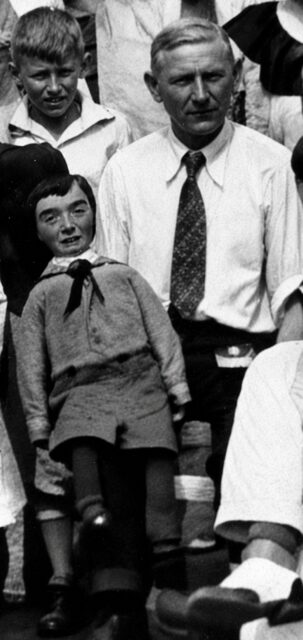
Max Rauscher with his homemade ventriloquist dummy at a gathering held at the Schmieder home place during the Great Depression years.
The children gathered close in fascination, some kneeling in the grass and others clutching at their mothers’ sleeves as they watched the puppet bob, nod, and seemingly speak on its own. They studied its painted face and moving mouth with equal parts wonder and suspicion, breaking into sudden laughter whenever Max shifted voices or made the dummy answer back with quick humor. Even the adults paused their conversations to watch and smile.
In those early Depression years, before radios had become common in many rural homes and long before television and modern entertainment, such performances transformed an ordinary farm gathering into something memorable. Beneath the summer sunlight and amid the sounds of accordions, laughter, and conversation, Max’s performances became part of the living rhythm of the Schmieder celebrations, remembered long afterward by those who had watched them as children.
Cider and Schnapps
George Schmieder’s homemade hard cider flowed freely at these gatherings. Like many farm families of the era, cider-making made practical use of apples while also providing refreshment during social occasions. Bottles of homemade schnapps and wine were likewise passed among the guests, their sharp warmth loosening conversation and song as the afternoon wore on.
At one especially lively gathering, George reportedly enjoyed rather too much cider and schnapps and failed to make it out for the evening chores — a rare occurrence on a farm where livestock demanded attention regardless of weather, celebration, or fatigue. The lapse was unusual enough that it became part of the family lore, retold for years afterward with laughter, amusement, and the gentle exaggeration that so often accompanies old family stories.
The Children’s Observations
The children especially noticed Bertha Heitz, the wife of Meinrad Eisenmann, who was the son of George’s Uncle Anton Schmieder. Bertha always arrived dressed fashionably and carried herself with a certain refinement, though family members later recalled that she was not especially well-liked among the children.
Her brother, Gus Heitz, who also lived in Buffalo and was married to Catherine Troidl, was remembered quite differently — a loud and tough-talking man who enjoyed drink and rarely went unnoticed once the cider and schnapps began to circulate. His booming voice and blunt humor often carried across the yard long before he came into view, drawing laughter from some and cautious distance from others.
Adolph “Otto” Berger and his wife, Frieda, from Buffalo, often attended with their young daughters, Elise and Dorothy. Frieda’s parents, Albert and Louise, lived on a farm they had purchased along Route 20 in Alexander. Otto worked maintenance at the DuPont plant in the city and occasionally brought packages of cigarettes from the vending machines there. To the children, the brightly colored packs of Lucky Strikes, Camels, and Chesterfields carried something mysterious and unfamiliar about them, as though they belonged more to the streets and factories of Buffalo than to the farms and fields surrounding Hall’s Hill.
At the Creek Bank
To the older boys, especially Fred and Arnold, the packaged brand-name cigarettes held an irresistible appeal and a sense of adulthood far removed from everyday life on the farm.
A few would sometimes disappear unnoticed during the gathering, hidden away until later when the boys slipped quietly down toward the creek bank to smoke them in secret beneath the willow tree, believing themselves safely beyond the sight or suspicion of the adults.
There, along the shaded bank where the water moved slowly beneath the overhanging branches, the boys crouched together in uneasy confidence, striking a match and passing the cigarettes back and forth while watching the thin streams of smoke drift upward through the summer leaves. The harsh taste often brought coughing and watering eyes, yet the act itself carried the thrill of secrecy and imitation — a brief and forbidden attempt to step into the world of the older men gathered back at the farmhouse above.
Echoes of an Earlier Time
In those years, nearly a century ago, entertainment was not purchased but created. Music rose from accordions worn smooth by use, from homemade instruments fashioned in barns and workshops, and from voices carrying songs remembered across oceans and generations. Much of what was shared at the gatherings had been raised, baked, fermented, or preserved by hand. Though money was scarce during the Depression years, hospitality remained abundant.
The gatherings at the Schmieder farm brought together laborers, immigrants, neighbors, and children beneath one roof, if only for an afternoon or evening. They were not extravagant affairs, yet they carried a richness of another kind — one rooted in family, tradition, labor, and memory. In the midst of uncertainty and hardship, the families fashioned joy from fellowship, music, cider, laughter, and the old songs of Germany — simple things, yet enough to sustain the spirit through difficult times.
Note: This account of gatherings at the Schmieder home place weaves together oral history, documented events, and family memory. It reflects the historical record where available alongside the lived experiences remembered and passed down through the family, recognizing that no single account can ever fully capture a life in its entirety.
Frederick Schmieder