

Chapter 38 — Building for the Future: Expanding the Schmieder Farm During the Depression
The Dairy Crisis
The years of the Great Depression brought hardship to farm families across western New York. By the mid-1930s, the worst of the dairy crisis had begun to ease, but prosperity had not returned to the Schmieder homestead. Milk prices were better than during the desperate days of 1933, when many farmers received scarcely enough for their milk to pay taxes, seed, and feed bills, yet every dollar still mattered. Cash was scarce, and markets remained uncertain. Many farmers postponed repairs or improvements simply because they could not afford them.
Newspapers carried frequent reports of collapsing milk prices, farmer meetings, and efforts to stabilize the industry through cooperative organizations such as the Dairymen’s League. One widely circulated advertisement warned that dairy farmers faced “low prices and ruin staring them in the face” and argued that only greater cooperation among producers could restore stability. Across New York’s milk shed, farmers debated the future of their industry while state officials sought new ways to regulate and stabilize milk markets.
George knew that survival would not come through waiting for better times. It would come through harder work, better barns, more efficient operations, and faith that the sacrifices of the present would someday bear fruit. While others delayed improvements, he looked for ways to strengthen the farm’s future. Every crop planted, every new milk cow added to the herd, every repair completed, and every dollar invested added to the hope he believed lay ahead. Despite the lingering hardships of the Depression, George remained convinced that careful stewardship, perseverance, and God’s providence would ultimately see them through.
Like countless dairy farmers across western New York, George and Rosa worked long hours for modest returns, never quite certain what the next milk check would bring. Yet even during those difficult years, the needs of the growing farm could not be ignored. As the dairy herd gradually expanded and the demands of daily farm life increased, the existing barns and facilities became less adequate for the work required each day.
Investing in the Farm
For George, improving the farm was an ongoing process. When George purchased the property in December 1928 with the financial backing and partnership of Louis Shreder, a cattle dealer and friend, the house, barns, and fields were in rough condition and required considerable attention. Bringing the farm to its full potential would take years of labor, careful planning, and continual investment.
The work was not undertaken for comfort or appearance. It was a matter of survival, stewardship, and providing for the future. Better facilities meant greater efficiency, healthier livestock, improved working conditions, and the possibility of building a more secure livelihood for his growing family.
Such improvements, however, could not be accomplished all at once. They came gradually, one project at a time, whenever money, materials, and labor could be assembled. Like many farmers of the era, George relied more upon resourcefulness than cash. Existing buildings were repaired whenever possible, and little was discarded if it could be put to a useful purpose. Materials were salvaged, repurposed, and incorporated into new construction, stretching every dollar as far as possible.
When George sought financial assistance for the next phase of improvements, he first approached his Uncle Anton Schmieder. At the recommendation of Anton’s son, Meinrad Eissenmann and his wife, Bertha, the request was declined. Undeterred, George turned instead to Sarah Miller, a widow from Attica, who agreed to loan the funds he needed. The loan represented a significant vote of confidence at a time when many lenders were reluctant to risk money on farm improvements during the uncertain years of the Depression.
With financing secured, George consulted Frank and William Lippold, respected local carpenters known throughout the area for their skill and craftsmanship. The brothers had previously worked alongside their brother, John N. Lippold, whose promising career was cut short by his death in 1926 from complications of scarlet fever and pneumonia.
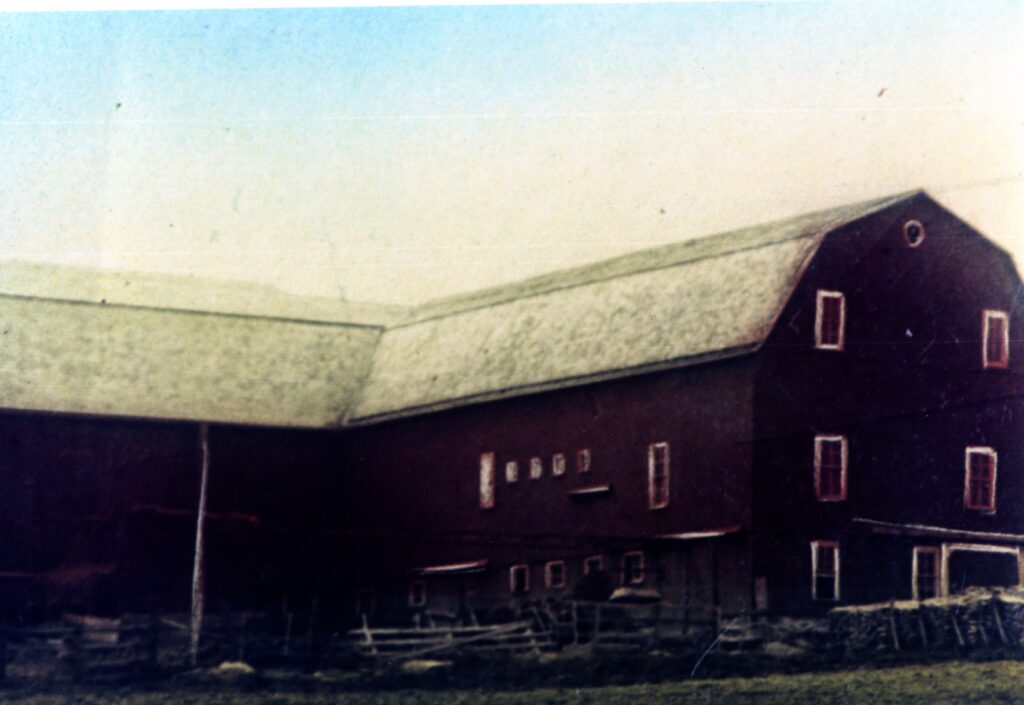
Working together, the Lippold brothers developed plans for a substantial addition to the south side of the dairy barn, a project that would require large quantities of lumber, heavy timbers, and many months of labor. It would become one of the most significant improvements undertaken on the farm during the Depression years, expanding the barn’s capacity while modernizing the dairy operation for the future.
Lumber from the Woodlot
Much of the lumber needed for the additions came directly from the farm itself. Beech, maple, oak, and elm trees were harvested from the woodlot on the western end of the farm. Using axes, George and Albert Beck, Rosa’s brother, first cut a notch into each trunk before taking hold of a six-foot, double-handled crosscut saw. Standing on opposite sides of the tree, they worked in a steady rhythm, the blade singing through the wood with each pull. The rasping sound echoed through the quiet woods beneath the bare branches overhead. As the cut deepened, the great tree began to creak and lean before crashing to the ground with a thunderous thud, its limbs snapping and crackling as they struck neighboring branches on the way down.
Once limbed and cut to length, the logs were chained behind Lonnie and Topsy, the farm’s faithful draft horses. Lonnie, a chestnut gelding, and Topsy, gray in color, leaned steadily into their harnesses as they hauled the heavy timber from the woods to a portable sawmill temporarily assembled in a nearby pasture.
There, amid the scent of fresh-cut timber and the shrill whine of a thirty-six-inch circular saw, the logs were rolled onto a carriage and fed slowly through the mill. Fresh sawdust drifted through the air and settled in golden piles beneath the blade as rough logs emerged as neatly stacked boards and heavy timbers.
During breaks in the work, George and the other men gathered near the mill, their cigarettes glowing briefly before thin ribbons of blue smoke drifted upward and disappeared into the cool air. Nearby was a stone jug of George’s hard cider, which was passed from hand to hand before the men returned to their labor. The steady hum of conversation, the scent of tobacco mingling with fresh-cut wood, and the rhythmic whine of the saw became familiar sounds of progress on the Schmieder farm as stacks of lumber rose in the pasture.
Before long, George’s familiar reminder could usually be heard: “Get back to work.”
The very land that sustained the family also provided many of the materials needed to improve and expand the farm. What could not be purchased with scarce Depression-era dollars was often supplied through hard work, ingenuity, and the resources of the farm itself.
The Lippold Brothers at Work
With the trees felled and the new boards and beams sawn, Frank and William Lippold began the new addition. The brothers often walked to the farm from their homes in Attica and, if necessary, drove an aging Model T truck to the job site. Years later, the brothers sold the aging truck to Hank Kautz for ten dollars, a detail remembered by later generations.
Their toolbox contained the simple hand tools of skilled craftsmen: hand saws worn smooth from years of use, well-balanced hammers, a plane, a carpenter’s square, chisels, and a wooden measuring stick marked with carefully notched intervals for common dimensions.
Frank would study the board, then use the measuring stick and square to mark the cut line with practiced precision. With a few steady strokes of his razor-sharp saw, he could cut a board remarkably straight and true. His movements were deliberate yet efficient, reflecting years of experience. Nearby, William fitted the boards into place and drove nails with quick, sure blows of his hammer, the sharp ring of steel echoing across the farmyard.
The brothers preferred working with green lumber freshly sawn from the logs. Softer and easier to nail than seasoned wood, it allowed construction to proceed more quickly and efficiently. As they worked, the scent of fresh-cut timber filled the air, mingling with the smells of hay, silage, and livestock.
Frank and William Lippold played a leading role in many of the improvements undertaken during those years. Their skill, practical knowledge, and reputation for quality workmanship made them trusted partners in George’s efforts to modernize both the farm and the family home. Most significant was the expansion of the dairy barn along its south side. The addition not only increased the barn’s capacity but also modernized many of its older sections.
Modernizing the Dairy Barn
New concrete feed mangers and gutters replaced older arrangements that had become increasingly inadequate for a growing dairy operation. Stanchions and water cups provided improved accommodations for the cows while making daily chores more efficient. The original portion of the barn had lacked proper gutters, making cleaning difficult, particularly during the long winter months when manure accumulated rapidly.
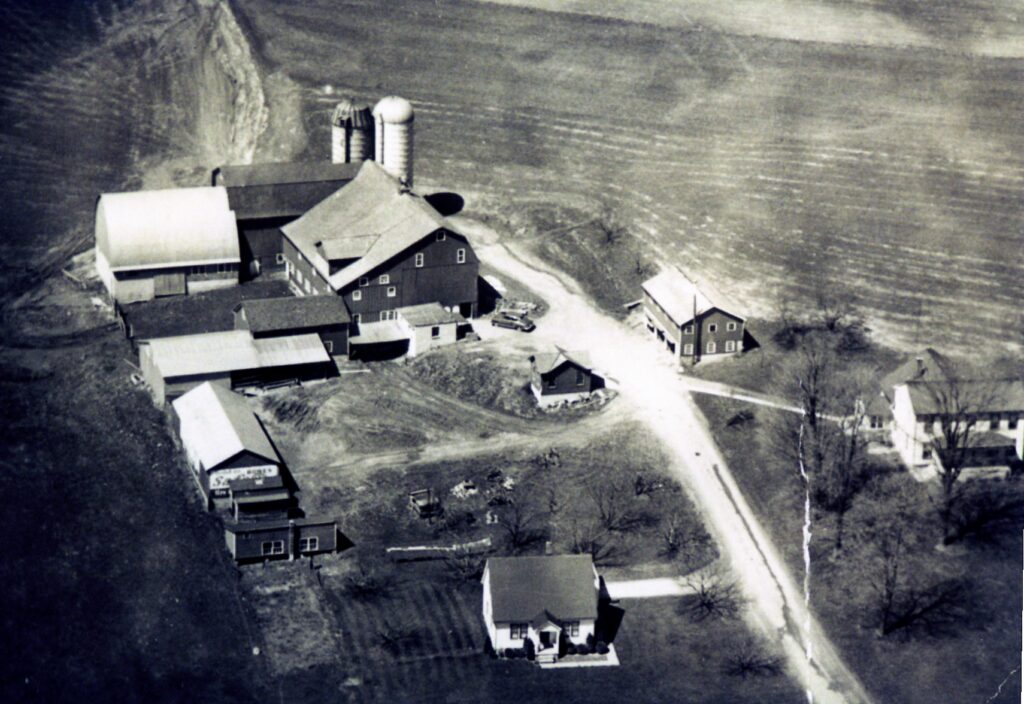
Before the addition was built, an older manure carrier exited the barn through the area where the new construction would eventually stand. As the dairy barn expanded, the system was redesigned and relocated. A new overhead track and carrier exited from the southwest side of the original barn, depositing manure onto a pile that would later be spread on the fields. The improved system made manure removal faster and more efficient, reducing labor while helping George manage the demands of an expanding dairy operation. Years later, in 1953, a bowed-roof heifer barn would rise on that same site.
To modern readers, such improvements may seem ordinary. For a dairy farmer in the 1930s, however, they represented meaningful advances in efficiency. Cleaner gutters improved sanitation, water cups reduced labor, and the improved manure handling system saved countless hours of work each year. Each change helped George manage a larger herd while reducing the physical demands placed upon both family members and hired men.
Above the dairy portion of the addition, George incorporated a granary, a chicken coop, and a haymow. These upper-level spaces provided room for feed, poultry, and winter hay, helping maximize the efficiency of the expanding operation and making full use of the barn’s available space. The granary stored wheat and oats harvested from the surrounding fields, which were ground into livestock feed throughout the year.
The haymow was filled each summer with loose hay brought in from the fields and stored on the upper barn floor. In some years, the space also served as storage for harvested beans.
In the chicken coop, laying hens supplied eggs for the family while broilers were raised for meat. Sunlight streamed through the coop windows, which looked out across the neighboring Blanchard and Stroh farms.
During seasons when the hay floor stood empty and the chores were finished, the Schmieder boys transformed the open space into an improvised basketball court, its rough wooden floor echoing with the sounds of games played high above the cattle below. For a few hours, the barn became more playground than workplace as set shots arced overhead and rattled against a basket fastened to the granary wall.
Water for a Growing Herd
While the barn addition addressed storage and livestock needs, George also faced another challenge essential to the future growth of the dairy operation: securing an adequate water supply. For years, the dairy operation had relied upon a shallow well near the barn, only fifteen to twenty feet deep, supplemented by a pipeline from a small handmade reservoir in the upper pasture that George had constructed years earlier. As the herd expanded, however, these sources could no longer provide an adequate supply. To meet the increasing demand, a deeper well was drilled through the existing shaft, extending perhaps thirty or forty feet into the earth.
Water for the cattle was pumped by a gasoline-powered engine equipped with a large flywheel and a water-cooled reservoir surrounding the cylinder. The steady “putt-putt” of the single-cylinder engine often echoed across the farmyard as it pumped water into a nearby galvanized storage tank. For many years, that familiar sound became part of the daily rhythm of life on Hall’s Hill. In later years, the engine was replaced by an electric pump, and a pipeline was eventually extended to the house, bringing greater convenience to both the barn and the family home.
When the work was finally completed, the enlarged barn stood noticeably larger than before. Fresh siding, new concrete work, improved stanchions, expanded feed storage, and updated manure handling reflected years of planning and labor. The addition stood as visible proof that even during the darkest years of the Depression, progress was still possible. To visitors, the changes may have appeared gradual. To George, they represented tangible evidence that the farm was moving forward despite the hardships of the era.
The improvements undertaken during the 1930s reflected George’s conviction that a farm was not merely property to be owned but a trust to be cultivated and improved. Each tree felled from the woodlot, each timber shaped by hand, and each structure raised upon the hillside testified to a belief that hard work, prudent stewardship, and providence would ultimately bear fruit. In the years that followed, the additions served the family well, supporting the growth of the dairy operation and easing the demands of daily labor.
Nearly a century later, much of the barn addition still stands as a testament to the craftsmanship of the Lippold brothers, the resourcefulness of George Schmieder, and the perseverance of a farm family that chose to build for the future despite the hardships of the Great Depression.
Note: This account of the Schmieder family and the Lippold brothers, whose craftsmanship helped build, improve, and sustain the farm, weaves together oral history, documented events, and family memory. It reflects the historical record where available alongside the lived experiences remembered and passed down through the family, recognizing that no single account can ever fully capture a life, a family, or a community.
Frederick Schmieder