

Chapter 40: From Revolution to Hall’s Hill: Alexander’s Founding Generation and a Fourth of July on the Schmieder Farm
As America commemorates the 250th anniversary of its independence, it is worth remembering that the history of the Revolution is not found only in famous battlefields and war heroes such as General George Washington. It is also preserved in communities like Alexander, New York, where members of the Revolutionary generation helped build the foundations of a new nation on the western New York frontier.
The legacy of Alexander’s Revolutionary generation endured for generations, eventually reaching the farms and families of Alexander, including the Schmieders, who celebrated Independence Day more than a century and a half after the Revolution. Their farm was situated between the former lands of Revolutionary War veteran Sebe Brainard and Dr. Jonathan Hall, Revolutionary War soldier, physician, and pioneer settler.
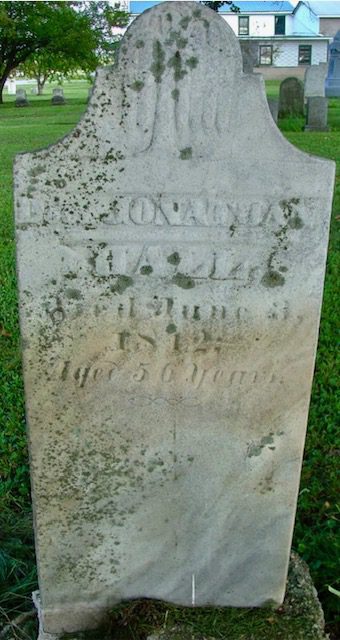
Dr. Jonathan Hall (1757–1812)
Revolutionary War Survivor, Physician, and Pioneer Settler
Born on December 11, 1757, in Wallingford, Connecticut, Jonathan Hall came of age as the thirteen American colonies moved toward revolution. When eighteen-year-old Jonathan Hall enlisted in the Connecticut service on June 30, 1776, the United States did not yet exist. Four days later, the Continental Congress adopted the Declaration of Independence. Hall entered military service as a British subject and, within days, found himself a soldier in a new nation.
Records identify him as both a private and a cornet in Captain John Couch’s Company, Colonel Bradley’s Regiment, General Wadsworth’s Brigade.
His military service placed him in one of the darkest episodes of the war. In November 1776, Hall was captured during the fall of Fort Washington near New York City. Along with eighteen other men from Captain Couch’s Wallingford company, he was confined aboard a British prison ship. Conditions aboard the prison ships were notoriously brutal, with disease, starvation, overcrowding, and exposure claiming thousands of American prisoners.
Of the nineteen men from his company confined aboard the vessel, only Jonathan Hall and one other soldier survived. The second survivor died shortly after returning home to Connecticut, leaving Hall as the sole long-term survivor from his company.
The experience undoubtedly left a lasting mark on the young soldier.
Following the war, Hall pursued medicine and became known for both his professional skill and public service. In 1787, he left Connecticut for New York, eventually settling in the developing communities of central New York.
Historical accounts identify him as:
- An early physician in Marcellus.
- One of the first physicians in Skaneateles, arriving by 1796.
- Builder of one of the village’s earliest frame houses.
- A pioneer in introducing smallpox inoculation to that region of New York.
Contemporaries remembered him as a respected physician and community leader whose medical practice became widely known throughout the area.
By the early nineteenth century, Hall moved westward again as settlement expanded into the Genesee Country. Eventually, he and his family established a farm and homestead on the prominent rise later known as Hall’s Hill.
Though Dr. Jonathan Hall’s time in Alexander was brief, his influence endured long after his death on June 6, 1812. He was buried in Alexander Village Cemetery. Over the next century, the land associated with the Hall name passed through several generations and owners, including the Hall family, the Timms, Franc Brainard Smith and her renowned Highland Hall Farm, the Kreutters, and ultimately the Schmieder and Kautz families.
More than a century and a half after the Revolution, George Schmieder would acquire both the Hall and Brainard farms, bringing under one ownership lands once held by two of Alexander’s earliest Revolutionary-era settlers. And on an Independence Day in the mid-1930s, while the nation faced another test in the Great Depression, the Schmieder family would mark the holiday on the southern side of Hall’s Hill.
Their farm lay between lands once associated with Dr. Jonathan Hall and Revolutionary War veteran Sebe Brainard. Within the next two decades, George Schmieder would acquire both properties, bringing together farms whose histories stretched back to Alexander’s founding generation.
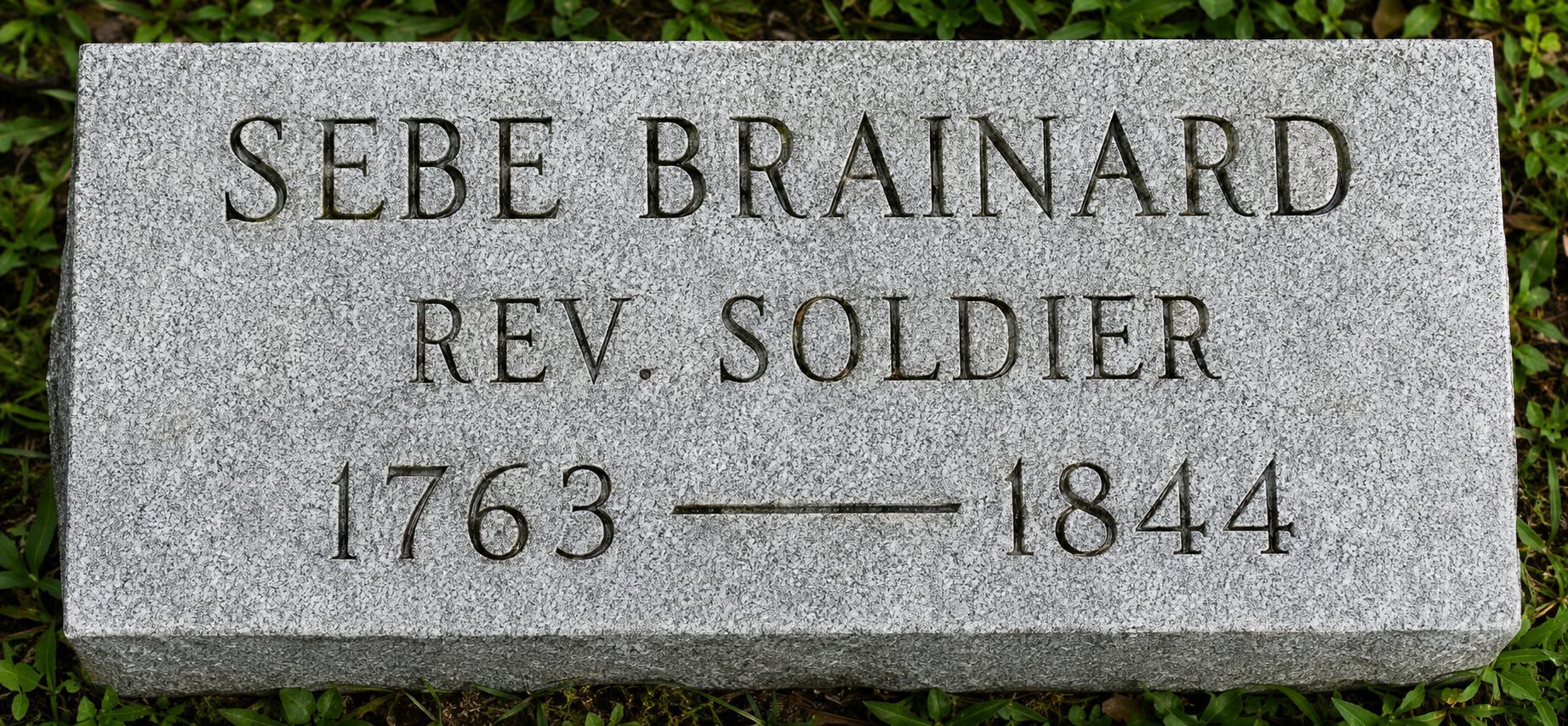
Sebe Brainard (1763–1844)
Born in Haddam, Connecticut, Sebe Brainard belonged to the generation that witnessed the nation’s founding. A Revolutionary War veteran, he later settled in Alexander and became part of the town’s early development.
His descendants would leave a lasting mark on local history. Sebe’s great-granddaughter, Franc Brainard Smith, transformed the Hall farm into Highland Hall Farm between 1916 and 1917, developing it into one of western New York’s premier dairy operations. More than a century after the Revolution, she carried forward the legacy of her great-grandfather while helping shape a new chapter in the history of Hall’s Hill.
As the nation entered the First World War, Franc emerged as a leader in Alexander’s Red Cross efforts, answering a new call to service during another moment of national trial. Through her stewardship, the histories of the Brainard and Hall families became intertwined, and the legacy of one of Alexander’s Revolutionary War veterans continued well into the twentieth century.
Dr. Jonathan Hall and Sebe Brainard were not alone. They belonged to a larger generation of Revolutionary-era settlers whose stories are also preserved in Alexander Village Cemetery.
The Patriots of Alexander
Alongside Jonathan Hall and Sebe Brainard, Alexander Village Cemetery contains the graves of several other men who served during the American Revolution and later helped build a new community on New York’s western frontier.
Caleb Blodgett (1751–1813)
Born in Hartford County, Connecticut, Caleb Blodgett came of age during the Revolution and later settled in Genesee County. Historical military records identify Caleb Blodgett as an ensign in the 3rd New Hampshire Regiment, while New York veteran records recognize his Revolutionary War service and burial in Alexander Village Cemetery.
Daniel Fuller (1758–1836)
Daniel Fuller served as a private in the New York Continental Line and later received a Revolutionary War pension. After living in Connecticut, Vermont, and Essex County, New York, he settled in Alexander. His service connected him directly to the Continental Army that fought for American independence.
Rodolphus Hawkins (1759–1847)
Born in Coventry, Connecticut, Rodolphus Hawkins served as a private in the New York Militia. He later settled in Alexander and became the patriarch of one of the community’s most influential families. His son, Henry Hawkins, would become a prominent educator, civic leader, and state legislator.
Lott Burge (1761–1846)
Lott Burge served in Connecticut during the Revolution and appears in military records as a drummer in the 2nd Regiment on September 2, 1780. Later records identify him as a Revolutionary War pensioner and resident of Genesee County. He was buried in Alexander Village Cemetery, where his grave remains today.
A New England Legacy
What is striking about these men is how many traced their roots to Connecticut and New England. They were part of the great westward migration that followed the Revolution. After helping create a new nation, they sought new opportunities on the frontier of western New York.
They brought with them not only military service and sacrifice, but also families, churches, schools, farms, and traditions that would shape Alexander for generations.
Today, beneath the canopy of mature trees in Alexander Village Cemetery, the gravestones of Dr. Jonathan Hall, Sebe Brainard, Rodolphus Hawkins, Daniel Fuller, Lott Burge, Caleb Blodgett, and other members of Alexander’s founding generation overlook the pastures and farmland that would eventually become part of the Schmieder holdings—a reminder that the lives of Alexander’s Revolutionary settlers and the generations that followed remained connected through the same enduring landscape.
A Fourth of July on the Schmieder Farm
More than a century and a half after the nation’s first Independence Day and the sacrifices of the Revolutionary generation, another generation marked the Fourth of July in its own way on the farms of Alexander.
For the Schmieder family during the 1930s, Independence Day was not a holiday from work. July was one of the busiest times of the farming season, and the demands of the farm continued regardless of the date on the calendar.
The cows still needed milking. Livestock still needed feeding. Hay needed to be gathered, and fields still required cultivation.
Horses pulled cultivators through rows of corn, beans, and potatoes, cutting down weeds between the rows. The weeds growing among the plants themselves had to be removed by hand. George Schmieder expected his sons and hired men to move steadily from row to row and field to field beneath the hot July sun. For hours they worked bent over among the crops, pulling weeds one by one from the rows. Mustard weeds were especially common, but countless others sprang up throughout the fields each summer.
By day’s end, sweat-soaked shirts, dirt-stained hands, and aching backs bore witness to the hard work required to keep the fields clean. The task often required three or four days of backbreaking labor.
For the Schmieders, the Fourth of July was not a day of family picnics or elaborate fireworks displays. The work of the farm came first.
Yet the boys had their own Fourth of July tradition.
Earlier in the week, they would walk to Curtis’s store, located at the Four Corners in the village, to purchase cherry bombs and assorted firecrackers. Then, after the evening chores were finally completed, they would gather around the house and down by the creek to light them.
The sharp cracks of firecrackers echoed through the summer air as darkness settled over the farm.
It was a simple celebration, but perhaps one that captured the spirit of the holiday as well as any parade. The freedoms secured by the Revolutionary generation were not merely remembered through speeches and ceremonies. They were lived out each day through honest work, strong families, and the opportunity to build a life on the land.
Remembering the Founders
Today, the graves of Caleb Blodgett, Daniel Fuller, Rodolphus Hawkins, Lott Burge, Sebe Brainard, Dr. Jonathan Hall, and many other early settlers remain in Alexander Village Cemetery.
Their stories connect the birth of the United States to the settlement of western New York and to the generations that followed. They remind us that American history is not only the story of famous leaders and distant battlefields. It is also the story of local communities, pioneer families, and ordinary people whose lives carried the promise of independence forward.
As we celebrate the 250th anniversary of the Declaration of Independence, we can remember these early Alexandrians and the generations that succeeded them. From the Revolutionary soldiers buried in Alexander Village Cemetery to the Schmieder boys lighting cherry bombs by the creek after a long day of pulling weeds, their lives form part of a single American story—one in which the sacrifices of the Revolutionary generation continued to echo across the fields, farms, and families of Alexander for generations to come.
Note: This account of Alexander’s Revolutionary War veterans and the Schmieder family weaves together oral history, family memories, and documented events. It reflects the historical record where available alongside the lived experiences remembered and passed down through generations, recognizing that no single account can ever fully capture the richness of a life, a family, or a community.
Frederick Schmieder