

Chapter 41—Willow Branches and Lead Sinkers: Schmieder Boyhood Along the Tonawanda Creek.
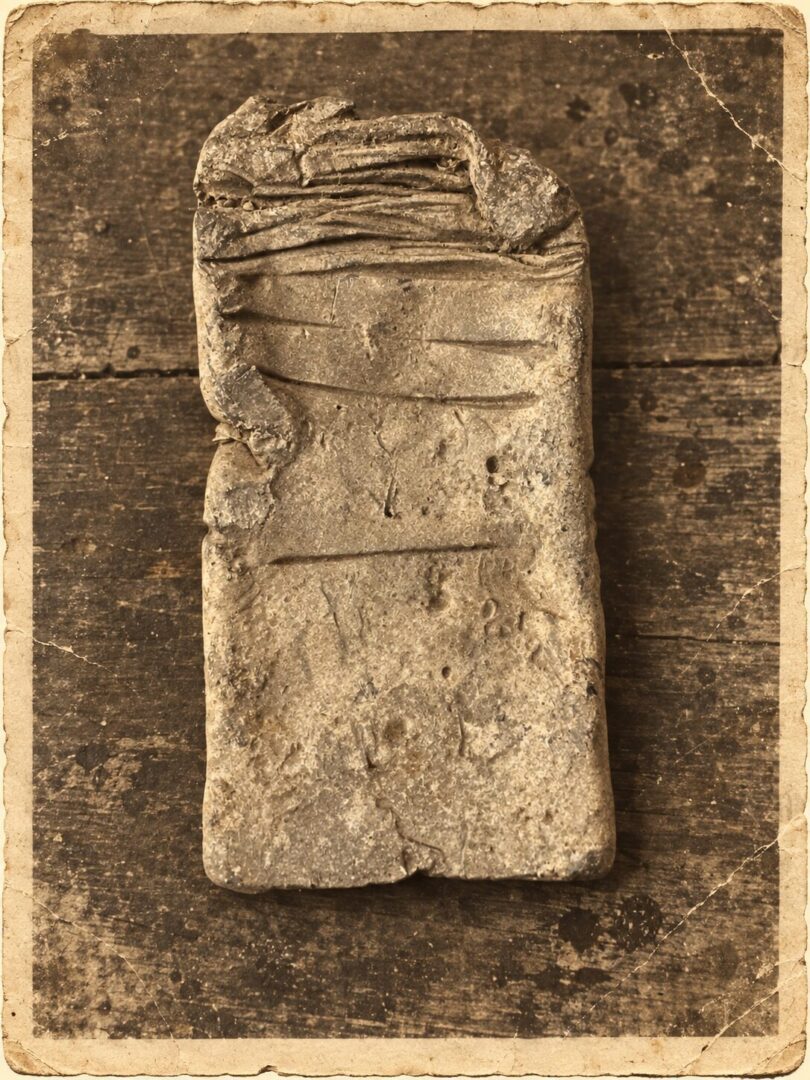
The original flattened lead pipe from which the Schmieder boys made sinkers for their homemade fishing lines. Their distinctive hatchet marks are still visible.
For the Schmieder boys growing up on the southern slope of Hall’s Hill during the Great Depression, the Tonawanda Creek was far more than a stream winding through the countryside. Flowing along the eastern boundary of the family farm, it offered adventure, recreation, and, on fortunate days, a freshly caught fish roasted over an open fire.
Long before expensive fishing equipment became commonplace, the boys learned to make do with whatever they could find. Their fishing depended upon ingenuity, resourcefulness, and a deep familiarity with the surrounding fields and woods—and with every bend and quiet pool of the creek that meandered near their home.
Each spring, melting snow and seasonal rains sent high, muddy water rushing through the Tonawanda. As the rains subsided, the creek gradually cleared, and yellow dandelions appeared among the greening grass of the surrounding meadows and fields. The days grew longer, the afternoon air grew warmer, and birdsong once again filled the hedgerows and nearby woods. From the pasture came the gentle lowing of the cows, mingling with the murmur of a small tributary flowing along the farm’s southern boundary toward the Tonawanda.
Near the farmhouse, tender new leaves trembled on the maple tree in the spring breeze, while Rosa’s rosebushes—bare and lifeless through the long winter—slowly awakened with new growth. For Fred, Arnold, and George—with their younger brothers Paul and Herbert, known as Herbie, following close behind—these familiar sights and sounds announced that fishing season had arrived.
Willow Poles and Homemade Sinkers
Fred and Arnold, the two eldest boys, searched the creek bank for long, straight willow branches. Once they found suitable ones, they cut enough to make fishing poles for themselves and for their younger brothers, George, Paul, and Herbie. Ordinary string served as fishing line, while hooks were purchased for pennies at Curtis’s store, a familiar destination for children from the village and surrounding countryside.
Even the sinkers were fashioned from materials found around the farm. When their father was not looking, the boys borrowed his hatchet and carried a piece of discarded lead pipe to the concrete barn floor. There, they took turns pounding the pipe flat, then chopped off small pieces and slipped them into their pockets for the walk down to the creek.
The boys gathered dry sticks and fallen branches from the woods bordering the small flats, then built a fire along the creek bank. Using an old metal container, they heated the lead over the glowing coals until it melted, then shaped it into rough but serviceable fishing sinkers.
Their father, George, might not have approved of the borrowed hatchet—or of everything involved in their sinker-making enterprise—but the boys usually found time for such adventures once the day’s chores were completed.
During the Great Depression, when money was scarce and little was wasted, nearly everything was made, repaired, or repurposed. Their homemade fishing tackle reflected both the necessities of the time and the practical ingenuity they developed through life on the family farm.
Bait from the Manure Pile
The boys did not have to travel far to find bait. In the pasture just outside the barn, beneath the track of the manure carrier, lay a rich pile of damp manure and decaying straw. Armed with shovels, they dug into its dark, moist layers in search of earthworms.
The worms thrived in the warmth and richness of the pile. As the older boys turned over clumps of manure and matted straw, the worms appeared—pink, glistening, and twisting in the newly exposed air. The youngest boys, Paul and Herbie, watched with wide eyes and open mouths before reaching eagerly into the pile. They laughed as they tried to grasp the slippery, squirming creatures and pull them from the pile. Their catch went into a tin can with enough damp soil and manure to keep the worms alive during the walk to the creek.
It was neither a clean nor a delicate task, but farm boys were accustomed to mud, manure, and hard work. To them, the manure pile was not simply farm waste. It was another useful part of the farm—and a dependable source of bait for an afternoon along the Tonawanda.
Along the Creek
The Tonawanda Creek and its tributaries became an outdoor classroom where the boys learned patience, observation, and practical skills. They studied the currents, watched the seasons change, and came to know the bends, pools, and shaded banks where fish were most likely to be found.
Fred and Arnold helped George, Paul, and Herbie tie lengths of string to their willow poles and attach the hooks and homemade sinkers. They showed their younger brothers how to thread a wriggling worm onto the hook without losing it in the grass or pricking their fingers.
The five boys settled along the creek bank, their bare feet dangling above the water as they lowered their lines into a deep, quiet pool. Patience did not come easily to the younger boys, who watched their lines expectantly and wondered how long they would have to wait. Then one of the willow poles suddenly bent, and its young fisherman felt the unmistakable tug of a fish. Excitement filled the air as the others crowded around, offering advice and encouragement until the fish was pulled from the water. For a moment, they stood together admiring the fish and sharing in the pride of their success.
On occasion, one of the boys caught a fish large enough to be worth eating. Fred or Arnold reached into a pocket that also held a rabbit’s foot for good luck and pulled out a well-used pocketknife. Opening its blade—dulled by countless small chores and boyhood projects—he cleaned the fish along the creek bank and prepared it for roasting over the open fire.
Soon the aroma of roasting fish mingled with the woodsmoke, the scent of damp earth, and the cool freshness rising from the creek. The boys ate slowly, carefully avoiding the small bones. Shared beside the water, the simple meal became another memorable part of the day’s adventure.
The Spring Sucker Run
By the late 1930s, another seasonal event drew the Schmieder boys beyond the familiar banks of the Tonawanda to a smaller creek flowing through Albert Beck’s farm on Beck Road in Attica. Each spring, schools of suckers migrated upstream from the Attica Reservoir to spawn. In the creek’s shallow waters, the fish could sometimes be seen moving in great numbers.
Armed with snagging hooks, the boys joined their cousin Carl Beck along the creek during the annual run. The arrival of the suckers was a familiar local event, bringing excitement to the creek bank and offering the cousins another opportunity for adventure, friendly competition, and camaraderie during difficult economic times.
Such experiences reflected a way of life familiar to many rural families during the Depression. Entertainment was seldom purchased. Instead, it was discovered outdoors—in the fields, woods, barns, pastures, and waterways surrounding the family farms.
The Creek Still Flows
For the Schmieder boys, the Tonawanda Creek became a place of adventure, learning, companionship, and refuge from the daily demands of farm life. With willow poles, worms dug from beneath the manure track, and sinkers fashioned from a discarded lead pipe, they created their own recreation from the simple materials around them. There they fished and swam, trapped and hunted, gathered with boys from neighboring farms, and washed away the dust, chaff, and sweat after long days working in the fields, haymows, and helping with the milking.
The creek was their playground, gathering place, and private world—a place where brothers worked together, tested their resourcefulness, and enjoyed the freedom of boyhood. The willow poles eventually disappeared, the campfires faded, and the boys grew into men—and, in time, fathers and grandfathers. Yet the Tonawanda Creek still flows quietly through the land, following the same bends and passing the same grassy banks they once knew. The stories they shared with their children and grandchildren remain part of the rich Schmieder family inheritance. Like the waters of the creek itself, the laughter, adventures, and memories of those Depression-era summers continue to flow from one generation to the next.
Author’s Note: This account of the Schmieder boys’ fishing adventures along the Tonawanda Creek draws upon memories my father, Fred Schmieder, shared with me about his boyhood adventures with his brothers.
Frederick Schmieder