

Chapter 43—The Swimming Hole: Summer Days on Tonawanda Creek
A Swimming Hole of Their Own
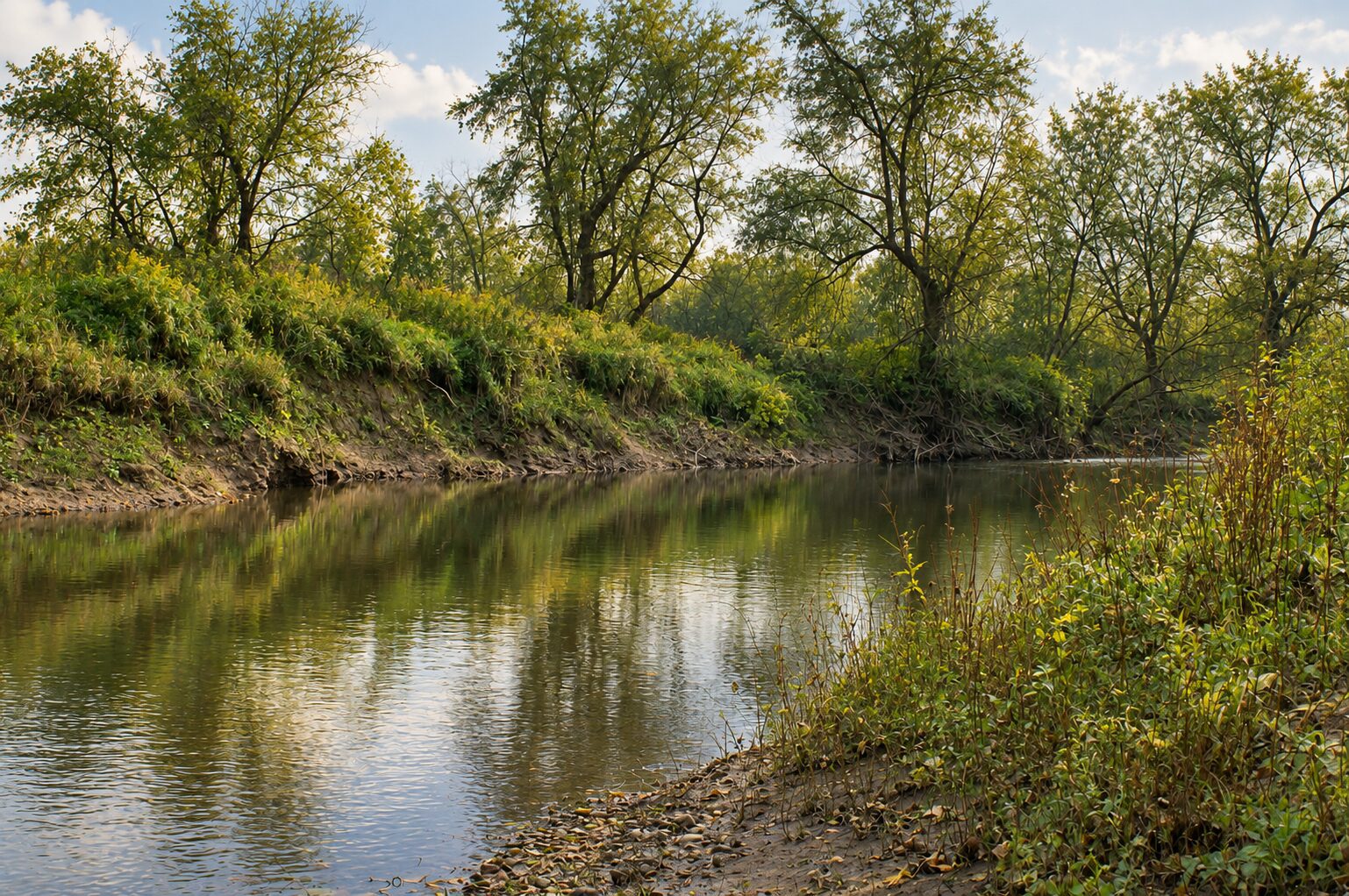
For the Schmieder boys growing up on a farm in Alexander, New York, Tonawanda Creek was more than a place to fish. During the summer, its cool water offered welcome relief from the heat and sweat of farm work. The boys went there on warm evenings and on Sundays after completing their morning chores and attending Mass at St. Vincent’s Church. With several free hours before the evening milking and other work began, they could swim, cook over a fire, and spend time with the children of visiting friends and relatives.
The boys did not simply find a swimming hole along the creek—they made one. At the water’s edge, they shoveled damp sand into bags, filling each until it became heavy and awkward to carry. They dragged and lifted the bags into the creek, then arranged them across the current to form a makeshift dam. As the water slowed and backed up behind the sandbags, a pool gradually formed, reaching a depth of five or six feet in places. The work left sand clinging to their hands and cool mud between their bare toes, but it gave them a swimming hole of their own.
Standing along the bank, the boys watched with pride as the water rose behind their dam. What they had created with little more than shovels, sand, and a few bags would become the setting for many summer evenings and Sunday afternoons.
A Diving Board from the Farmyard
The boys searched the farmyard for a wooden plank long enough to extend over the water and thick enough to bear their weight. Fred carried the front and Arnold the rear, while George, Paul, and Herbie followed them down to the swimming hole. After choosing the right spot, they buried one end of the plank in the creek bank and left the other projecting over the deepest part of the pool.
Stepping out over the water took a little nerve. Fred, the oldest, went first. Encouraged by his brothers, he stepped cautiously onto the plank and inched toward its end. The board held. Fred paused, looked down at the water, took a deep breath, and jumped. His brothers cheered as he struck the water with a splash. One by one, they followed him onto the board and took their turns leaping into the pool.
A Bar of Soap
After a long, sweaty day working on the farm, the swimming hole served another purpose. After finishing the supper Rosa had prepared on the wood-burning cookstove, the boys carried a bar of soap from the washroom down to the creek. The water felt cool against their sun-warmed skin as they passed the soap from one brother to another, scrubbing away the day’s dirt and washing their hair. Small bubbles drifted across the surface amid their splashing.
Then the soap went back on the bank, and the boys returned to the diving board. Their swimming hole was both a playground and a bathtub. On some evenings, Rusty Waite, a friend who lived on a farm across the creek, joined them for swimming and horseplay.
Sundays at the Creek
Sunday afternoons at the creek were not always limited to the Schmieder boys. George and Rosa often welcomed friends from Buffalo and the surrounding area to the farm. Among their visitors were Adolph “Otto” Berger and his wife, Frieda, fellow German immigrants who lived in Buffalo. Their young daughters, Elsie and Dorothy, often joined the Schmieder children in their creek adventures.
The boys’ cousins Hank and Eugene Kautz sometimes joined them as well. Everyone knew to keep an eye on Hank. Without warning, he might slip through the water behind an unsuspecting swimmer, grab him around the shoulders, and pull him beneath the surface. For a few startled moments, the laughter above the water became muffled as the swimmer struggled to break free. He would finally surface sputtering, wiping creek water from his eyes and nose while Hank laughed nearby. To Hank, it was harmless fun; to whoever he had dunked, it was thoroughly irritating.
A campfire added another pleasure to those afternoons. The smell of woodsmoke mingled with the aroma of hot dogs roasting over the flames, while marshmallows slowly browned at the ends of sticks. After eating, everyone was soon back in the creek.
With family and friends swimming, splashing, and laughing together, the swimming hole became more than a place to cool off. It became a Sunday gathering place and a welcome refuge from the work and heat of summer.
Secrets at the Creek
The boys also had their secrets. When Otto Berger visited, he sometimes brought George cigarettes that he had obtained at the DuPont plant where he worked. The boys would quietly hide a few and later carry them down to the creek, where they could smoke beyond the watchful eyes of their parents. The secluded swimming hole offered them both a measure of freedom and a convenient place for youthful mischief.
The Kreutter Girls’ Swimming Hole
The Schmieder boys were not the only young people who made the creek part of their summer lives. Elsewhere along Tonawanda Creek, Grace and Alice Kreutter had their own swimming hole where the creek bordered their family’s farm on Creek Road. The Kreutter family had also owned the Hall’s Hill farm where George and Rosa had lived as tenants before purchasing a farm of their own in 1928.
On occasion, the Schmieder boys made the hike to the Kreutter girls’ swimming hole, extending their summer adventures to another familiar stretch of the creek.
Hahn’s Pond
Charlie Hahn, the son of Arthur and Sarah Hahn, lived on a small farm on the northern side of Hall’s Hill, near the Alexander Firemen’s Grounds. The same age as Hilda Schmieder, Charlie often walked to school with the Schmieder children. A pond behind the Hahn farm offered another place for local children to swim during the summer.
Charlie’s life eventually carried him far from the quiet farms and fields around Hall’s Hill. During World War II, he served as a second lieutenant and bombardier in the U.S. Army Air Corps. His plane was shot down over Austria, and he spent the remainder of the war as a prisoner of war—a harrowing turn in the life of a young man who had grown up on his parents’ small farm in the quiet community of Alexander.
Where Children Once Swam
The swimming holes along Tonawanda Creek and the pond on the Hahn farm were simple places, shaped by the surrounding land and shared by the families who lived nearby. They offered relief from the summer heat, freedom from the day’s chores, and time with brothers, cousins, and friends.
Today, the Hahn farm barns are gone. The pond that once echoed with laughter and splashing has been filled in, and crops grow where children once swam. The sandbag dams along Tonawanda Creek have long since washed away, and the voices along its banks have grown quiet. Yet those who swam there carried the memory of those summer afternoons with them throughout their lives.
Author’s Note: This account of the Schmieder boys’ swimming adventures draws upon memories my father, Fred Schmieder, shared with me about his boyhood experiences alongside his brothers and friends.
Frederick Schmieder