

Chapter 44 – The Rosary in Her Apron Pocket: Rosa’s Joys, Sorrows, and Hope
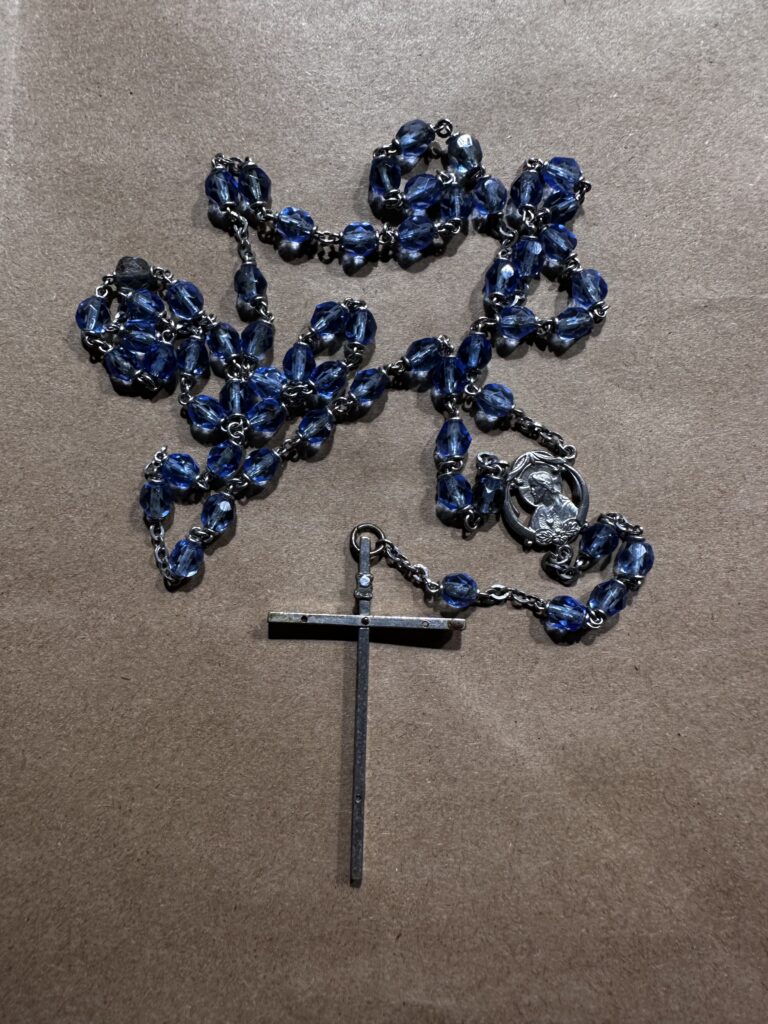
Before dawn, while the household was still quiet, Rosa Schmieder began her day in the kitchen. As she stoked the cookstove to life, she prayed. The fire needed tending before breakfast could be prepared. Ahead lay meals to cook, clothes to wash and hang, and children to feed, dress, and comfort. One task followed another, often interrupted by a child who needed her. She tucked the rosary she had carried to bed into her apron pocket, close at hand through the long hours of caring for her family.
Those beads accompanied a life filled with reasons to give thanks, daily needs to bring before God, and moments when prayer became an urgent plea.
Understanding the Prayer Rosa Carried
For readers unfamiliar with the rosary, its beads and repeated prayers may be more recognizable than its meaning. The rosary is a way of prayerfully reflecting on the life of Jesus Christ in the company of Mary, His mother.
St. John Paul II described it as contemplating the face of Christ with Mary. In familiar terms, it invites a person to consider Jesus’ life through the eyes of the mother who welcomed Him at birth, cared for Him during childhood, and stood near Him at the Cross.
The beads help the person praying keep their place. Each group of ten Hail Marys, called a decade, accompanies reflection on a particular “mystery”—an event of faith whose meaning invites continued contemplation. The repeated prayers provide a steady rhythm for that reflection. In the Hail Mary, Catholics ask Mary to pray for them; the meditation centers on Christ.
During Rosa’s lifetime, the mysteries were arranged in three groups: joyful, sorrowful, and glorious. They recalled Christ’s coming and childhood, His suffering and death, and His Resurrection and the promise of life with God. The luminous mysteries, concerning His public ministry, were added by St. John Paul II in 2002, after Rosa’s lifetime.
Each October, the Church gives particular attention to this devotion, observing the Memorial of Our Lady of the Rosary on October 7. Rosa’s prayer in a farmhouse kitchen belonged to a practice shared by Catholics around the world.
Within that prayer, Rosa could bring before God the concerns of everyday life: gratitude for a child’s birth, fear during an illness, sorrow after a loss, and hope for a better future for the family she loved.
The Joyful Mysteries: Welcoming Life and Giving Thanks
The joyful mysteries begin with the Annunciation, when Mary accepted God’s calling to become the mother of Jesus. They continue through her visit to Elizabeth, Christ’s birth, His presentation in the Temple, and His finding there after Mary and Joseph’s anxious search.
These events hold the joy of welcoming a child, sharing good news, and recognizing God’s presence within family life. They also reveal that joy can exist alongside uncertainty and responsibility.
Rosa’s life offered its own occasions for thanksgiving. On November 7, 1920, she married George at St. Martin’s Church in Freiburg, Germany, originally part of a thirteenth-century Franciscan monastery. Her hands, stained with tobacco from hand-rolling cigars at a factory managed by her half-brother, Josef, held George’s as they began their married life. These were the same hands that moved over her rosary beads. The prayers that had accompanied her working days would now accompany their life together.
Yet the joy of their marriage was shadowed by the sorrow and tears caused by George’s family’s rejection of her. She began married life carrying both happiness and heartache, bringing her joy and sorrow before God in prayer.
Alongside that rejection came the promise of a new beginning: Der Schweizerhof, their farm, restaurant, and inn in Wagenhausen, Germany, in the shadow of the historic monastery, Kloster Sießen. It offered a home and a livelihood to build together, bringing new responsibilities and reasons to give thanks.
There, on July 31, 1921, they welcomed their first child, Hilda Marie. Soon afterward, Fr. Geiger baptized her at St. Gallus, their small country parish church. Her birth and baptism brought fresh joy to their young family—milestones that echo the welcome and dedication of a child celebrated in the joyful mysteries of Christ’s birth and His presentation in the Temple.
The Sorrowful Mysteries: Praying Through Uncertainty
The sorrowful mysteries lead through Christ’s agony in the garden, His scourging, crowning with thorns, carrying of the Cross, and Crucifixion. They invite reflection on suffering, self-giving love, and trust in God amid anguish.
For George and Rosa, the promise of their new beginning soon gave way to hardship.
In the summer of 1922, they lost their farm, restaurant, and inn as Germany’s inflation accelerated and its currency collapsed. Eight months pregnant with their second child, Rosa faced the loss of their home with nowhere to turn. Her parents, Jakob and Monika, were struggling themselves and had no room to take them in, while George remained estranged from his family.
They faced a sorrowful season of their own. Rosa’s prayers grew more urgent, her fingers moving over the beads as she cared for Hilda and awaited the birth of their second child.
Help came from Werner Zaugg, their friend and Hilda’s godfather, who offered them a tiny third-floor apartment on Teggingerstraße in Radolfzell, near Lake Constance. Small as it was, the apartment gave their growing family shelter when they needed it most.
Fred was born in that apartment on September 5, 1922, and was baptized at the Minister of Our Lady. His birth brought another occasion for joy, even as the family’s circumstances remained uncertain.
Economic hardship continued. Fred developed rickets, adding concern for his health to the struggle to provide for the household. In desperation, George and Rosa applied to immigrate to Australia, Argentina, and the United States.
An answer to their prayers came through Wilhelm Pfaff, a relative who had settled in Bennington, New York. He agreed to sponsor George, opening a path to America.
That opportunity required another sacrifice: George would go ahead, leaving Rosa and the children behind until they could join him.
George departed in the autumn of 1923. For thirteen months, Rosa prayed her rosary for him and their young family as they waited to be reunited.
Then, on December 3, 1924, she boarded the SS Bremen with three-year-old Hilda, two-year-old Fred, and one-year-old Arnold. In the cramped steerage quarters, she cared for her three small children as the ship rolled with the Atlantic waves. Each day brought them closer to George and the hope of a new life together.
Their arrival in America that December reunited the family. After separation and uncertainty came the joy of being together again—a husband and wife reunited, three children safely across the ocean, and a chance to begin anew.
Fear and Thanksgiving in a New Land
Reunion in America brought joy, but it did not end the family’s trials. In the mid-1920s, young Fred fell into a tub of scalding wash water. His screams announced a terrifying accident, and his injuries required hospitalization at St. Jerome’s Hospital in Batavia, where the nuns of the Sisters of Mercy cared for him and prayed for his recovery.
No account preserves Rosa’s prayers during his hospitalization. Given her lifelong devotion, she would have turned to her rosary in prayer for Fred and those caring for him.
The family’s early years in America brought new fears as George and Rosa worked to earn a living and provide for their children. Having lost their home and livelihood in Germany, they now hoped and prayed for a farm of their own—a place to raise their children and build a future together.
In December 1928, their winning bid at the auction of the Phelps farm opened the way to that long-awaited opportunity.
After displacement, separation, and the Atlantic crossing, they could once again begin building a home and livelihood on their own land. It was an answer to prayer and a reason for renewed thanksgiving.
The farm would demand years of labor, and the Great Depression would bring further hardship. But the purchase marked a hopeful beginning: a place to raise their children and put down roots.
Such moments of gratitude belonged alongside the concerns Rosa brought to prayer. The joyful mysteries offered room to rejoice in a new home, a growing family, and help received along the way.
A Mother’s Urgent Prayer
As their children grew, family life continued to bring both happiness and concern. Then came another crisis.
Late one summer evening, word reached the house that Arnold had been struck while riding his motorcycle.
His passenger was dead. Arnold’s condition was uncertain. Rosa did not yet know whether her son was alive.
Her son Fred remembered her praying the rosary, her eyes filled with tears as she paced through the house, waiting for news. Her hands trembled as her fingers moved from bead to bead. The familiar prayers she offered so often in the quiet before dawn became an urgent plea for Arnold’s safety and for the soul of the passenger who had died.
The sorrowful mysteries offered a language of faith for such anguish: Christ’s suffering, His trust in the Father, and Mary’s steadfast presence near the Cross.
Whether Rosa was contemplating a particular mystery that day is not recorded. What remains is Fred’s memory of his mother praying as she waited for news, unable to protect her son herself.
Her daily devotion had given her a familiar prayer to return to in that frightening hour.
The Glorious Mysteries: Living in Hope
The glorious mysteries turn toward the Resurrection, the Ascension, the coming of the Holy Spirit, and Mary’s Assumption and Coronation. They direct prayer beyond the needs of the present moment toward the promise of life with God.
That promise has particular significance in a life marked by loss.
George died in 1967. Their marriage had endured family opposition, separation, immigration, economic hardship, years of farm work, and the raising of eight children. Rosa lived until 1985, eighteen years after his death.
The details of her private grief are not preserved here. Yet the glorious mysteries express the Christian hope within which she had long prayed: death does not have the final word, and God’s care extends beyond earthly life.
These mysteries offer hope when a loss cannot be reversed or a question remains unanswered. Christ’s Resurrection points toward life with God, even while grief must still be borne.
Throughout her life, Rosa brought everyday needs before God: food for the household, work, health, and her family’s safety. The glorious mysteries invited her to entrust her loved ones to His care beyond those daily needs—even beyond death—with the hope of eternal life and reunion with those who had gone before her.
Gratitude for years shared with George could exist alongside sorrow at his absence. Concern for children and grandchildren could be accompanied by trust in God’s continuing care. Joy, sorrow, and hope could meet within the same prayer.
A Mother’s Name, a Garland of Prayer
Rosa’s mother, Monika, bore the name of St. Monica, remembered for her persevering prayers for her son Augustine. The connection calls to mind generations of mothers whose hopes and concerns for their children found expression in prayer. Much of that prayer went unrecorded, carried quietly within the work of family life.
Rosa’s full name, Rosalia, offers another connection. Derived from the Latin word for rose, it shares a root with rosary, whose name evokes a rose garden or garland. The rosebushes she tended on the farm lend a fitting image to her devotion: flowers nurtured through patient care, prayers offered through years of joy and sorrow. Her roses and her rosary remain two ways of remembering Rosalia—a woman tending her home, caring for her family, and making room for prayer.
One Rosary Through the Years
In time, George and Rosa raised eight children, and their family grew to include forty-one grandchildren. Births, visits, celebrations, and successful harvests brought joy into a household sustained by work and care.
Rosa’s life did not unfold in separate seasons of happiness and hardship. A new beginning could bring gratitude and worry together. Love for a child could be a source of delight and, suddenly, of fear.
Her rosary accompanied them all.
Today, it is preserved by her granddaughter, Paula Schmieder Lord. Its age is unknown. The blue faceted beads and metal cross remain, and a broken chain has been repaired. The corpus—the figure of Jesus—has long been missing from the cross.
Rosa was a quiet and humble woman who sought neither attention nor honors. Her days were filled with work that rarely drew recognition: preparing meals, washing clothes, tending her home, and caring for her children. In these ordinary responsibilities, she expressed her love. Prayer accompanied that work, woven into the daily care of her family.
In October, the Church’s attention to the rosary invites a renewed understanding of the prayer Rosa knew so well: contemplating Christ with Mary and bringing the needs of daily life before God.
Before dawn, beside the cookstove, Rosa prayed. When frightening news reached the house, she prayed in earnest. Through years of work, rejoicing, uncertainty, and loss, the beads remained close at hand.
The rosary in her apron pocket tells something essential about her life: she carried her family’s joys and sorrows into prayer, and she continued in hope.
Author’s Note: This account of Rosa’s prayer life draws on oral history, documented events, and family memories. Some passages offer reflections on how her lifelong devotion may have accompanied those experiences, rather than a record of her particular prayers. Together, they honor what has been remembered and passed down, while acknowledging that no account can fully capture a life.
Frederick Schmieder