
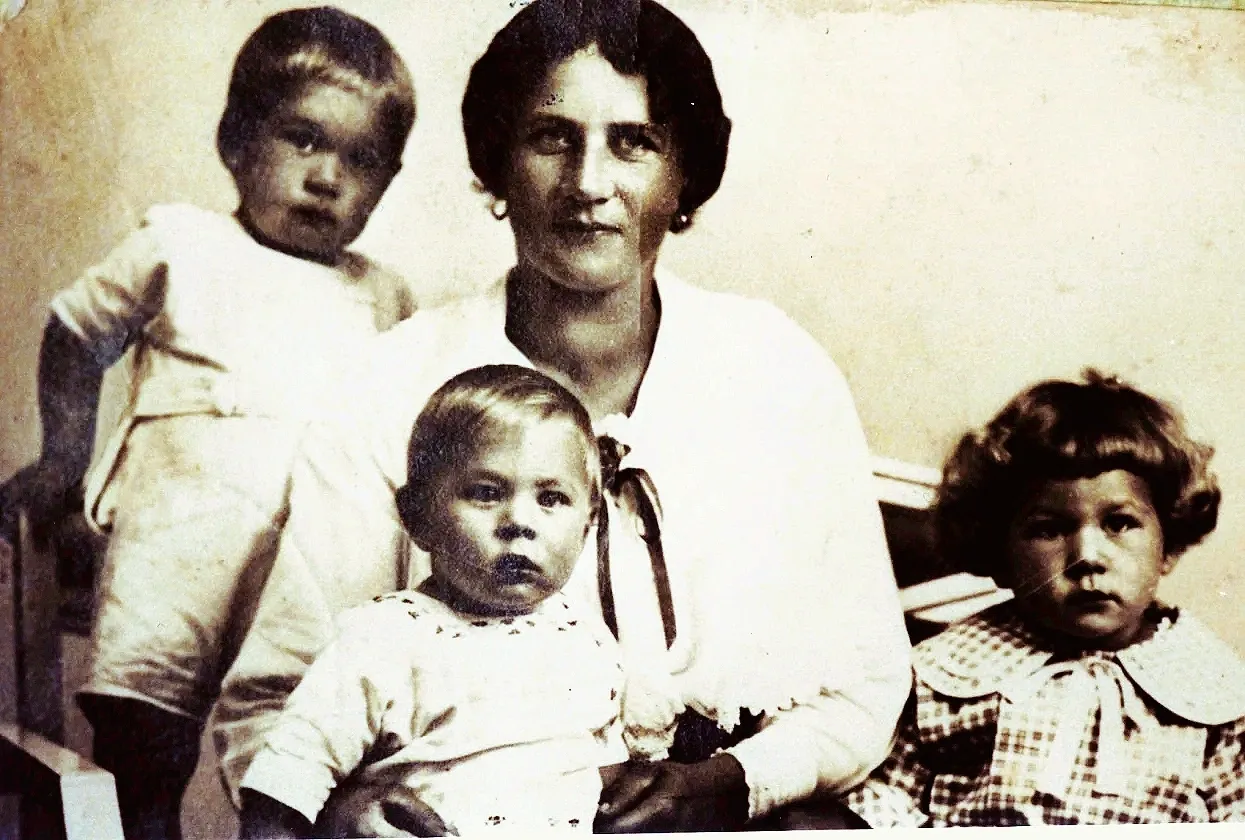
Chapter 5: The Last German Years — Schönberg, 1923–1924
Passports in Hand, A Dream Set in Motion
On August 16, 1924, Rosa and her children marked a pivotal moment in their journey as they received their German passports. They had spent nearly ten months living with the Beck family in Schönberg, Germany, while George Schmieder worked diligently to forge a new life for their family in New York State. However, this milestone was just the beginning, as subsequent challenges awaited them, including the implementation of a new U.S. immigration law known as the Immigration Act of 1924, often referred to as the Johnson-Reed Act.
A Law That Could Keep Them Apart
This legislation limited immigration by establishing an annual cap on the number of immigrants permitted. For the fiscal year, Germany’s quota was set at 52,225, meaning only this number of German immigrants could legally enter the United States during that time. In their correspondence across the Atlantic, George and Rosa expressed considerable concern about adhering to this quota and securing a visa.
Clearing Debts, Clearing the Way
The next challenge was obtaining an exit permit (Auswanderungsgenehmigung) from the local or regional authorities. This permit confirmed that Rosa had no outstanding debts. On October 11, 2024, Rosa successfully received clearance from the tax authority in the nearby city of Lahr, allowing her to apply for a visa.
Eight Steps Between Rosa and America
The American Consulate in Stuttgart was the next step in the process, which included:
1. Visa Application Forms
• Personal information, occupation, financial status, and U.S. contact details.
• An affidavit of support from George Schmieder, their sponsor, demonstrating that he can financially support Rosa and the children.
2. Passport and Birth Certificate
• A valid German passport issued by local authorities.
• A certified birth certificate proving age and nationality.
3. Proof of Relationship (if joining a spouse or family)
• Marriage certificate
• Birth certificates for Hilda, Friedrich, and Arnold.
• A letter from George confirming his intent for them to reunite.
4. Quota Number Registration
• Rosa had to register for a quota number through the consulate.
5. Medical Examination
• A U.S.-approved doctor in Germany must certify that the applicant is free of contagious diseases, mental illness, or physical conditions that could make them a public charge.
6. Police Certificate (Good Conduct Report)
• The German police had to confirm that Rosa has no criminal record.
7. Proof of Financial Stability
• Bank statements, proof of employment, or George’s financial records to demonstrate that Rosa would not become a public burden.
8. Visa Fee Payment
• Rosa was required to pay all the processing fees and medical exam costs.
Hope and Anxiety in the Consulate Waiting Room
Having gathered all the necessary documents, Rosa and her sister Theresia took the train from Lahr to her appointment at the American Consulate in Stuttgart, located at Böblinger Str. 10. The consulate is situated in a mixed residential and commercial area characterized by tree-lined streets and small shops, where she planned to submit her application and obtain a quota number.
The spacious lobby of the American Consulate in Stuttgart welcomed visitors with its long wooden benches and a formal reception area that featured polished wooden check-in desks. Large wall maps of the United States displayed key landmarks and destinations alongside immigration notices and instructions in English and German. As she scanned the bilingual signage, a sense of concern washed over her regarding the challenge of learning a new language. Rosa sat quietly beside Theresia, her thoughts swirling as she anxiously waited for her name to be called for her appointment.
This year marked a challenging time for hopeful immigrants like Rosa, who faced new hurdles in pursuing the American dream. As she waited, the weight of the quotas loomed over her aspirations.
A clerk’s voice called, “Frau Rosa Schmieder.” Rising to her feet, she was led to an interview room. Her documents were clutched tightly in her hand as she prepared for her essential appointment. Upon arrival, she received significant news: she and her children were eligible under Germany’s immigrant quota for the year and had been assigned a quota number. However, if the quota for Germany were filled, Rosa would face a frustrating wait until the start of the next fiscal year on July 1, 1925, before she could reapply.
The clerk confirmed that her documents were complete and that the Consulate would review and respond to her application. The process could take several weeks to months.
Rosa and Theresia walked one and a half miles to Stuttgart Hauptbahnhof (Stuttgart Central Station) to return home via the Gäubahn (Stuttgart–Horb railway), transferring to the Black Forest line and then to Lahr. The four-and-a-half-hour train ride allowed for quiet reflection and conversation.
As the train rolled smoothly along the tracks, Rosa felt a heavy weight on her heart as she contemplated her future and that of her children. She confided her fears, her voice barely a whisper amidst the hum of the train. She spoke of the daunting prospect of crossing a vast ocean with three young children in tow, each wave of worry crashing over her like the turbulent sea they would soon face. The thought of being dropped off in the bustling heart of New York—a city teeming with millions of strangers—sent shivers down her spine. Her mind raced with logistical concerns, and she admitted her anxiety about finding the right train to navigate to Attica, New York. With each passing moment, the journey felt more overwhelming. An insurmountable challenge loomed before her.
Noticing Rosa’s turbulent emotions, Theresia spoke with encouragement, her voice steady and reassuring. She emphasized that Hilda, Friedrich, and Arnold would have brighter futures filled with opportunity. Theresia’s comforting presence radiated hope as she shared her heartfelt wish to someday join Rosa in America.
Memories of a Homeland She’d Soon Leave
As the days began to wane, a subtle hint of autumn painted the leaves while the apples in the orchard swelled with ripeness. Rosa’s brothers harvested the crops while Grandpa Jakob gathered the summer honey (Sommerhonig), crafted from the sweet nectar of vibrant wildflowers, fruit-laden trees, and aromatic summer herbs. Hilda and Friedrich watched eagerly, their eyes sparkling with curiosity, as he delicately removed the honeycombs from the hives, scraped away the wax capping, extracted the golden honey, and strained it before storing it in jars.
The village farms were adorned with various apple trees and other fruit trees, including cherry and plum, showcasing unique and interesting apple varieties like the Rheinischer Winterrambur, known for its large size and exceptional storage qualities, and the Bohnapfel, a popular choice for producing Apfelmost cider, which was to be made soon.
Rosa cherished rare moments when she could escape the constant demands of her children’s needs—moments that came only after the laundry was washed by hand after she helped with the endless tasks of meal preparation, farming, gardening, and preserving food for the long winter. With these tasks behind her, she would venture into the enchanting forest behind their home with her daughter, Hilda.
Together, they wandered among the tall, whispering pines that swayed gracefully in the gentle breeze, releasing a rich fragrance emblematic of the Black Forest. Nearby, the remnants of Hohengeroldseck Castle, a once-mighty fortress established in 1260, lay in ruins. The French ravaged it in 1689 during the Nine Years’ War (1688–1697). The castle, perched on Schlossberg Mountain, overlooks the Kinzig Valley and tells stories of a grand past, adding a layer of mystique to their adventures.
Her thoughts drifted back to a simpler time as she reminisced about her hour-long walks through these woods to attend Volksschule, an eight-year primary school for children ages six to fourteen. She recalled the long walks to and from the cigar factory where she worked in Reichenbach, managed by her half-brother Josef, which left her hands stained by the tobacco leaves.
In the private moments shared between her and George amidst those hillside forests, he traversed from one side of the forested mountain, arriving from his family’s homestead in the Gereut Valley. Simultaneously, she approached from the opposite side—these memories, rooted in the time before the post-war chaos that crippled Germany and shattered their dreams.
As they wandered the worn paths, Hilda delighted in the sweet songs of birds weaving through the trees. During these serene moments, Rosa and Hilda experienced the tranquility of nature, deepening their bond in the sacred stillness of the woods, a homeland she would soon leave behind, holding its memories deep within her heart.
One Signature Closer to America
On October 11th, Rosa received her Schuldenfreiheitsbescheinigung (debt clearance certificate) from the City of Lahr municipality. Local officials also stamped her passport, indicating she was free of any outstanding debt. This marked another step closer to the long emigration process.
On Tuesday, November 18th, she received news that Howard Taylor, American Vice Consul, approved and signed her and her children’s visas. This required her to return to the American Consulate to collect the final documents. Given the significance of the visas and the potential risks of documents being lost or tampered with during mailing, applicants were advised to visit the consulate in person. This ensured that all final details were accurate and in order before their departure.
Thus, Rosa made another trip to the American Consulate on a chilly mid-November day, collected her visas, and conveyed her heartfelt gratitude to the clerk, who wished her good luck in her new life and that of her family. Rosa exited through the heavy wooden doors and walked to the nearby Norddeutscher Lloyd shipping line office, which had been in operation since 1857.
Four Tickets, A Thousand Fears
The shipping lines’ office bustled with customers seeking new beginnings. The company’s logo, featuring a crossed anchor and key over an oak-leaf wreath, adorned a wall displaying a detailed map of the ports its ships sail, including Bremen, the port city from which Rosa will purchase passage.
Her heart raced as she double-checked the neatly organized stack of her passport, necessary documentation, and visas, all finally in order after months of preparation before presenting her travel requests to the booking agent. The agent discussed the three levels of travel accommodations available. Unfortunately, she barely had enough money to cover the cost of the third-class steerage section, including discounted tickets for Hilda, Friedrich, and Arnold.
The clerk issued four tickets from Bremen, Germany, to the port of New York, marking an important milestone in her journey. The ship was set to depart on Wednesday, December 3, 1924, with a promise of arrival in New York on Monday, December 15. Yet, as she clutched the tickets tightly, a pang of anxiety hit her; her funds were rapidly dwindling. Would she have enough to cover the rest of her trip? With each passing moment, doubt crept in, casting a shadow over the reality that she would leave her parents, siblings, and friends to a world she did not know.
Counting Down the Final Days
On the train ride back to Lahr, her heart began to pound so fiercely that it felt like it could leap from her chest. Lightheadedness washed over her, leaving her dizzy and clutching the seat. Each clack of the wheels on the tracks echoed the turmoil within her, amplifying a growing dread that wrapped around her like a suffocating fog. The uncertainty of what awaited her gnawed at her insides, making her feel as though each breath could be her last.
It was just ten days until they would have to say goodbye for good. A somber atmosphere lingered over the house. Grandma Monika cherished every moment of having her eldest daughter back home, treasuring the laughter and joy brought by her three beloved Schmieder grandchildren. Yet, a heavy ache remained in their hearts, knowing they might never see each other again.
The Last Supper at Home” or “A Table Filled with Laughter and Goodbyes
The family organized a farewell gathering, filling the air with nostalgia and warmth as they shared a delightful dinner on the Sunday before their bittersweet departure. In the kitchen, laughter resonated as Magdalena, Theresia, and Rosa joined Monika, each stirring pots and pans. Meanwhile, they reminisced about their cherished childhood adventures, their stories punctuated by laughter and occasional tears.
In another room, Grandpa Jakob, Albert, Wilhelm, and Jakob Jr. animatedly entertained the children, their playful antics and gentle teasing filling the space with joy and lightheartedness. Half-brother Josef, accompanied by his wife and lively children, along with Rosa’s brother Franz, his wife Frieda, and their precious new daughter, also named Frieda, arrived with an array of delicious dishes and kuchen, eager to contribute to the celebration of shared memories and new journeys ahead. The day was filled with food, Wilhelm’s cider made from their orchard, laughter, love, and the bittersweet pangs of saying goodbye, leaving a lasting imprint on every heart present.
As Rosa looked around the large table, she gazed at her father, Jakob, a descendant of Georg Beck and Barbara Schremp, both born in the mid-1600s. He was seventy-two years old now and had slowed considerably. His hands trembled, especially when eating or drinking. His gait was now slow and shuffling. A wooden cane assisted him whenever he went outside. Recently, he had been diagnosed with diabetes. Although insulin was discovered in 1921 and became commercially available in 1923, he would not have had access to it.
Then to her mother, Monika, who was born in 1862 to Genovefa Heitzmann. She was sixty-two and ten years younger than her father, Jakob. Rosa noticed her mother’s aging. Her food needs to be softer, as she has lost some teeth. The arthritis in her hands, back, and neck makes working more difficult, but she doesn’t complain. Despite her debility, she perseveres and always does for others.
Monika faced significant challenges; she was born out of wedlock and given her mother’s family name, Heitzmann. Her father remains unknown in historical records. Monika grew up in poverty. During her early years, she and her mother lived with her grandfather, Martin Heitzmann, until he died in 1868. Her mother worked as a day laborer. When Monika was old enough, she also labored in various farmers’ fields to make a living. In 1893, at thirty-one, she was single and employed as a maid in Reichenbach when the widower Jakob Beck sought a wife to help care for his children. They were married by Fr. Hornstein at St. Nikolaus Catholic Church in Seelbach on November 27, 1923, and lived on the Trentenhof farm in Seelbach before moving the farm in Schönberg.
A profound sense of gratitude filled her heart for her loving family. However, an unexpected wave of sadness washed over her, overshadowing the joy of being surrounded by loved ones. She felt a deep ache as she realized that she would soon be unable to meet the needs of her aging parents in the twilight of their years, a stark reminder of the fleeting nature of time and the inevitable changes it brings.
Packing Memories and Fears
On the eve of Rosa’s heart-wrenching farewell, her sisters gathered around her trembling hands as she carefully packed her trunk. Each item echoed a memory of what it had once been, reminding her of what she was leaving behind. Unspoken fears weighed heavily as the significance of their impending separation grew. Magdalena and Theresia, with trembling voices, whispered heartfelt promises of future visits to America. In the soft glow of the small room, Monika entered, holding tightly to baby Arnold, who had come into the world just one year ago in this very room, the only home he had ever known.
As the evening drew to a close, Jakob added more logs to the wood stove. Although the warmth of the fire was comforting, his heart felt the chill and emptiness of their departure. He lingered a bit longer by the fire, clinging to cherished memories of his daughter, Rosa: her birth, First Communion, her young family, and the frightening time when she was almost killed after being thrown from the wagon—her head smashing into a rock.
The Day Hearts Were Torn Apart
As night gave way to the morning dawn, a sense of urgency began to fill the Beck house. The cookstove blazed, and the flickering glow of oil lamps illuminated weary faces. Smoked hams and slabs of bacon hung from hooks in the kitchen. The sounds of moving chamber pots echoed through the hallways. The children needed to dress and have their breakfast. The farm animals stirred in the barn, awaiting attention. All the daily routines went on, except this was the day steeped in loss and separation—an agonizing day that would push hearts to the brink of their endurance.
A nineteen-year-old family friend, August Kautz, arrived with a horse and wagon. He volunteered to take Rosa and the children to the train station in Lahr. Inside the house, he took off his coat to warm himself by the fire, sipped a hot cup of coffee, and enjoyed a slice of Monika’s freshly made bread slathered with honey from Jakob’s beehives.
The air was thick with emotion, each tick of the clock representing one less moment together. Then the clock struck- the time had expired. The end had come, and the men loaded Rosa’s trunk into the back of the wagon. Thick blankets were arranged for Hilda and Friedrich.
Tears They Couldn’t Hold Back
The goodbyes were barely audible, enveloped in a thick atmosphere of sorrowful whispers. Tight embraces squeezed the air from their lungs while the glistening tears cascading down their cheeks spoke volumes about their profound grief. Rosa felt a deep ache in her chest as she realized she and the children would never again bask in the warmth of Grandma and Grandpa Beck’s love and stories.
Friedrich clung to Monika’s side, his bright eyes shimmering with unshed tears, yearning for the comforting safety she offered. In her heart, Monika felt a wistful ache, secretly wishing that the moment could last forever, that they could remain together in this bittersweet instant, shielded from the painful reality of their separation.
One Last Look Back
Hilda and Friedrich were lifted into the wagon and bundled snugly in layers of soft, worn blankets, their tiny bodies barely visible. Rosa sat up front, cradling baby Arnold in a thick, warm blanket against her broken heart, her fingers trembling slightly as she held him close. August gripped the reins, his knuckles white with tension, while the creaking wagon lurched forward. With tears brimming in her eyes, Rosa cast one last desperate glance back at her family as they stood silently, their faces etched with sorrow and love, waving goodbye with aching hearts. The sight of them left an indelible mark on her soul, a bittersweet memory that she would carry with her forever.
Note: This account of the lives of our grandparents, George and Rosa Schmieder, from 1923 to 1924 includes factual events and personal perspectives. It reflects individual interpretations and subjective insights, acknowledging the difficulty of accurately capturing every detail of past events.
Frederick Schmieder