
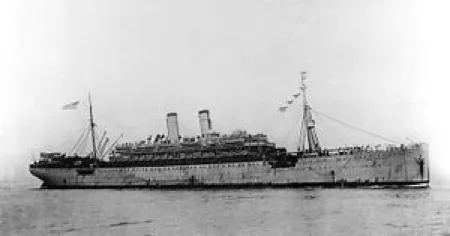
Chapter 6: Tears and Hope — A Passage to America, 1924
SS Bremen: The Ship That Carried Rosa and Her Children to a New Life in America
Farewell to Home: Boarding the Train in Lahr
The rhythmic creaking of the wagon wheels lulled little Arnold into a peaceful sleep. His head bobbed gently with each bump as August Kautz (Gus) held firmly to the reins. Meanwhile, Hilda and Friedrich (Fred) transformed the cramped space into a world of play. Their laughter rang out as they played together, seeking adventure in every sway of the wagon. It was a cold and gray morning that seemed to reflect Rosa’s emotions as the wagon jostled along the rough path toward the train station in Lahr, the air heavy with a lingering sense of loss. Muted conversations did little to ease the pain in her aching heart.
As they reached the station, emotion and dread washed over Rosa, her eyes welling with tears. Gus loaded her belongings onto the platform. With heartfelt sincerity, she turned to Gus, offering a final poignant farewell filled with gratitude for his kindness in giving them a ride. Rosa had no time to wallow in her feelings; she had to safely get herself and the children to Bremen, four hundred miles away.
Burdened with luggage, she carried Arnold while instructing Hilda to hold onto her coat with one hand and Friedrich’s with the other. As she guided the children across the threshold into the third-class section, she silently bid farewell to the land that had been her home for thirty years, stepping into an uncertain future filled with the unknown, unsure of what awaited her.
Ten Hours on Hard Wooden Benches
It is daunting for a mother embarking on a two-week journey alone with three small children aged three, two, and one. The hard wooden benches and cramped third-class train compartment were filled with fellow travelers, many of whom were also emigrants in search of a new beginning across the Atlantic, including twenty-year-old Maria Fischer from Reichenbach, who would be traveling on the same ship as Rosa to America.
In Rosa’s travel bag, she had diapers, clothes for the children, and food items: homemade bread, baked goods, cheese, apples, and flasks of water and milk.
The children, restless during the journey, squirmed and fussed, but Rosa soothed them with lullabies and gentle reassurances. She told stories about their new home and their father, who had few memories of them. Among their scant belongings, Rosa had brought a cherished children’s book from the Black Forest, filled with illustrations of woodland creatures and fairy tales. As the train rattled along the tracks, she turned the pages for Hilda and Friedrich, pointing to the familiar images in the book and to the ships visible from their train window as they traveled along the Rhine River.
The train’s lavatories were cramped and small, emptying directly onto the tracks. There were no diaper-changing areas, so Friedrich and Arnold had their diapers changed at their seats. Soiled diapers were placed in a separate bag and tightly wrapped to minimize odors until they could be washed later.
The transitions between trains in Offenburg and Frankfurt were particularly challenging, as she had to navigate the crowded platforms while carrying Arnold, holding onto Hilda, and supporting Friedrich. Occasionally, a kind stranger or conductor would offer to help lift a bag or steady a child.
Weary Arrival in Bremen
The ten-hour journey weighed heavily on Rosa, both physically and emotionally. As the train rattled toward Bremen and the bustling Port of Bremerhaven, her thoughts wandered to what lay ahead: reuniting with George, overcoming the challenges of a new country, and nurturing hopes for a brighter future for her children. Yet, at that moment, she needed to focus on gathering the children and their luggage, her heart heavy with anticipation.
The railway station buzzed with travelers, many of whom spoke languages she didn’t understand and wore unfamiliar clothing. She felt exhausted from the journey; the children were hungry and irritable as a biting cold wind blew in from the north.
A Night Among Strangers: The Emigrant Hotel
The Norddeutscher Shipping Line offered temporary boarding accommodations near the bustling port of Bremerhaven for emigrants preparing to embark on their journeys. This arrangement was made when purchasing their passage tickets, ensuring travelers had a place to stay before departure. As night fell over Bremen, a horse-drawn taxi cart, with its wooden wheels creaking against the cobblestones, transported the young Schmieder family from the Bremen Hauptbahnhof to the lodging facilities near the port, where they would eat and rest before beginning their long journey across the sea.
The utilitarian lodging near the port served as a temporary haven for countless travelers, including Rosa and her children. In the spacious communal dining hall, the inviting aroma of freshly baked bread and simmering soup provided comfort after their long journey. The vibrant sounds of myriad conversations filled the space, with voices in various languages sharing tales of home and aspirations for a better life. Amidst the bustling crowd, Rosa navigated through the throngs, managing to secure meals for herself and her children as they faced the daunting journey ahead.
The facility offered communal washrooms where Rosa diligently worked to clean the children using cold, running water. She hand-washed their diapers, hopeful they would dry by morning. Navigating the shared space among strangers, she ensured her little ones were clean and prepared for the next leg of their journey. Their assigned room was simple and sparsely furnished, with rows of metal-framed beds lined against plain walls. The mattresses, made of straw or horsehair, provided some comfort to the weary travelers. As she tucked her children into bed, she used their travel blankets to keep them warm against the chill of the room.
The night was restless, filled with the sounds of other travelers, crying infants, and creaking beds. Despite her exhaustion, Rosa lay awake, her thoughts centered on the ship waiting for them and the unknown future that awaited across the Atlantic.
On the crisp Wednesday, December 3, 1924, eager travelers stirred awake before dawn, bustling about as they gathered their belongings in nervous anticipation of their impending voyage. Representatives from the shipping line verified and confirmed the passage details, ensuring everything was in order. Following this, a series of medical examinations was conducted, ensuring that Rosa and her children met the strict immigration medical standards required for their journey across the sea.
At the Dock: First Glimpse of the Ships
Rosa, Hilda, Friedrich, and Arnold waited in line at Bremerhaven Port along the Weser River, 40 miles from the North Sea. She took in the vastness of the port before her. The air was filled with the smells of industry and coal smoke. Towering ships lined the docks, their massive hulls casting long shadows over the bustling wharf. She had never seen such an enormous congregation of vessels; among them was the ship that would carry them to America—the SS Bremen.
The 18,000-ton steamship measured 564 feet, a floating fortress that had witnessed its share of history. Initially launched in 1900 as the Prinzess Irene, it was seized by the United States during World War I, renamed the Pocahontas, and used to transport troops across the Atlantic. Now, reclaimed by a German shipping company in 1922, it bore the name SS Bremen, though its grandeur was reserved for first-class passengers.
Life Below Deck: The Hardships of Steerage
Rosa and the children were directed below deck to their third-class steerage accommodations on the ship. These passengers were not allowed to enter the first or second-class areas of the ship. Once on board, Rosa found herself surrounded by a cacophony of sounds. The steady hum of the ship’s engine vibrated beneath them. Babies cried, dishes clattered in the mess hall, and footsteps echoed as crew members moved through the narrow corridors. Rosa’s quarters were cramped, with little more than a few bunks and a small trunk for their belongings.
Into the North Sea: The Voyage Begins
During the late afternoon of December 3rd, the SS Bremen blasted its horn and began its several-hour, forty-mile journey up the Weser River and into the North Sea. A winter storm intensified as the ship entered the open waters of the North Sea. Strong winds and turbulent seas rattled the vessel, causing it to creak and groan with every crashing wave against its steel hull. The dim electric lighting flickered in the steerage section as the ship lurched.
Rosa clutched Arnold to her chest in the ship’s cramped confines, her heart racing as she felt the warmth of his body nestled against her. Hilda and Friedrich sat on either side of her, their eyes wide with fear. The ship groaned and pitched, forcing Rosa to brace herself against the cold metal frame of the bunk as the waves crashed against the hull—a desperate prayer to the heavens above as she envisioned the ship tilting precariously into the tumultuous sea.
Meanwhile, the ship’s stewards navigated the narrow aisles, assisting seasick passengers. The stagnant air in steerage was thick and oppressive, heavy with the acrid smell of vomit mixed with coal smoke from the engine’s steam boiler. The atmosphere felt suffocating as the North Sea unleashed its fury upon the vessel.
A Fragile Calm on the Open Sea
As the seas calmed, a routine of ship life developed. Passengers acclimated to the rolling waters. Meals were taken in the cramped quarters of a busy and noisy communal dining area, where tin plates and cups clanged on long tables.
Meals were simple: Breakfast included porridge, bread, and butter. Lunch featured soup, bread, sausages with mustard or sauerkraut, and pickles or other preserved vegetables. Dinner consisted of a stew made with either pork or beef, accompanied by potatoes, rice, cabbage, or other root vegetables. For Rosa, managing mealtime with three young children was no easy task.
A Locked Door and a Mother’s Panic
Before the trip, Rosa had wisely transitioned Arnold to a bottle. Aboard the ship, she needed to ask the kitchen staff for powdered milk to mix with cold water. It had a flavor that Arnold was not used to, but he managed. One time, Rosa left Hilda, Friedrich, and Arnold in the cabin while she prepared a bottle of milk for Arnold. To Rosa’s great surprise, upon her return, she found the door locked. Friedrich had secured it, and no matter how hard she tried to persuade Hilda to unlock it, it stayed closed.
Her heart raced with growing panic as she frantically searched for a steward. When she finally found one, he swiftly unlocked the door, revealing a sight that brought immense relief: all three children were safe, their playfulness undisturbed by the misdeed.
Arnold’s First Steps at Sea
Amidst the joy of watching his older sister and brother run around the ship, Arnold, with a determined look in his eyes, decided it was time to emulate their mobility. He took his first faltering steps on his own, with the vastness of the Atlantic Ocean beneath his tiny feet—a milestone celebrated by his family, a rarity that few can claim.
The First Glimpse of Lady Liberty
In the early morning of December 15, 1924, a triumphant blast of her horn announced the SS Bremen’s grand arrival in New York’s bustling harbor. The passengers felt a mix of relief and excitement after an arduous 12-day voyage across the treacherous North Sea and the vast Atlantic Ocean. The weary yet hopeful immigrants erupted into jubilant cheers. In contrast, some openly wept, while others clasped their hands in silent prayer at the magnificent sight of Lady Liberty—her towering figure standing tall with an arm raised towards the heavens, a beacon of hope welcoming them to a land of opportunity.
Rosa stood on the crowded deck, surrounded by the chilly harbor, holding onto Hilda, Friedrich, and Arnold. Her heart swelled with a mix of anxiety and exhilaration as she embraced this historic moment in her family’s history. It was a time when destiny and hope converged, allowing them to weave their dreams into the vibrant tapestry of American life. They were embarking on a new journey filled with promise, pursuing their American Dream despite the uncertainties ahead.
Through Ellis Island’s Halls
Officials boarded the ship, docked at the Hudson River piers in Manhattan, to conduct brief medical evaluations of first- and second-class passengers, searching for infectious diseases and other conditions that could prohibit their entry. Once cleared, they were permitted to disembark and continue to their destinations. In contrast, third-class passengers had to wait 1 to 2 hours before taking the New York Ferry to Ellis Island for their medical and legal assessments, all while marveling at the view of the New York skyline, a memory etched in time.
Rosa stepped off the ship, holding her children close while juggling their heavy luggage, and then was ferried to Ellis Island; a rush of emotions enveloped her. They were finally on solid ground for the first time in nearly two weeks. Their legs felt weak and wobbly as they adjusted to the stability beneath their feet. Along the way, a sailor gave Friedrich a piece of candy as a welcoming gesture.
The Great Hall of Questions
Upon arrival, they were guided into the bustling main building of Ellis Island, where they queued in long lines within the cavernous Great Hall. Officials checked their paperwork while doctors conducted brief health examinations. Inspectors marked individuals with potential medical issues with chalk symbols on their clothing, such as an “ X’ for mental illness or’ E” for eye disease, indicating that further examination was required.
Rosa’s heart pounded as she clutched Hilda and Friedrich’s hands, fearing that any misstep might separate them. After hours of waiting, their turn finally arrived. A stern-faced official reviewed their documents, glancing back and forth between Rosa and her children. A doctor looked into their eyes, examined their hands for signs of illness, and listened to their breathing. Relief flooded over Rosa when they received clearance to proceed.
With their papers stamped, Rosa and the children climbed the stairs to the second floor of the Registry Room, where they underwent legal clearance. The Registry Room buzzed with hushed conversations and the shuffling of feet. Rosa could hear other passengers speaking in various languages — all anxiously awaiting their turn.
The immigration officials, aided by an interpreter, began to ask questions, their voices stern yet calm:
- What is your name?
- How old are you?
- Where were you born?
- Are you married or single?
- What is your occupation?
- Where are you going in America?
- Do you have any family there?
- Who is meeting you when you arrive?
- What is your final destination?
Rosa answered each question. The official reviewed the answers with a careful eye, scrutinizing her documents before asking one final question:
- Do you plan to become a U.S. citizen?
She replied, “Yes.” After a tense moment, the official nodded, stamped their papers, and waved them on. They were finally free to continue their journey!
Once their immigration process was complete, Rosa and the children gathered their few belongings. They boarded the New Jersey Ferry bound for the Central Railroad of New Jersey Terminal in Jersey City, feeling the chill of the December air. The journey had been long and arduous, yet their dream of reuniting with George was finally within reach.
A Long Night Toward Batavia
The bustling red-brick railroad terminal on the waterfront featured large arched windows and a distinctive clock tower. It served as the gateway to inland America, filled with fellow immigrants clutching their luggage while holding tickets to unknown destinations.
While they waited to board the overnight train to Batavia, New York, which involved several transfers, she bought food and milk for the children, changed diapers, and awaited their train—the final leg of a two-week journey.
After the sun had set, they boarded their train, a car dimly lit by overhead bulbs casting a flickering glow over the rows of wooden seats. Aboard the train, she noticed the porters were unfamiliar faces of African descent. Her initial fears were quickly eased by their kindness and willingness to help.
The rhythmic clatter of wheels against the rails created a constant lull, interrupted only by the occasional whistle as the locomotive passed through towns and snow-covered fields. Hilda and Friedrich, exhausted from the long day, curled up beside their mother, their small bodies pressed against her for warmth. Restless and whimpering, Arnold nestled in Rosa’s arms while she gently rocked him to sleep.
Sleep came in fitful moments, interrupted by station stops and occasional cries from the children. Rosa adjusted the travel blanket around herself and the kids, feeling the weight of exhaustion settle over her. Despite her fatigue, she pushed aside fleeting worries about whether she was on the correct train and what would happen if George wasn’t at the station when they arrived.
As dawn broke on Tuesday morning, December 16, just nine days before Christmas, the Batavia station appeared on the horizon. Weary travelers began to rouse from their slumber as frost-covered fields reflected the morning sun’s early light. Rosa prepared the children to see their father after nearly fifteen months of absence, serving them the bread, cheese, and fruit she had purchased at the New Jersey station.
At Last: Batavia Station
The train slowed, its whistle signaling as it approached the main line of the New York Central Railroad through Batavia, New York—their final destination. The station featured a standard design, characterized by a brick structure, a peaked roof, and large windows.
Rosa’s heart raced as she stepped onto the cold platform, lifting Arnold onto her hip while holding Hilda’s and Fred’s hands with determination. She felt a swell of gratitude for having navigated their exhausting two-week journey with just five cents to spare- a testament to her resilience against the obstacles and challenges of such a trip alone with three children.
Her eyes scanned the crowd, hoping the man who would take them to their new home was waiting. Suddenly, a man in his late forties approached. He introduced himself as Ed Siegert. A resident of Attica and a new friend of George’s, Ed was of German descent and the owner of a car, a purchase George could not afford. His work involved the grocery business, ice delivery, and auto sales. Mr. Siegert’s first wife had died many years earlier, and he and his second wife had two boys, aged five and four.
Rosa and Arnold sat in the front seat of the black Model T, while Hilda and Friedrich occupied the rear. He covered them with a blanket to shield them from the cold winter air that seeped into the vehicle. They eagerly braved the cold, bumpy ride to Gulf Road, where George, eager to see his family, rushed out to greet them.
Home at Last: A Long-Awaited Reunion
After fifteen grueling months of separation marked by hardship, deep loneliness, and unrelenting uncertainty, their reunion overflowed with emotion. George rushed to the car, and they threw themselves into each other’s warm embrace, tears of joy streaming down Rosa’s cheeks. George scooped up Hilda and Fred, marveling at how much they had grown in his absence. Their laughter filled the air, a beautiful melody he had long awaited. Then, with calloused hands full of awe and love, he reached for Arnold, his son born during his time away, and held him for the first time, feeling the weight of the world lifted from his shoulders at that moment.
Note: This account of our grandparents, George and Rosa Schmieder, in December 1924 includes factual events and personal perspectives. It reflects individual interpretations and subjective insights, while acknowledging the challenges of accurately capturing the details of past events.
Frederick Schmieder
Below is a YouTube video showing the SS Bremen from 1929. Unfortunately, it doesn’t showcase the difficult accommodations in the steerage section.