
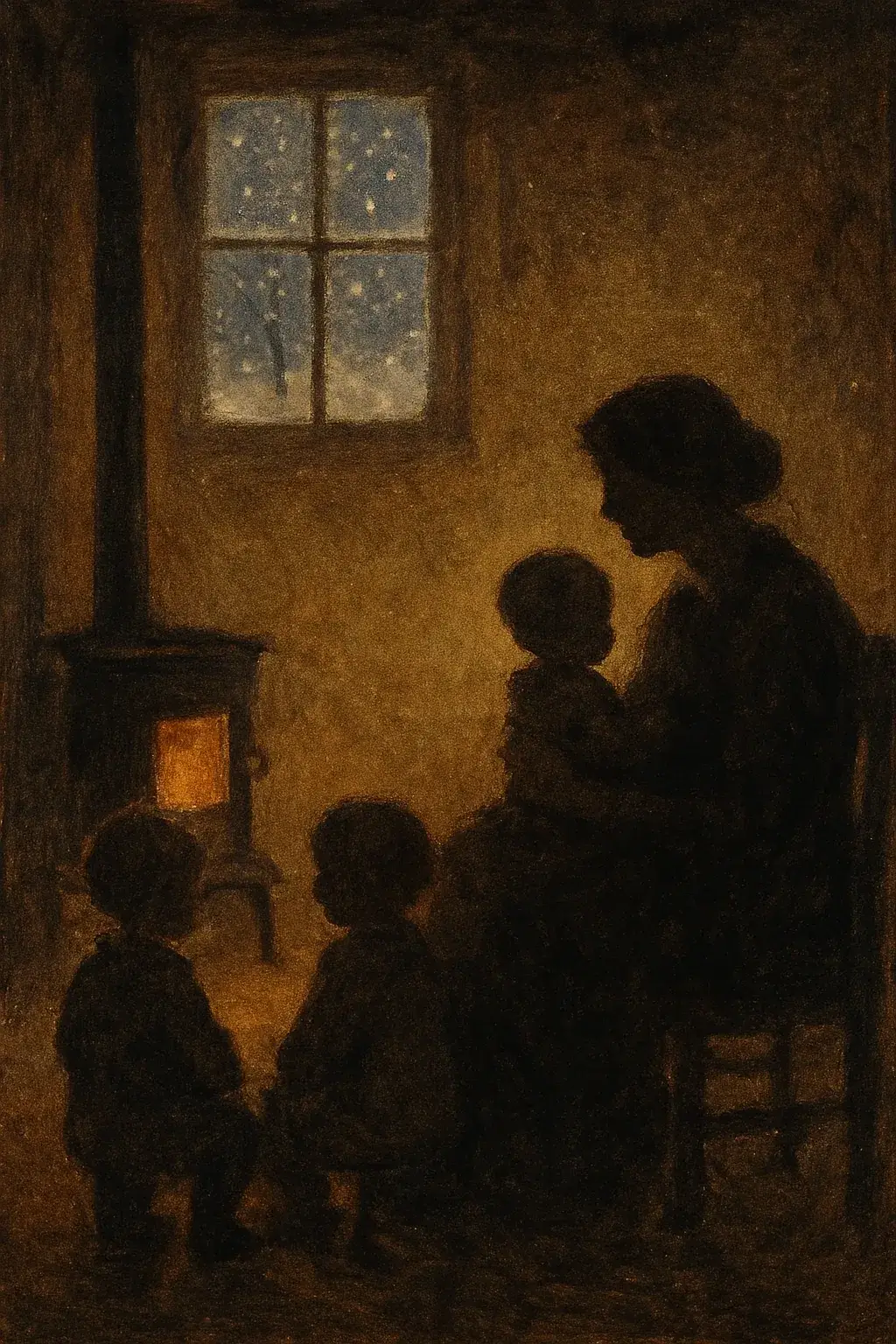
Chapter 7: Schmieder Family’s First Christmas in America, 1924
Loneliness in a New Land: Longing for Christmas Past
The bitter cold seeped through the frost-covered window like an uninvited guest. Rosa wrapped her woolen shawl tighter around her shoulders, exhausted from her journey and aching from the separation from her family. The silence of the pre-dawn hours, which she spent alone with her thoughts in this strange land, weighed heavily on her heart as if she had lost someone genuinely dear. Shaken by the howling wind, each rattling window echoed her feelings of isolation and loss.
As Christmas approached, Rosa felt the heavy burden of their poverty. When she arrived by train in Batavia, she had only five cents in her pocket—barely enough for a loaf of bread, yet she clung to the fragile hope of a better future. There would be no tree, no gifts, no festive feast—only the hush of falling snow outside and the quiet stirrings of her children within. She felt adrift in a sea of homesickness and regret, shaped by the war and economic hardship that had driven them from their homeland. More than anything, she longed to give her children the kind of Christmas she remembered from her youth—rich with faith, family, and tradition. But instead, all she could offer was a cold, bare room and a simple meal, shared in love but marked by sacrifice.
After enduring two grueling weeks of travel from her quiet village in Schönberg, nestled in Germany’s Black Forest, to the rolling hills and fields of Attica, New York, Rosa was finally reunited with George on December 16, 1924. The joy of that moment was palpable—her family was whole again. The laughter of their three small children—ages three, two, and one—filled the air. Yet, even amid the joy, there was the weight of uncertainty. Despite the joyful reunion, something precious and irreplaceable had been lost along the way—the roots of their heritage and the deep connections of extended family.
Having arrived in America thirteen months earlier, on November 9, 1923, George had worked tirelessly to earn enough money to bring his family over. He lived frugally, working on road crews and local farms, surviving a head injury, and carefully storing food for the winter—potatoes, apples, cabbage, and smoked meats. He was learning a new language and purchased what he could afford: flour, sugar, and a few household essentials. His cousin and sponsor, Wilhelm Pfaff, his wife, Amelia, and Uncle Anton Schmieder offered crucial guidance.
The burden of starting anew in this unfamiliar land, with so little to show for their sacrifices, pressed upon her soul. The sight of their rented house on Gulf Road, with its drafty windows and bare walls, struck her as a cruel reminder of how far they had fallen from the life they once dreamed of in Wagenhausen. The house, sparse and unwelcoming, seemed to reflect the emptiness she felt within. It lacked warmth, both physically and emotionally. It was a place to survive, but not to thrive. That truth, however unspoken, hung heavily in the air; yet together, they would work tirelessly to carve out a better future.
A Cold Dawn in a Strange House
That bleak Thursday morning, December 25, 1924, brought a biting cold that crept through every crack in the old house. With a heavy heart, George rose early. The weight of the day pressed on him as he stepped softly across the creaking floorboards, careful not to wake the children huddled together in their shared room for warmth.
He gazed down at their serene, peaceful faces, a testament to their innocence. A deep, gnawing sorrow gripped his heart—these precious children, who had entered a world fraught with hardship, deserved so much more than the weight of their circumstances. He longed to protect them from the struggles that he and Rosa faced. Uncertain about the future, he was determined to provide for and protect them.
George added split logs to the wood stove, watching the flames dance to the sound of crackling wood as he warmed his hands. He then filled the cook stove’s firebox, entrusting the task to Rosa as she started her day.
In the dark, frigid morning, George’s way to the barn was lit only by the flicker of a kerosene lantern. The crunch of snow beneath his boots broke the stillness. Though it was time for chores, the barn also offered him space to think and pray.
He looked at Rosa’s tear-filled eyes and the innocent slumber of Hilda, Fred, and Arnold. The weight of their dire circumstances and financial struggles pressed heavily upon him. In quiet contemplation among the hay mows and farm animals, he renewed a silent prayer: that one day, they would have the security of their own farm.
Back inside, Rosa moved through the stark kitchen. The soft glow of a kerosene lamp flickered against frost-glazed windowpanes. As warmth from the cookstove began to fill the space, she placed a cast-iron skillet on its surface and prepared a breakfast of eggs and potatoes.
The aroma of the humble meal filled the air. Rosa’s eyes brimmed with tears. This was Christmas—the celebration of Christ’s birth. Yet she felt sorrow more than joy. With each bead of her rosary slipping through her fingers, she whispered prayers for strength and solace. Although she sensed the presence of the divine, she felt more alone than ever. Still, she thought of Mary and Joseph—also weary and far from home, seeking shelter and hope.
The cheerful faces of the children brought comfort. Rosa and George exchanged a quiet, heartfelt “Gesegnete Weihnachten”—Blessed Christmas—as they prepared for the morning meal. The diapers were changed, and the children were dressed by the stove’s warmth. Their giggles and playful chatter at breakfast offered a fleeting but precious refuge from the quiet burdens their parents carried.
Echoes of Home Across the Ocean
As church bells rang from the nearby village, nostalgia washed over them. The tones echoed memories of St. Stephan’s, their church in Reichenbach, and the convent bells of Siessen—symbols of home, faith, and a farm they once owned and lost in Wagenhausen. They had purchased it with hope, only to lose it amidst the trials of life. Each toll seemed to intertwine their past with the present, creating a bittersweet melody of love, loss, and new beginnings.
Although it wasn’t the Christmas George and Rosa had envisioned for their children, that frosty morning in 1924 brought them a gift more precious than anything they had left behind: the gift of family and being together. Separated from their extended family by an ocean, they found comfort in each other and the quiet presence of their little ones. It marked the first of forty-two Christmases they would spend together in their new homeland.
The True Miracle of Christmas
Amid their modest home’s cold, drafty walls, they discovered the true miracle of their first American Christmas—loneliness, sorrow, and separation transformed into a sense of togetherness and hope, like the quiet miracle of a manger birth—unseen by the world but full of promise.
Note: This account of George, Rosa, and the children’s first Christmas in America in 1924 blends oral history, factual events, and personal recollections. It reflects recorded facts and family interpretations while recognizing the challenges of capturing past experiences in complete detail.
Frederick Schmieder