
Chapter 8: Scalding Water and Saving Grace
Fred’s Story at St. Jerome’s
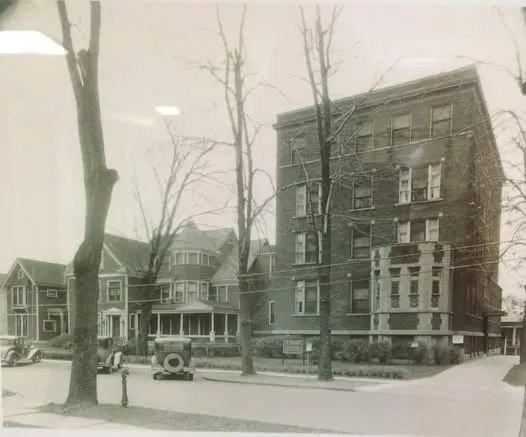
St. Jerome Hospital, Batavia (circa 1920s)
Operated by the Sisters of Mercy, St. Jerome’s offered care to the sick and poor of Genesee County. Here, young Fred Schmieder received healing after a severe scald injury—an act of mercy that left a lasting imprint on his family’s story.
No Time for the Past — Survival in a New Land
For George and Rosa, daily life as new immigrants from Germany was an endless cycle defined by necessity and the struggle for survival. It involved relentless work from dawn to dusk, fueled by haunting memories of their past—Germany’s economic collapse and the subsequent loss of their home and farm in Wagenhausen, a hamlet of Bolstern.
Although they missed their homeland and families, they did not have time for self-pity. Global events had compelled them to risk everything and travel over four thousand miles to another continent in search of a better life for themselves and their children.
Their days began before the sun rose, with George working for Louis Shreder while Rosa managed the children and household responsibilities. Every moment was filled with labor, and every ounce of energy went into creating a life for their children amidst adversity. With no financial safety net and few alternatives, they remained steadfast in their commitment to endure alternatives.
Monday Morning, A Mother’s Work
Rosa’s work schedule required designating specific days for baking bread, cleaning, laundry, and ironing. Saturday was set as the children’s bath night. Sundays were allotted for rest, attending Mass at St. Vincent de Paul’s, and visiting other German families there.
On this Monday morning, she put on her apron and tightened the strings. She gathered buckets of water from the hand-pumped well while gray clouds loomed overhead, creating a grim start to the day. The floorboards creaked beneath her as she filled the iron kettle on the cookstove to boil water for laundry. The scent of wood smoke and steam from the boiling pots filled the kitchen, where the galvanized wash tub awaited.
A Scream Rosa Would Never Forget
She filled the wash tub with boiling water and reached for the lye soap when Hilda and Fred came running through the kitchen, giggling as they chased each other. Suddenly, Fred backed against the washtub, and in an instant, his small body hit the side before slipping in—his back, right hip, and upper leg plunged into the boiling water.
What followed was a piercing scream that Rosa would remember for the rest of her life — a sharp, chilling cry that seemed to slice through the walls around her. The air was thick with terror as she turned, her heart racing, and saw Fred — twisted in agony, flailing anxiously, his face contorted into a mask of sheer horror. Hilda stood frozen, her eyes wide with disbelief.
Rosa instantly reached out, her fingers trembling, and grabbed his arm, yanking him out of the boiling washtub. His cries grew louder as steam rose from his body. She quickly tore away his clothes. To her shock, the skin on his right side — from shoulder blade to buttock and down the back of his leg — was blistering before her eyes. Fred wailed in agony. The pain refused to subside.
No Phone, No Car — A Desperate Race for Help
Her hands trembling, she wrapped him in a cloth soaked in cold well water. Her voice cracked as she tried to comfort him, even as panic surged inside her. They needed help — and quickly- but they had no phone or car.
George rushed Fred to the home of their elderly friend and fellow German, Jacob Kuppinger, who lived nearby. Jacob was a widower; his wife, Frieda, had passed away several years earlier.
To St. Jerome’s — A Father’s Fear, A Friend’s Help
Upon arriving, Mr. Kuppinger immediately helped George and Fred into his car, and together, they rushed to St. Jerome Hospital in Batavia.
Rosa tried to hold herself together as she returned to care for the other children. Tears streamed down her face, her body still trembling from shock as she whispered prayers for Fred’s survival. She held Hilda tightly, who was also traumatized by what she had witnessed. The scene replayed endlessly in Rosa’s mind, each memory a fresh stab of guilt and sorrow over the accident she could not prevent.
For George, it was a tense and harrowing ride. He cradled Fred carefully in his arms, trying not to let his injured side press against anything. The pain intensified with every jolt over the rutted roads. Fred whimpered and gasped while George attempted to comfort him with soft words and desperate prayers.
Jacob Kuppinger gripped the steering wheel with white knuckles, his face taut with concern. He prayed they had enough gas to reach Batavia in time — the boy’s life depended on it.
St. Jerome’s: A Sanctuary of Mercy
The car finally stopped at 16 Bank Street, the location of St. Jerome Hospital, highlighted by its new red brick addition- a sanctuary for medical care built on faith and compassion. The two men hurried inside, with George holding Fred tightly against his chest.
At the reception desk stood a Sister of Mercy in her traditional habit: a black tunic, a white coif, and a wimple. A silver crucifix was pinned to her chest, and a veil flowed down to her mid-back. She listened to Mr. Kuppinger, who translated George’s frantic words.
Fred — A Little Boy in Pain
Recognizing the severity of Fred’s condition, she quickly ushered him into a treatment room. Fred was gently placed on a narrow hospital bed. One of the Sisters held his hand, murmuring calming words while she and a student nurse swiftly moved to assess his injuries. George’s heart nearly stopped when he saw Fred’s back: the scald wound extended from his right shoulder blade down his side and across his buttock. The skin was blistered, red, and sloughing, with blood-tinged drainage leaking from the scalded tissues.
Tending the Wounds
The Sister summoned a doctor from the hospital — most likely Dr. William Johnson, the chief surgeon, or Dr. Henry Spofford. A dose of morphine was administered promptly, causing Fred’s cries to begin to subside.
In the background, another Sister prepared a basin of sterile normal saline, freshly made that morning by boiling water and carefully measuring salt in the hospital’s small pharmacy. Instruments were retrieved from the sterilization room, still warm from the enamel pot, and a tray was placed on a folded linen cloth beside the bed.
Skilled Hands, Sacred Work
The doctor entered wearing a starched white shirt and tie, his sleeves rolled up. He tied a cotton apron over his shirt and tie and then slipped on boiled rubber gloves. The Sister handed him sterilized scissors and forceps. With precision and care, he drained the bullae and trimmed the sloughing skin. Although sedated, Fred felt the pain from the procedure.
Once cleaned, the burns were dressed with white gauze soaked in Carron oil — a cooling mixture of limewater and linseed oil that helps alleviate pain and prevents the dressings from sticking.
Medicine and Mercy
They explained to George, with Mr. Kuppinger translating, that Fred had sustained second and third-degree burns on the right side of his back and buttock. The risk of infection and dehydration was high. While Fred had survived the initial trauma, the road to recovery would be long and uncertain. The doctor added that it was a miracle he hadn’t fallen in entirely — the outcome would have been far worse.
The family had no money to pay, but the Sisters assured George that Fred would remain at the hospital regardless. Like many religious hospitals of the era, St. Jerome’s served the sick and poor without regard for their ability to pay.
The Sisters Who Serve
The Sisters of Mercy have been caring for Batavia’s sick since 1889. Their work expanded significantly in 1917 when Rose Jerome, a devout Catholic widow, donated her home on Bank Street to the Sisters. Her nephew, Andrew Decot, contributed a neighboring property. Together, these buildings became St. Jerome Hospital — initially with just 18 beds, operated by a small group of the Sisters.
However, the need continued to grow. In 1922, the Sisters completed a four-story brick addition that increased capacity to 50 beds. This addition included updated patient rooms, a surgical suite, and a small chapel where prayers were offered daily for the sick and dying. The project was made possible through parish donations, benefactors, the Ladies Hospital Aid Society, and the tireless fundraising efforts of the Sisters who lived humbly and devoted themselves entirely to their calling.
In Monsignor John Nash’s dedication to the new addition on November 1, 1922, he emphasized the mission of serving the needs of the poor. He stated, “ No one will be excluded from this hospital. If you have to choose at any time between the rich or the poor, give the bed to the poor.”
He also shared the Sisters’ dedication to their vocation when he was quoted as saying, “ When a Sister watches over a bed of the patient when she is in need of rest and has a desire for some less strenuous task a Voice whispers–What you do unto the least of my brethren you do unto me.”
Rosa Waits and Weeps
Back at home, Rosa clung to her faith, her heart heavy with worry as she whispered desperate prayers, pleading for the safety and well-being of her little boy. The relentless ticking of the clock amplified her fears with each passing second. Despite her futile attempts to distract herself with the chores that filled her day, her thoughts remained anchored on Fred — consumed by his pain and engulfed by an overwhelming tide of guilt for failing to keep him safe.
Rosa rushed outside when Mr. Kuppinger’s car finally pulled into the driveway, but Fred was not with him. Her stomach dropped until George explained that Fred was in the best hands possible and would remain in the hospital for several days, maybe weeks.
A Mother’s Return — Back to Her Child
The following day, and for many days afterward, a kind friend named Edward Siegert drove Rosa to the hospital and accompanied her inside to assist with translation.
Inside the ward, one of the Sisters greeted her — a woman dressed in a floor-length black tunic, a starched white apron, and the traditional coif and veil of the order. A silver crucifix was pinned to her chest, and a black rosary swung softly at her waist as she walked.
When Rosa saw Fred, her breath caught. His small body was wrapped in white bandages. Overwhelmed, she held back tears as she approached his bedside. Despite the haze of morphine, Fred’s eyes fluttered open. He extended his small hand toward her, and Rosa grasped it firmly, her fingers wrapping around his. It was a moment of healing between mother and child.
The Rhythm of Recovery
Fred’s days soon settled into a quiet, healing rhythm.
Each morning at 6:00 a.m., the Sisters began their rounds — checking his temperature with a glass thermometer, taking his pulse, and gently inspecting the dressings. Then came the dressing change — the most challenging part. A warm bowl of Carron oil sat beside a tray with sterilized instruments, gauze, and saline. The attending doctor supervised the removal of the old bandages. His wounds showed signs of healing at the margins.
However, the central tissues — still necrotic — were carefully debrided. Fred became braver with each passing day. Both patients and staff grew fond of the little German boy with wide eyes and quiet resilience.
The Sisters cared for Fred as if he were their own. They ensured he drank milk and broth to stay hydrated. They read to him softly and taught him simple English words. They prayed with and for him, believing that healing the soul was as important as healing the body. Reverend Mother Helena would check Fred’s progress to ensure he was well cared for.
The Women Who Helped Heal
Ladies like Mrs. Minnie Wassink, President of the Ladies Hospital Aid Society, visited patients, including Fred. They brought him small toys and children’s books. The Society greatly supported the Sisters and the community by organizing fundraising events and coordinating sewing circles to create hospital linens, infant clothing, and other patient necessities.
Healed, But Forever Changed
Days turned into weeks. Fred’s burns began to heal with healthy granulation tissue. He avoided infection and gradually regained his strength. Rosa, now a familiar face in the ward, often brought loaves of homemade bread to show her gratitude to the Sisters.
Finally, the doctors declared that Fred was well enough to return home. He had survived — but the scald injury left him with permanent, disfiguring scars on the right side of his back and buttock, a lasting reminder of the pain he endured.
As he left, the Sisters stood at the door, offering their best wishes and prayers for the little boy they had become very fond of.
A Debt of the Heart
George and Rosa were deeply grateful to everyone who had supported Fred: Jacob Kuppinger, Edward Siegert, the generous contributions from the church, and local citizens’ donations to St. Jerome Hospital for the benefit of the poor.
Reverend P.J. O’Donavan, the pastor of St. Vincent’s in Attica, would visit and pray for Fred. They appreciated the doctors’ unwavering commitment and the kindness and compassion of the Sisters of Mercy. These individuals ensured that children like Fred—burned, frightened, and without resources—received not only medical care but also compassionate support at St. Jerome’s Hospital, where they were regarded as deserving souls in need of healing.
Note: This account of George, Rosa, and Fred Schmieder encompasses factual events, oral history, and personal perspectives. It reflects individual interpretations and subjective insights while acknowledging the challenges of accurately capturing the details of past events.
Frederick Schmieder