

Chapter 9: From Gulf Road to Hall’s Hill
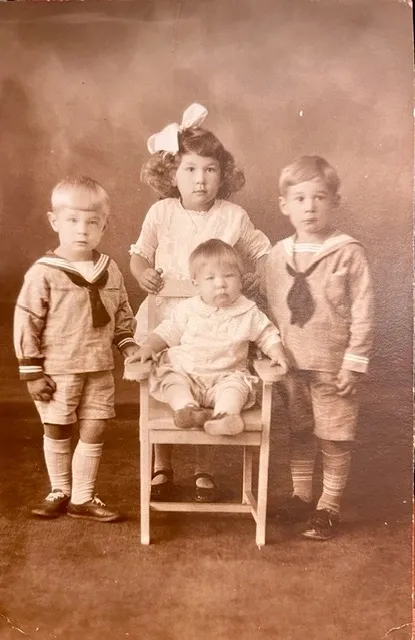
Schmieder children, c. 1926 — left to right: Arnold, Hilda, and Fred; seated: George.
The Schmieder Family’s Early Years, 1925–1926
A Familiar Face: Albert Beck Arrives
More than six months had passed since Rosa and her children—Hilda, age 3; Fred, age 2; and Arnold, just 1—arrived in Attica after leaving their village of Schoenberg, Germany. George dedicated himself to long hours working on Louis Shredder’s farm. Meanwhile, Rosa, now five months pregnant and still quietly homesick, faced the daily challenges of raising three young children in an unfamiliar land.
A welcome light in her life emerged mid-June of 1925 when her younger brother, Albert Beck, arrived from Germany. He had traveled aboard the Bremen, the same ship that had brought Rosa to America.
His arrival brought Rosa immense comfort. His warm smile and familiar presence reminded her of home—of shared memories, traditions, and the rhythm of a life left behind.
Albert quickly became a reliable helper both on the farm and at home. He joined the haying and threshing crews, chopped wood, repaired tools, and assisted Rosa with the children, who delighted in their Uncle Albert’s playful nature. After the day’s work was done and the children finally drifted off, the three adults gathered around the kitchen table, sharing stories of the old country. Rosa would listen quietly as Albert and George sipped cider and spoke in low, familiar tones—an echo of home that softened the edges of their homesickness.
Labor Day 1925: Where the Dream Took Root
Despite the gray skies and the threat of early rain, local families gathered at Attica Grange No. 367 on Monday, September 7, 1925, to celebrate Labor Day. There were picnics, speeches, games for the children, and a brass band playing cheerful tunes for the afternoon crowd.
First established as a national holiday in 1894, Labor Day was intended to honor the dignity of work and the contributions of everyday laborers, particularly those in agriculture, manufacturing, and trades. Born from the efforts of labor unions during a time of poor working conditions and long hours, the holiday symbolized progress and pride in America’s workforce.
For George Schmieder, however, the day carried a sting. While others took the holiday off, he remained at work. That morning, when he asked his employer, Louis Shreder, why he hadn’t been given the day off like the other hired men, Shreder’s reply was blunt:
“Because you’re German. And this is an American holiday.”
Though grateful for the work, something in George shifted that day. The words sat heavy in his chest, and Labor Day became a turning point. George knew then that he wanted something of his own—land, independence, and a future where no one else could define his worth. He and Rosa began to dream more seriously of finding a farm they could call their own, a place where they could raise their children, rooted in the soil they worked themselves.
Born on American Soil: George Albert’s Arrival
The maple trees along Gulf Road blazed with red and orange, their leaves drifting gently to the ground—a brilliant signal that summer had fully given way to fall. By the early morning of October 16, 1925, autumn had settled deep into the hills of Attica, and Rosa felt the first unmistakable waves of labor.
The stillness of the darkened house was softly broken as George stirred from sleep. Rising quickly, his feet scuffed against the cold wooden floor. Moving with quiet urgency, he added split logs to the wood stove. Flames caught and crackled to life, their warmth pushing back the chill that lingered in the farmhouse’s plaster walls.
In the next room, Hilda, age 4, Fred, age 3, and Arnold, nearly 2, remained fast asleep, unaware that they would have a new baby brother before the day was done. Rosa sat at the edge of the bed, her hands gripping the straw-filled mattress, her breath shallow and measured. Though no stranger to childbirth, this time felt different. It was her first in America—far from the familiar hands of midwives in Wagenhausen, Radolfzell, and Schoenberg, and distant from the rhythms of her former life. Perhaps one of the local physicians—possibly Dr. John Kneeler—had been called to assist.
Hours passed. Then came a final, piercing cry—sharp, strong, and full of life. George Albert Schmieder entered the world. His voice echoed through the house, boldly declaring his arrival. Rosa cradled him close, marveling at his tiny fists, flushed cheeks, and the soothing rhythm of his breathing as he settled into the curve of her arm.
Later that day, Hilda, Fred, and Arnold tiptoed into the bedroom, their eyes wide with wonder at the tiny miracle wrapped in a woolen blanket. And there, in the quiet glow—amid the scent of woodsmoke, boiled linens, and October light streaming through the window—the family gathered around their newest blessing.
George Albert was the first of their children to be born on American soil, and his arrival marked more than a birth. It was a quiet covenant between past and future—a fragile but enduring hope that this new land would someday yield its blessings, not just for them, but for all those who would come after.
Anointed in Grace: George Albert’s Baptism
After an October Sunday Mass at St. Vincent’s Church, with the morning sun casting soft colors through the stained glass, George and Rosa approached the baptismal font carrying their newborn son, while the other children were anxious to witness the baptism.
Father Bernard Gill smiled warmly as he anointed George Albert’s forehead with holy oil and poured blessed water over his head, reciting the ancient baptismal prayers. At the side stood Albert Beck, the proud uncle and godfather.
The Search for Land and Belonging
Rosa and George, now parents of four children under five, felt a growing need for their own homestead. They faced financial constraints amid the daily difficulties and challenges of their household and farm responsibilities.
George devoted long hours to his job, striving to save as much as possible, but their savings fell short of what they needed. Lacking collateral and facing the adversities of being immigrants, borrowing from the Bank of Attica proved daunting. As alternative solutions, they considered the possibility of purchasing a farm where the current owner would agree to carry the mortgage or renting a farm with the option to buy it.
Hard Times on the Land
World War I caused a significant economic shift in the agricultural landscape. Farm prices that had surged during the war plummeted dramatically by 50% between 1919 and 1925. Many farmers who expanded their operations and took on loans, assuming that high demand would persist, found themselves unable to repay their debts.
This agricultural depression, which preceded the Great Depression, was worsened by adverse weather conditions in Western New York, with dry summers in 1921 and 1925 impacting crops such as corn, hay, and oats. In Genesee and Wyoming counties, smaller dairy and mixed crop farms suffered greatly, forcing families to either lose their farms to banks or auction them. Between 1920 and 1930, it is estimated that 10% to 15% of farms in the area changed ownership through foreclosures and distress sales.
A Deal Sealed with Trust
Louis Shreder, George’s employer and mentor, as well as a cattle dealer, stayed informed about the local farms being foreclosed or rented. One day, Gottlieb Kreutter, a successful fifty-year-old German farmer from Alden and the owner of a farm on Hall’s Hill in Alexander, sought new tenants for the Alexander farm.
Louis drove George and Albert Beck in his car to meet Gottlieb at the farm on Alleghany Road (Rt. 98/Alexander Rd), just south of the village of Alexander.
After touring the farm, George and Gottlieb reached an agreement in the kitchen of the old farmhouse. They decided on a price of about five dollars per acre, with payment due only after the initial harvest had been gathered.
No guarantees extended beyond that harvest; it was a straightforward arrangement. George would take on the responsibility of working the fields and maintaining the house and barns, which allowed him to remain on the farm. With his tall, slender frame and firm grip, Gottlieb extended his hand across the well-worn wooden table, and in that moment, they sealed the deal — an old-fashioned agreement built on mutual trust and respect.
Moving Day: The Road to Hall’s Hill
George and Albert loaded the wagon with simple furnishings, bedding, tools, clothes, utensils, and a cook stove. It groaned under its load as George clicked his tongue, urging the horses forward with the initial burden. They made their way down the serene Maplewood Lane, passing the Stevens Farm and mansion, hoping they might be as successful someday.
The horses hesitated as they crossed the iron Stroh Road Bridge, which spans Tonawanda Creek near the greenhouses. They slowly approached the intersection of Stroh and Alleghany/Alexander Roads, known as “Bloody Corners.”
As the use of automobiles became more widespread, the intersection increasingly became a hotspot for accidents, injuries, and fatalities. Collisions occurred frequently, with cars often crashing into farm wagons and one another, resulting in chaotic and bloody disaster scenes.
Turning north onto Alleghany/Alexander Road, they passed open fields and farms, including Glor, Brainard, and Phelps Farms, before climbing “Hall’s Hill” to the Kreutter Farm. George could never have imagined that he would one day own all those farms.
Where the Ice Left Its Mark
Long before George and Rosa, this land was shaped by ancient ice 12,000 to 15,000 years ago. Hall’s Hill, with its proud elevation above the Tonawanda flatlands, was formed by glaciers — a mound of gravel and earth left behind when the last great sheets of ice melted northward.
In 1811, a pioneer named Jonathan Hall stood atop this same rise with an axe, carving out a farmstead from the wilderness. He bestowed the hill with its name and created a legacy that would endure long after his time. Unfortunately, his young wife, Almira, tragically died in 1821, and he followed in 1852. They are both buried in the Alexander Cemetery.
A Journey of Hope
George and Albert returned to the Gulf Road house to gather the family.
Rosa sat beside George in the wagon, cradling little George Albert. She sighed, relieved that the move was complete, yet realized the work ahead.
Uncle Albert tended to Hilda, Arnold, and Fred, whose burns had healed, although they left him scarred. The wagon creaked along the bumpy roads, carrying not only their family but also a fragile cargo of dreams, stitched together with faith and hope in pursuit of a better life.
Note: This account blends oral history, factual events, and personal recollections. It reflects recorded facts and family interpretations, recognizing the challenges of capturing past experiences in complete detail.
Additional Note: In later years, the farmhouse on the Kreutter Farm—once home to George and Rosa—became the residence of Gus Kautz and Therese Beck, continuing the family’s story on Hall’s Hill.
Frederick Schmieder