
Forged in Time: The Black Forest and the Schmieder Family Legacy
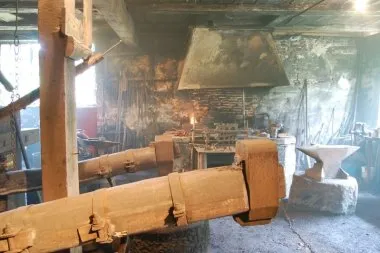
Geroldsecker-Waffenschmiede in Seelbach
The Roman Push and the Shadowed Lands Beyond the Rhine
In the decades around the birth of Christ, **Emperor Augustus—Julius Caesar’s grand-nephew and adopted son—**sought to extend Rome’s frontier beyond the Rhine. His generals led disciplined legions into the vast woodlands the Romans called Germania, a patchwork of river plains and deep forests east of the Rhine and north of the Danube. Rome built forts, brokered alliances, and fought hard—yet actual conquest proved elusive. After the Varus disaster in AD 9 in the long forests later famed as the Teutoburg, Rome pulled back to the Rhine and Danube, choosing frontier control over occupation.
Into the Abnoba Woods (later “Black Forest”)
To the southwest rose the highlands the Romans knew as Abnoba Mons, with great tracts of forest (the Silva Marciana). Steep valleys, cold streams, and dark canopies challenged supply lines and morale. Traders and scouts brought back tales of formidable tribes and rugged country. The darker legends—wolves, witches, wandering spirits—belong mainly to later folklore. Still, they capture something true about how those woods felt to outsiders: thick, watchful, and unwilling to yield their secrets.
The Rise of the Alemanni and the Fall of Rome
By the third century, the shifting Germanic world gave rise to a new confederation along the upper Rhine and Danube—the Alemanni, whose name, meaning “all men,” reflected their union of diverse tribes. They clashed repeatedly with Roman legions, testing the empire’s northern frontier and earning a reputation for courage and independence.
As the Western Empire weakened, the Alemanni moved more freely through Roman lands, at times allying with neighboring groups during the upheavals of the fifth century. Yet their fortunes turned near the century’s end when Clovis, the Frankish king, defeated them at the Battle of Tolbiac (c. 496). The loss fractured their political unity and brought their territory under Frankish rule.
In the generations that followed, Alemannic peoples gradually embraced Christianity, and their speech, customs, and settlement patterns shaped the southwest German lands. In the Black Forest—particularly around Reichenbach near Lahr in Baden—this Alemannic imprint endures in parish life, place-names, and dialects. It’s here that the Schmieder and Beck lines later take root, carrying forward a regional culture forged from forest, frontier, and faith.
The Schmieder Legacy: Masters of Fire and Iron
As civilization spread through the Black Forest, new industries reshaped the land. Rich veins of silver and iron nourished a thriving mining culture, while towering firs were felled and floated down the Rhine to feed the glassworks of the Low Countries.
Among the artisans who defined this era were the blacksmiths—the Schmieder—masters of fire and iron. The name itself descends from the old Germanic smiþ → modern German Schmied (“smith”), with the -er marking “one who practices the craft”—one who works iron. Their work was both craft and calling: the forge where strength met artistry, and the ringing of hammer on anvil set the village’s rhythm. From plowshares and horseshoes to hinges and blades, the Schmieder supplied what survival and defense required, standing at the community’s center as makers whose skill shaped both daily life and enduring legacy.
By 1280, records mention the Hohengeroldsecker Waffenschmiede, a water-powered weapons forge in nearby Seelbach. There, smiths labored to arm the knights of Hohengeroldseck Castle, whose stone walls still command the König and Schutter valleys. Whether or not our ancestors worked in that forge, we can imagine their faces lit by the glow of molten metal—the air alive with heat, the steady pulse of hammers echoing through the stone.
Each strike was an act of creation: transforming ore into tools, armor, and symbols of survival. The craft was sacred, passed from father to son, shaping both livelihood and lineage. To be a Schmied was to be a maker—to wrest form from chaos, to temper raw matter with patience and faith.
In the rising sparks and murmured prayers of that ancient forge, we glimpse the origins of our name and our family’s enduring spirit—rooted in the Black Forest, forged in fire, and carried forward through every generation that bore the mark of the Schmieder.
From Prehistory to the Schmieder Family
While the specific lives of our ancestors are lost to time, DNA evidence outlines their long migrations.
Paternal line (Y-DNA R1b). Our paternal line belongs to haplogroup R1b, which likely spread into much of Europe during the Bronze Age (~3000–2000 BCE), building on earlier arrivals of modern humans who reached Europe ~45,000 years ago. Deeper still, all branches trace to African origins, with splits unfolding as climates shifted and migration corridors opened across the Near East and Eurasia.
Ice Age and post-Ice Age movements. During the Last Glacial Maximum, many ancestors persisted in southern European refugia (Iberia, Italy, the Balkans), later recolonizing central and northern Europe as glaciers retreated (~19,000–11,000 years ago). By the Mesolithic (after ~10,000 BCE), forebears of today’s Central Europeans lived in forested landscapes later described by the Romans as “Germania.” Historical groups such as the Alemanni emerged much later (in the late Roman era), reflecting cultural formations—not single family lineages—within that region.
Maternal line (mtDNA H). Our maternal line is haplogroup H, which ultimately descends from a common African ancestor (~150–200k years ago). Haplogroup H probably arose in West Asia ~20–30k years ago and expanded broadly in Europe after the Ice Age (~12–15k years ago), becoming especially frequent in Western and Central Europe. Over time, our foremothers entered the cultures of Europe—and eventually the Black Forest—where our family story took root.
Reichenbach and Schönberg: The Heart of Our Family’s Past
Nestled among rolling hills and fir-clad peaks of the Black Forest, the village of Reichenbach—first recorded in 1270 AD—stands where history and nature intertwine. For centuries, its winding paths and timber-framed homes have borne witness to the lives that shaped its legacy—including ours. It was here that our grandfather, George Schmieder, first opened his eyes to the world. Just beyond the shadow of Eichberg Mountain, in the small hamlet of Schönberg, our grandmother, Rosalia Beck, spent her youth learning both the beauty and the hardship of the land.
Tracing deeper into the record, we meet the earliest known member of our Schmieder line: Mathias Schmieder, our sixth great-grandfather, likely born in the 1670s in Schönberg. Life in the Black Forest was demanding, ruled by the rhythm of the seasons and the ever-present threat of war. After losing his first wife, Mathias married Barbara Roßer in 1706 at the Catholic Church of Reichenbach. Their union continued a lineage defined by resilience, faith, and perseverance—virtues that would sustain their descendants through centuries of upheaval.
High above them, like a silent guardian, stood Geroldseck Castle, raised in the mid-13th century to command the valley and its ancient Roman road to Lahr. For four hundred years it symbolized authority and endurance—until the Nine Years’ War (1688–1697), when French forces of Louis XIV swept through the Rhineland and left it in ruins. Its crumbled walls still crown Schönberg Hill, a solemn reminder of both grandeur and loss.
Yet even as the castle fell, the people’s spirit endured. The families of Reichenbach and Schönberg, including our own forebears, rebuilt their lives with unshaken resolve. In their perseverance, we find our own strength—a legacy carried quietly through the centuries, from the heart of the Black Forest to the lives we live today.
A Legacy of Strength and Perseverance
Our Schmieder ancestors of the Black Forest were more than blacksmiths—they were a backbone of their communities. With each strike of the hammer, they forged not only weapons for knights and tools for farmers, but a spirit of resilience that defined their world. The name Schmieder became a mark of craftsmanship, dedication, and perseverance.
Though records offer few details, their legacy endures in the blades, plowshares, and ironwork that shaped daily life. The earliest Schmieder we can name, Mathias Schmieder of Schönberg in the late 1600s, stands as a clear point in the record; his descendants—farmers, craftsmen, weavers, sawyers—carried that skill forward, shaping not only tools but the very terms of survival.
Even where the archives fall silent, their endurance speaks. Wars, famine, plague, shifting empires, and unrelenting work did not break them. Their sacrifices laid the foundation on which we now stand.
We are not only their descendants; we are the living continuation of their strength and skill. Their love of making, their steadiness in labor, and their indomitable spirit run in our blood. They did more than shape metal and land—they forged a legacy we are honored to carry.
Their story is our story. Their spirit lives in us.
Note: This account of our distant ancestors is a tapestry woven from factual events and personal perspectives. This narrative encompasses individual interpretations and subjective reflections, recognizing the inherent challenge of accurately capturing every detail of past events.
Frederick Schmieder