

Grace Amid Hard Times: Easter Faith and Family, 1933
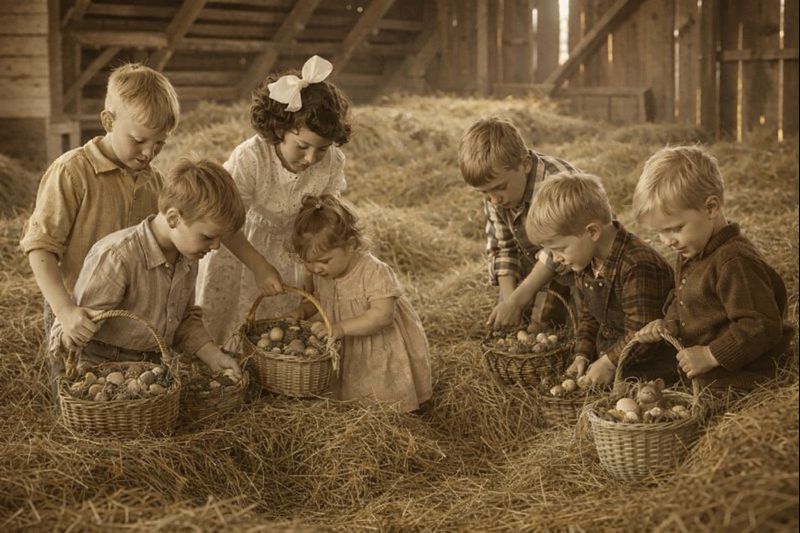
Easter Morning, 1933 — The Schmieder Children searching for their baskets in the barn haymow (AI recreation)
Hard Years on the Homestead
By 1933, over one in ten farms in Genesee and Wyoming Counties were lost, some due to foreclosure, while others were abandoned. Amidst this turmoil, George and Rosa Schmieder clung to their farm, worrying each day whether they would have enough to meet the mortgage by month’s end. It always seemed they were on the verge of foreclosure, but they managed to make the payments somehow.
They purchased their two-hundred-acre farm in Alexander, New York, at an auction on December 7, 1928, in partnership with Louis Shreder. Mr. Waite, a local farmer, poignantly remarked about the farm’s condition, saying, “If the crows fly over that farm, they had better pack a lunch.”
Undeterred, George and Rosa worked tirelessly from dawn until dusk, determined to make the farm profitable. However, the stock market crashed just as the 1929 harvest season was coming to an end.
Banks failed, businesses shuttered, and unemployment soared. Between 1929 and 1933, dairy prices plummeted by nearly 50%, while the production costs of crops such as corn, wheat, and potatoes fell below their market prices.
Storms Beyond the Farm: Shadows of the Depression
A farm report from WBEN radio station in Buffalo on April 10, 1933, captured the dire situation of farmers in the Midwest:
“… In Oklahoma and western Kansas, dust storms have blanketed farmlands in darkness for the third straight week. Crops have been smothered beneath windblown topsoil, and livestock losses are climbing. President Roosevelt has called for expanded emergency aid to the hardest-hit areas. Meanwhile, parts of the Northeast continue to experience dry conditions, with New York farmers reporting poor soil moisture as spring planting approaches. Rural communities are urged to conserve water and prepare for a late growing season…”
During this time, Pope Pius XI, in his Easter season addresses, expressed deep concern over the global economic crisis. He emphasized the enduring role of family and church charities, urging acts of mercy as a reflection of Easter hope.
Rosa embodied that call to mercy, quietly offering meals to strangers passing through the back roads searching for work.
The Pope also warned of rising political dangers abroad. He voiced alarm over Hitler’s recent appointment as Chancellor of Germany on January 30, 1933, and expressed concern for those suffering under the Soviet Union’s communist regime.
An Easter Dawn of Hope
On Easter morning, April 16, 1933, a chill lingered in the air but would eventually rise to mid-fifties temperatures. George, Albert Beck, Fred, and Arnold woke early to tackle their farm chores as the sun rose in hues of pink over Alexander’s rolling hills and the flats of Tonawanda Creek.
Before gathering the eggs and milking, they needed to feed and water the cows, pigs, and chickens. The boys worked faster, knowing an Easter surprise might await them.
After finishing their chores, Albert and George carried the filled milk cans to the road and placed them on a wooden stand for the milk truck driver to pick up for processing. The boys returned to the house while George and Albert had one more task to complete—hiding the small Easter baskets that Rosa had prepared the night before while the children were asleep.
Baskets in the Hayloft: A Barn Full of Wonder
Hilda, dressed in a printed flour sack dress sewn by Rosa, helped gather the younger children: George Jr., Paul, Herbert, and little Erma, who would turn three the following week.
George returned to the house, and the children eagerly anticipated news from their father about their Easter surprise. Their excitement intensified as George, Rosa, and Uncle Albert led them up the gravel driveway toward the big “L”-shaped red barn, with its fieldstone foundation and gambrel roof covered in weathered wooden shingles.
To their right stood the remnants of an old orchard, including Snow apple trees, their buds just beginning to bloom. Beside the barn stood an aging wooden silo, where barn pigeons cooed softly from the ledge.
The younger children struggled to contain their excitement. Their eyes widened in anticipation as George and Albert slowly pushed open the heavy wooden barn doors, which creaked along their worn tracks.
With a joyful shout, the children dashed inside, their shoes thudding against the thick, planked floor. The gentle mooing of cows echoed softly from their stanchions below, immersing them in the familiar sounds of rural farm life.
They climbed the ladder to the hayloft, still holding the dwindling winter stores of loose hay as the sweet aroma of cured hay enveloped them. Hilda held Erma’s hand until George hoisted her to join the search. Morning light filtered through a small loft window, catching dust motes in golden beams that floated toward the hay fork and rail overhead.
Laughter and excitement filled the air as seven spirited children dashed back and forth through the loft, their eyes sparkling joyfully. Each delighted shriek echoed as they discovered their baskets, tucked among the hay, turning the hunt into a magical adventure.
Rosa stood quietly, watching her children dart through the hayloft — each one radiating their own blend of mischief, energy, and wonder.
Easter Baskets of Grace
George raised his arms to catch Herbert and Paul as they jumped down from the loft into his embrace. The children admired their baskets as they walked back toward the house.
Inside were the eggs they had dyed the day before with onion skins, coffee, purple cabbage, and beet juice—imperfect colors but beautiful.
Nestled alongside the eggs was a modest handful of mixed-colored jelly beans and a few chocolates, carefully selected from Zwetsch’s Store on the southeast corner of Alexander. Operated by brothers George and Ed Zwetsch, the general store featured a tin ceiling with hanging lights that cast a warm glow over its worn hardwood floor, high shelves, and counter.
The children studied the small jelly beans, savoring the flavors—licorice, clove, cinnamon, lemon, mint, cherry, and molasses—each one a rare delight in lean times. Some of the children were trading for their favorite.
Sacred Celebration at St. Vincent’s
After the Easter basket hunt, George gathered Hilda, Fred, and Arnold and set off for St. Vincent’s in Attica, where Easter Mass was already beginning. Meanwhile, Rosa stayed home, tending to their noontime Easter dinner preparations.
The church was alive with the sounds of families shuffling into pews, coats rustling, and whispers rising before the bells. White lilies lined the altar, their fragrance mingling with incense, and their trumpet-shaped blooms lifted heavenward in quiet celebration.
The lilies meant more than decoration for many—they were a promise in bloom. They were a sacred reminder that resurrection was possible despite hardship, loss, and uncertainty. In a world still shrouded by poverty and fear, the lilies spoke of renewal, mercy, and a life that awaits beyond this one.
Easter Bread and a Table of Plenty
Rosa’s Easter dinner was the centerpiece of the Schmieder family celebration. The kitchen filled with the savory aroma of smoked ham, sauerkraut, potatoes, and the warm sweetness of her braided Easter Raisin Bread.
She rose early on Holy Saturday, kindled the wood stove, and gathered the ingredients for her mother Monika’s cherished recipe: plump raisins, rich butter, and fragrant spices filled the room as she mixed them, evoking memories of Easter mornings in her childhood home in Schoenberg, Germany.
Rosa kneaded the dough with quiet reverence, knowing this bread symbolized more than tradition — it marked the joyful return of sweetness after the long austerity of Lent. She shaped it into a braided loaf, its woven strands reflecting the bonds of family and the continuity of faith. As the dough rose beside the stove, it served as a reminder that Christ rose from the dead.
The Blessing Around the Table
The family gathered around the dining table, lowering their heads in reverence and forming the Sign of the Cross as George recited the traditional Easter grace, expressing gratitude for the meal and the significance of the holy day.
Around the worn wooden table, warmed by the wood stove in the corner, sat George, Rosa, Uncle Albert, and their seven children — Hilda, Fred, Arnold, George Jr., Paul, Herbert, and Erma, who sat on a thick catalog to reach her plate.
Rosa’s braided Easter Raisin Bread sat at the center, golden brown and slightly glossy, surrounded by steaming bowls of potatoes, sauerkraut, and slices of smoked ham.
The children passed dishes with wide eyes, careful hands, and eager appetites. Fred reached for an extra slice of bread, his fingers lingering on the soft crust. Hilda gently assisted Erma with her cup while Uncle Albert and George poured cider into glasses, complimenting Rosa on her delicious Easter meal.
There were no elaborate decorations — only the clinking of forks, lively conversation, and the laughter of the younger boys. For the Schmieder family, this was celebration enough. There was food, family, and faith; for a brief moment, they were insulated from the world’s tribulations.
Quiet Resurrection
Despite the hardship of providing even the most modest Easter baskets—filled with only a few colored eggs, jelly beans, and bits of chocolate—Rosa, George, and Uncle Albert felt their hearts lift as they watched the children’s joy shine that Easter morning. In their laughter, they saw a reflection of God’s grace—a quiet resurrection amidst their daily trials. The children’s delight became a blessing, a moment of sacred relief, reminding them that even under the weight of poverty, love could multiply like loaves and fishes, and hope could rise, just as Christ did.
What Easter Left Behind
Many decades later, long after the children had grown and married, Fred would still speak of their Easter Sundays during the Depression with quiet affection.
He didn’t remember the color of the eggs or how much ham was on his plate. What stayed with him was the smell of his mother’s Easter Raisin Bread baking in the kitchen and the thrill of climbing into the hayloft to find a hidden Easter basket. He recalled the teasing laughter of his brothers and their Uncle Albert and how there was always enough food, family bonds, and grace to carry them through even the hardest years.
“We didn’t have much,” Fred would say. “But we always had enough to eat. And more than that — we relied on each other.”
Note: This account of George and Rosa Schmieder and their children celebrating Easter in 1933 includes oral history, factual events, and personal perspectives. It reflects individual interpretations and subjective insights while acknowledging the challenges of accurately capturing details of past events.
Frederick Schmieder